In the second part of our Software-Defined Vehicle series, Eloi Baudoux, Design Innovation Director at Dassault Systèmes, explores why seamless connected experiences have become automotive’s hardest unsolved problem and what experience simulation can do about it.
In our first article in this series, Sylvaine Caillou made the case that it was time to turn engineering investment into real customer value. The goal: better experiences that improve satisfaction and OEM profitability.
But as OEMs push their SDV strategies forward, a new and harder challenge is coming into focus. The question is no longer whether automakers can deploy software. It is whether they can deliver a seamless connection across the growing ecosystem of devices, services and digital platforms that now define what customers experience.
I spoke with Eloi Baudoux, Design Innovation Director, at to understand why that experience so often breaks, and what it will take to fix it.
The connected experience problem is bigger than the vehicle
Delivering seamless connected vehicle experiences means creating consistency across every touchpoint a driver encounters. That includes onboard interfaces, smartphone applications, charging stations and parking services. Behind each of those touchpoints sit different systems, different providers and different back-end infrastructures. Bridging them is an entirely new level of complexity for the automotive industry.
What makes it harder still is that customers now judge the vehicle experience against standards set by digital-native companies. Tech products that are built around frictionlessness and simplicity by design. Legacy OEMs must now compete at that level across an ecosystem far broader than they have ever managed before.
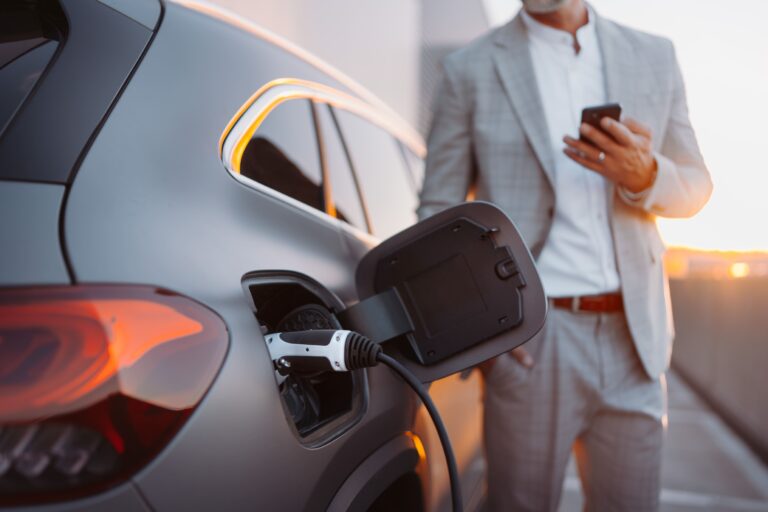
EV charging brings this into sharp relief. In the combustion era, a driver could refuel almost anywhere with a predictable experience. Little coordination between automaker and fuel provider was needed. Electric mobility is different. If a charging station fails to recognize a vehicle, if authentication breaks down or a session cannot be initiated, the entire experience collapses. It is no coincidence that some early EV adopters have returned to combustion engines after a bad charging experience. Today, only a handful of OEMs manage this well and largely because they chose to own their own charging networks.
The broader lesson is this: connected mobility now depends as much on how OEMs orchestrate their partner ecosystems as on the technology inside the vehicle. Many automakers have already accepted this by integrating platforms like Android Automotive and Google services. In the software-defined vehicle era, success is no longer about controlling the entire experience. It is about integrating well.
The insight: connected services need their own digital mock-up
Orchestrating seamless experiences across complex ecosystems is one thing. But how do OEMs align designers, engineers and partners around a shared vision, early enough to make a real difference?
Baudoux believes the industry needs a new kind of shared representation. One that plays the same role for connected vehicle experience development that the digital mock-up once played for physical vehicle design.
In the 1990s and early 2000s, the digital mock-up transformed collaboration inside automotive companies. Stylists, engineers, interior designers and architects could gather around a single shared model, negotiate trade-offs and align on decisions. They collaborated on driver visibility, interior space, modularity long before a physical prototype existed.
For smart cockpit development, ADAS features and connected services, the industry needs exactly that kind of evolution.
“What is now necessary is a common, user-centric space where designers and engineers from every company involved in the experience can collectively envision and simulate what the customer will actually live and negotiate the trade-offs needed to make that experience seamless,” says Baudoux. “Without a shared representation of the experience, teams can optimize every component and still disappoint the customer.”
The goal is not to validate a screen in isolation. It is to simulate complete user journeys. Those journeys span hardware, software, electrical and electronic architectures, and the full network of third-party services.
Experience simulation: making it real
This is exactly what experience simulation is beginning to address. As Karel Van Rompuy, Industry Process Consultant at Dassault Systèmes, explains:
“For connected experiences, we now need what digital mock-ups once brought to physical vehicle development: a shared representation where designers and engineers can collectively envision, simulate and arbitrate the final user experience before it exists.”
Through the partnership between Dassault Systèmes and Apple, teams can now experientially simulate a Virtual Twins of connected experiences. These environments are modeled using CATIA Magic, Dassault Systèmes’ model-based systems engineering solution. They connect directly to the UX tools designers already use, including Figma, Unreal Engine and Unity.
The demo below shows this in action. It is a proof of concept for connected HMI design and validation. Teams simulate and evaluate the full connected vehicle experience together, in a shared immersive environment, before a single line of production code is written.
Looking ahead
The first phase of the Software-Defined Vehicle revolution focused on making the architecture possible. The next phase is about something more demanding: ensuring that the experience it enables feels seamless for every customer, at every touchpoint.
For OEMs, that means new ways of collaborating across ecosystems and new tools for simulating experiences before they are built. Above all, it means placing human-centric mobility at the heart of every decision from day one.
This is the second article in our ongoing series on Software-Defined Vehicle and the future of connected mobility. Stay tuned for the next article, where we continue exploring the approaches and tools reshaping how driver experiences are curated, especially what role AI has to play.

Prodatta Sengupta is the Transportation & Mobility Industry Marketing Lead at Dassault Systèmes. She has been with the company since 2016, building expertise in sales strategy and industry marketing for the global automotive sector. She writes about the trends and technologies redefining the industry, from Software-Defined Vehicles and EV innovation to Industrial AI and Virtual Twins. Based in Paris, Prodatta holds an MBA in International Business and Geopolitics and is passionate about art history, environmental protection and ethical innovation.