The investment is in. OEM revenues from automotive software and electronics alone are on track to nearly triple by 2030, reaching $248 billion according to BCG and the World Economic Forum. The ambition across the industry is clear. But turning that engineering investment into an experience customers genuinely love, and a business model that keeps delivering long after the sale, is a different challenge entirely.
To explore what it really takes, I sat down with Sylvaine Caillou, Transportation & Mobility Industry Business Value Consultant Director, to get her perspective on where the biggest opportunities are for the industry, and what the path forward looks like.
The vehicle has become a platform and the opportunity is huge.
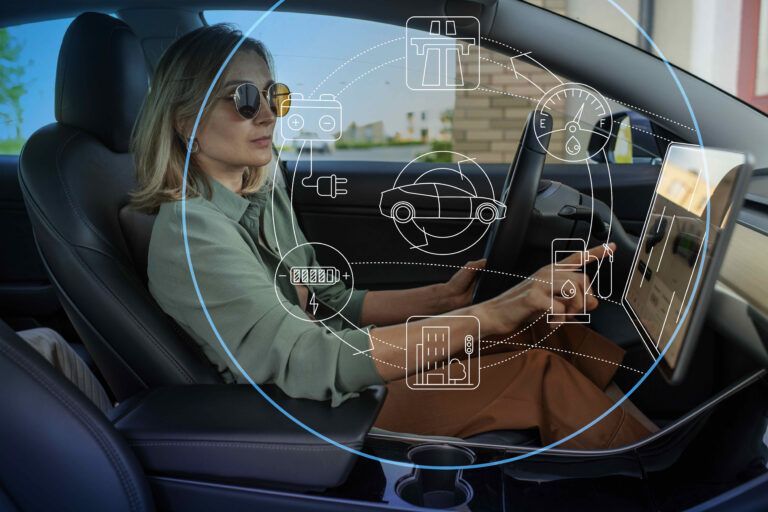
Software-defined vehicles (SDV), AI, autonomous driving aren’t incremental upgrades. As Sylvaine puts it, they fundamentally change what a vehicle is. The intelligent cockpit becomes a “third place to live“: somewhere to relax, work, entertain, … and buy. The business model shifts from a one-time transaction to an ongoing relationship with features-on-demand, subscriptions, and over-the-air (OTA) updates that improve the product over time, and sustain the residual value of the vehicle.
That last part is where things get interesting for OEMs. The infotainment and digital aftersales market is projected to reach nearly $14 billion by 2030, according to Oliver Wyman’s 2025 Infotainment Survey. Roughly half of consumers already say they’d pay for at least one in-vehicle digital feature. For OEMs who master the end-to-end user experience, the reward is recurring revenue at scale, genuine customer loyalty, and a brand that actually gets stronger with every software update.
The smart cockpit is where complexity converges.
The challenge is real. An SDV smart cockpit isn’t a single product, it’s a system of systems. Dozens of modules developed in parallel, across multiple teams, with thousands of interactions that all need to work together seamlessly. When a customer sits down for the first time, none of that complexity should be visible. The experience should feel intuitive and coherent from the first touch.
That’s a high bar. And right now, Sylvaine points to the gap between the UX that gets designed and the UX that actually gets delivered as where significant value is being left on the table.
The root causes are well understood. UX design and systems engineering often work in silos. Specifications are too vague early on. Integration happens too late. Trade-offs get made without a full view of the system. Naming these clearly is the first step to fixing them and the teams who fix them first will own the market.
Three things are worth keeping in mind. Decisions made upstream cost 10–100× less to fix than those caught late in development. Post-sale software services represent a massive and still largely untapped revenue opportunity. And a user experience that genuinely improves over time is fast becoming the new engine of customer loyalty.
Design upstream. Deliver continuously. Win on experience.
The decision to “shift-left” is clear: move key decisions earlier, simulate the vehicle HMI and the full intelligent cockpit behavior before production, and catch inconsistencies early, when it’s cheap, not when they’re costly and customer-facing. Every issue resolved upstream is time and money saved downstream.
After launch, the software-defined vehicle gives OEMs something no previous vehicle could offer: real usage data. The ability to measure, iterate, and improve the user experience continuously. A strong UX isn’t one that peaks at launch, rather it’s one that earns customer trust over time.
Setting up an agile environment powered by AI and XR where 3D and UX designers, systems and software engineers work seamlessly on the same model, and where requirements, changes, and tests are orchestrated and traceable is a key success factor to design, develop, and validate the next-generation SDV user experience.
In a software-defined vehicle, value isn’t just created in the code. It is realized and grown in the experience of using it.
This is the first article in our ongoing series on automotive digital cockpit and SDV user experience. Next up, I’ll be speaking with another expert to go deeper on the solutions and approaches making this possible. Stay tuned!

Prodatta Sengupta is the Transportation & Mobility Industry Marketing Lead at Dassault Systèmes. She has been with the company since 2016, building expertise in sales strategy and industry marketing for the global automotive sector. She writes about the trends and technologies redefining the industry, from Software-Defined Vehicles and EV innovation to Industrial AI and Virtual Twins. Based in Paris, Prodatta holds an MBA in International Business and Geopolitics and is passionate about art history, environmental protection and ethical innovation.