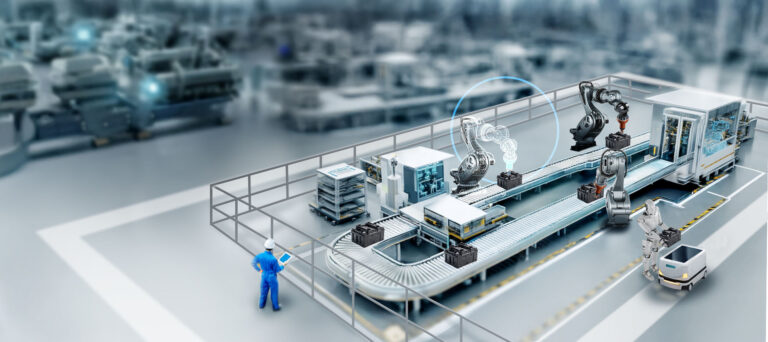
More than nine out of ten manufacturers expect smart manufacturing to help them become more competitive over the next three years. A similar proportion believe AI will significantly transform business models and operations over the next two years. That level of consensus is significant in any industry, and it’s driving a wave of investment around industrial AI, the Industrial Internet of Things (IIoT), robotics and virtual twin technology, which promises to turn the factory into an environment where data drives decisions, machines learn from experience and operations continuously improve on their own.
And yet, so far, only one in eight CEOs have achieved revenue growth and cost reductions from their AI investments. More than half have seen neither. Somewhere between the capital allocation and the results on the shop floor, something is going wrong, and it’s happening consistently enough that it can’t be written off as poor execution or bad luck.
How, then, are the successful manufacturers making AI-driven smart manufacturing work for them? Well, they aren’t spending more or deploying different technologies. They’re connecting them together so that:
- IIoT is the data foundation
- Virtual twins are the decision layer
- AI is the optimization engine.
IIoT: Connected data on the shop floor
IIoT is where operational visibility begins. It connects machines, sensors and systems across the shop floor to give manufacturers a live view of performance, conditions, usage and anomalies. However, data collection alone doesn’t lead to performance improvements. Manufacturers that went all in on sensor deployment may now be data rich but still make reactive decisions because data is disconnected and insights stay local.
Used in isolation, IIoT shows what is happening, but not what will happen next or what to do about it. Its full value only emerges when connected to a broader system with simulation and optimization layers that can interpret data and then act on it.
Virtual twins: Test decisions before making them
The most expensive mistakes in manufacturing don’t happen in planning meetings; they happen on the factory floor when a line reconfiguration disrupts throughput, a new robot integration creates bottlenecks no one anticipated, or a change that sounded right in theory turns out to be wrong in practice.
Manufacturers can use virtual twins, physics-based, data-driven models of the factory continuously updated with real-world operational data, to reduce this risk. Within this virtual environment, they can simulate production line configurations, test how robots from different vendors interact within the same cell, model throughput and logistics flows, and validate human-machine workflows.
This validation layer is now extending into immersive augmented reality (AR) too. With spatial computers, manufacturers can step directly inside the virtual twin environment to walk a production line that doesn’t yet exist, test maintenance procedures in a risk-free setting and train technicians on equipment before it’s installed. It’s the same underlying logic as virtual twins — test before you commit — applied in a way that makes the consequences of decisions viscerally clear before anyone acts on them.
When fed with accurate data, virtual twins change the question from “what went wrong?” to “what will work better?” And that move away from trial and error transforms the economics of smart manufacturing.
Industrial AI: Towards a self-optimizing factory
AI is only as effective as the data and context behind it, which is why many manufacturers struggle to translate AI pilots and investments into sustained performance.
When disconnected, AI stays as an analytical layer with limited impact. When AI is built on real-time IIoT data enriched by operational context from virtual twins, it becomes a driver of continuous optimization to:
- Catch equipment failures before they cause stoppages
- Adjust production schedules in response to real demand signals
- Build autonomous production systems that adapt to real-time conditions rather than waiting for human instruction
- Capture organizational expertise, making it transferable across teams and sites.
Science-based industrial AI, built on secure sovereign cloud foundations brings a level of reliability and trust that general-purpose AI tools can’t match in an industrial setting. From here, the factory of tomorrow learns, adapts and evolves.
Combining the power of IIoT, virtual twins and industrial AI
Each technology investment has standalone value. But the real results come from how they work together, creating a virtuous loop where data flows seamlessly from one layer to the next. Dassault Systèmes’ 3D UNIVERSES make this possible. These virtual plus real environments powered by the 3DEXPERIENCE platform unite modeling, simulation, data science and AI capabilities so manufacturers can build their smart factories within a secure, cloud-based industry environment and continuously improve it.
When this happens, manufacturers see:
- Up to 10x faster creation of factory virtual twins
- Up to 30% shorter commissioning times through virtual multi-brand integration
- Up to 90% reduction in unplanned downtime via AI-driven predictive maintenance
- Up to 50% cost reduction by testing and evaluating retrofit strategies in virtual twins.
AI-driven smart manufacturing is already on the shop floor. The real advantage now comes down to how manufacturers connect all these capabilities to turn isolated initiatives into repeatable, scalable outcomes.
Frequently Asked Questions About Smart Manufacturing
How Does AI Improve Factory Productivity?
AI improves factory productivity by analyzing IIoT data to optimize manufacturing processes and prevent downtime. It uses predictive maintenance to stop equipment failures before they happen. AI algorithms also support computer vision for automated quality control and handle repetitive tasks so workers can focus on high-value activities.
Why Are Virtual Twins Important for AI Implementation?
Virtual twins provide the necessary context for AI to make accurate decisions. They act as a risk-free environment where manufacturers can test AI-driven recommendations before applying them to the physical factory floor. Choose a virtual twin platform if you need to simulate complex robotic integrations or validate production changes safely.
What Is the Difference Between Industrial AI and General AI?
Industrial AI relies on science-based models and physical AI libraries to handle the strict reliability requirements of manufacturing environments. General AI focuses on broad text or image generation, whereas industrial AI interprets sensor data, predicts mechanical wear and optimizes highly specific factory workflows.
How Long Does It Take to See ROI From Smart Manufacturing?
The timeline for ROI varies based on the facility’s existing digital maturity. However, when manufacturers connect IIoT, virtual twins and AI through a unified platform, they often see immediate reductions in unplanned downtime. Some companies report up to 30% shorter time to delivery and significant productivity improvements within the first year of deployment.

Michael Mayr is a Robotics and Machining Industry Business Strategy Director, Industrial Equipment. Mayr has over 20 years of experience in industrial automation at leading global sensorics and robotics market companies (including Leuze, Yaskawa and KUKA). He has held positions as a product manager and the head of portfolio management and business development. Since 2019, Mayr has been leading Dassault Systemes' robotics and machine tools industry segment as Director of Business Development.