Drug discovery has a scale problem.
The demand for new therapeutics continues to grow. Researchers are expected to evaluate more targets, explore larger chemical spaces and move promising candidates into the clinic faster than before. At the same time, pharma and biotech face increasing pressure to reduce costs, improve success rates and make better use of resources.
Physics-based computational methods have helped guide experiments, eliminating poor candidates early on and allowing researchers to focus resources on the most promising candidates. But modern drug discovery now requires a growing collection of technologies beyond physics-based modeling, including machine learning, generative AI and biological foundation models. Each method provides valuable insight, but also requires expertise to apply it correctly.
Scientific Innovation Outpaces Adoption
Computational and data scientists are becoming extremely valuable in pharmaceutical research. Yet, the field is moving too quickly. New models and capabilities emerge continuously, making it difficult for the scientist to evaluate, adopt and integrate the latest into existing research workflows.
As AI capabilities continue to expand, the limiting factor is increasingly not new technology or computation, but the ability to operationalize scientific knowledge at scale.
What Would Actually Help the Scientist?
Drug discovery is not simply a sequence of tasks to automate. It is a process of reasoning, hypothesis generation, interpretation and decision-making. Scientists remain responsible for understanding results, evaluating tradeoffs and determining what the next experiment is.
The goal of agentic discovery is not to replace scientists, but to help them think more effectively.
What may help the scientist is a collaborator that can organize information, recommend novel methods, surface new possibilities, automate repetitive tasks and help navigate increasing complexity while keeping them in control.
MARIE: BIOVIA’s Scientific Virtual Companion
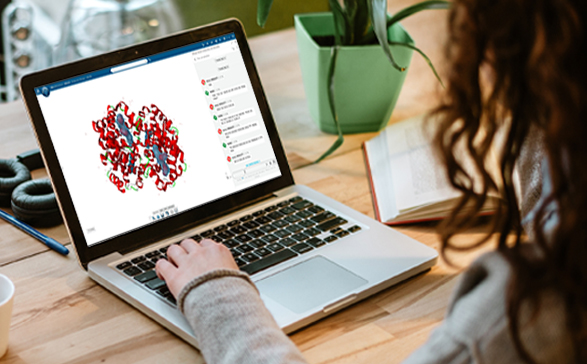
This is where BIOVIA’s scientific virtual companion MARIE enters the picture.
MARIE acts as a bridge between scientific intent and scientific execution.
Rather than navigating multiple applications, identifying appropriate computational methods and manually assembling workflows, MARIE places the right tools, data and expertise in front of the scientist when they are needed.
MARIE does not replace scientific judgment; instead helps scientists spend more time evaluating new ideas, testing hypotheses and advancing discovery with novel technology.
Building the Future with MARIE, accelerated by NVIDIA
Trained on our industry world models, MARIE builds upon decades of BIOVIA innovation in scientific AI, workflow automation, machine learning, modeling and simulation. Solutions such as BIOVIA Pipeline Pilot have long helped scientists orchestrate data, methods and workflows. MARIE extends these capabilities by making them more accessible, adaptive and interactive.
To accelerate this vision, BIOVIA has integrated NVIDIA NIM microservices, and more recently the BioNeMo Agent Toolkit into the 3DEXPERIENCE platform, with NVIDIA Nemotron reasoning models coming soon. These technologies provide access to an expanding ecosystem of biopharma AI capabilities, including molecular generation, protein structure prediction, biological reasoning and more. When orchestrated into scientific workflows by experts at BIOVIA, NIMs transform from standalone AI models capabilities into reusable services, making advanced AI more accessible to scientists who aren’t experts in data science or molecular modeling.
The result is not simply access to more models.
It is the ability to provide scientists with a unified experience that combines new technology with domain expertise, while keeping them in the driver’s seat.
Better Together
Neither AI models nor scientific software alone will fully solve the scaling challenge facing drug discovery.
BIOVIA provides industry know-how, data foundation and decades of scientific domain expertise needed to transform those capabilities into scientific outcomes. NVIDIA provides accelerated computing, AI infrastructure and foundation models.
Together, we are creating a future where scientists can evaluate more possibilities, adopt new technologies more quickly and focus their time where it creates the greatest value: making scientific discoveries that improve lives.
The future of scientific discovery is not autonomous AI, it is collaboration between scientists and scientific virtual companions.
📩 Stay up to date with the latest BIOVIA events, customer stories, blogs, and more.

Dr. Ceren Tuzmen Walker is a Senior Manager of Brand Marketing at BIOVIA. She has degrees in Molecular Biology, Computational Biology and Bioengineering, and a strong background in science communication and storytelling. Since she joined BIOVIA, Ceren has been leading messaging and brand storytelling for drug discovery and data science solutions. She is passionate about empowering scientists with the right tools for accelerating innovation.