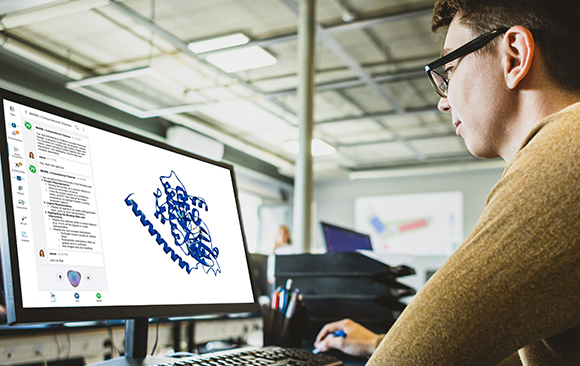
Computational drug design is not short on techniques. The hard part is not whether a method exists; the hard part is properly executing it in context. We must select the right method, configured the right way, executed in the right order, and put it into the hands of the scientist who needs the answer. Then we must make sure the result is understandable and has a clear assessment of uncertainty. Reducing the friction in this process is where the next wave of value lies, and it is exactly what BIOVIA’s MARIE virtual companion is designed to do. Recently, we have been adding amazing capabilities to MARIE, working with NVIDIA and using the new BioNeMo Agent Toolkit.
Focused on Acceleration
Dassault Systèmes and NVIDIA bring together NVIDIA accelerated computing and Dassault Systèmes applications for scientists and engineers. The result is faster, higher-quality output bringing more value to our customers, where they advance software-driven product development with ease and efficiency. Everybody wins.
A Phase Change in Computing
It is clear that a phase change is underway in computing. Advances in machine learning are opening possibilities that simply did not exist a few years ago. Having been at the forefront of deploying modeling and simulation applications that combine AI and machine learning with accelerated computing, Dassault Systèmes has accumulated a deep well of knowledge and know-how for turning these developments into value for our customers. That experience is now converging into a unified approach. BIOVIA is transforming scientific experiences on the 3DEXPERIENCE platform by combining its scientific modeling, simulation, and data science capabilities with NVIDIA’s accelerated computing, generative, and agentic AI. Together, these capabilities will help scientists move more efficiently from data to insight, accelerating therapeutics and materials innovation.
Meet MARIE
At the center of the scientist’s experience is MARIE, an AI-powered virtual companion that brings scientific knowledge directly to scientists and researchers on the 3DEXPERIENCE platform. MARIE is not a chatbot bolted onto a workflow; it is a scientific companion that interacts in natural language and connects the scientists to the right scientific tools at the right moment.
Going Further, Faster, with the Agent Toolkit
To make MARIE go further faster, BIOVIA is integrating new accelerators for our solvers—machine-learned approximations and GPU batch optimization—alongside NVIDIA accelerated computing. The BioNeMo Agent Toolkit gives our MARIE teams the latest innovations in agentic methods, tool use, and GPU-capacity optimization. The toolkit is the key to making use of NVIDIA’s full life science stack. We are also working with NVIDIA Nemotron, building autonomous agents to coordinate complex scientific tools and tasks.
The biomolecular models matter just as much as the orchestration. NVIDIA NIM microservices for MolMIM and a new generation of Chemical Language Models help quickly identify therapeutic candidates, molecular mechanisms of action, and predict properties and behaviors. These are not science projects sitting off to the side; the BIOVIA drug discovery solutions already include access to NVIDIA NIM microservices, and BIOVIA continues to incorporate additional NIM microservices, open models, libraries, frameworks, and life-sciences recipes wherever they can enhance and accelerate our existing software.
Why This Matters
The point of all this is not AI for its own sake. It is to let expert, practicing scientists do their work with less friction and a shorter path from idea to computation to experiment. By enabling MARIE to carry out natural-language prompts, where results are critically dependent on using the correct software tools, in the correct configuration, and in the correct order, we make computational drug design faster and more cost-efficient.
Crucially, we do this without giving up the things that make computational results trustworthy: accuracy, precision, explainability, and full traceability of the methods used. Agentic AI does not replace scientific rigor in this picture; it removes the overhead between a scientist’s intent and a correctly executed, defensible computation. That is the difference between AI that demonstrates well and AI that can be trusted in a regulated, high-stakes discovery environment.
We are early in this journey, and the pace is only increasing. As more NVIDIA accelerated computing is woven into the solutions our scientists use every day, the question for drug discovery teams shifts from “Can we run this method?” to “What should we ask next?”; which is exactly where a scientist’s attention belongs.

Leo Bleicher is the Director of Bioscience and Scientific Informatics Development at BIOVIA in San Diego. He spent two decades working as a medicinal chemist, cheminformatics and drug discovery information scientist before joining BIOVIA in 2012.