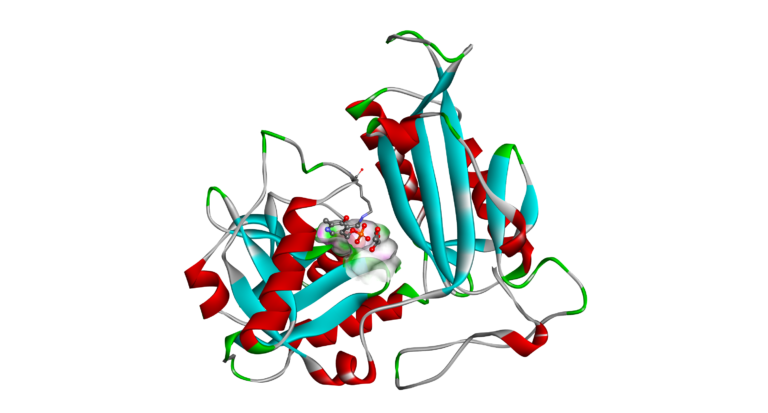
Proteins Do Not Work Alone
Cellular environments tend to be crowded, packed with proteins, lipids, cofactors, ions, nucleic acids and organelles. Thus, proteins do not work in isolation. To affect cellular functions, proteins often require one or more cofactors or binding partners, and they must be able to recognize this particular partner from the wide array of molecules present within the cell. For example, a small molecule may bind in the active site to facilitate enzyme catalysis, or a protein may need to specifically recognize and bind a glycan on the surface of a target protein to either direct or inhibit an immune response. Biological function is not a property of a protein alone; it is a property that emerges due to coordinated effort of multiple “players” within a cell.
Initially, structure-based, generative protein design tools were similar. The protein design problem was broken down into distinct steps that each tackle a more approachable problem. For example, the first stage of the design pipeline generated a generic backbone, often referred to as a scaffold, that represents a protein binder. Initially, these backbones were protein only, leaving important biological context, such as interacting ligands or nucleic acids, out of the picture. Then, the second stage of design was to assign a sequence to the scaffold. In order to identify if a sequence was a good candidate, the third stage may then predict the structure using AlphaFold or OpenFold, comparing the predicted structure to the generated scaffold. If prediction and scaffold agree, the design was thought to be of higher quality and more likely to bind the target. Overall, this approach included multiple simplifications to make the protein design task computationally tractable and to release a protein design tool quickly, even if it could not cover every scenario. Despite such simplifications, initial generative protein design tools were able to successfully design de novo protein binders. However, these simplifications limited what scientists could attempt to design and how quickly they could generate new candidates.
Today, computational biologists can design de novo binders and redesign existing binders to modulate protein-protein interactions through integrated workflows in BIOVIA Discovery Studio Simulation on the 3DEXPERIENCE platform so long as the design context contains only proteins composed of the standard 20 amino acids. Those workflows have proven very useful to our users, but they also raise the next questions: What if the ligand is part of the design? What if they could design an enzyme around the substrate, or a protein built to engage one specific small molecule and nothing else?
A Model That Designs the Whole Arrangement
RFD4-Proteína, a deep learning framework developed at the Institute for Protein Design with NVIDIA, is the next generation of protein design. Proteins, cyclic peptides, ligands, glycans and nucleic acids are all represented in the design task, so the chemistry around the protein is part of the design. Sequence and structure are generated together, not one after the other, which means the model can settle what a residue is and where it sits as one decision.
For scientists, the practical effects are the ones that matter. More of the designs that come out of the model survive in silico evaluation, so fewer candidates have to be generated to find something worth taking forward. Candidates arrive faster, and when a fold performs well, it can be resampled to produce variations on a theme rather than starting over.
What We Plan to Bring to Discovery Studio Simulation
We are working to bring RFD4-Proteína into BIOVIA Discovery Studio Simulation, with development priorities shaped by what our users tell us they need the most.
Two potential kinds of design workflows are in scope:
- Enzyme design with the ligand present: Design a protein scaffold around the catalytic site and the enzyme’s substrate together, accounting for their relationship during design rather than scaffolding the site and hoping the substrate fits.
- Ligand-conditioned protein design: Design a protein for one specific small molecule, with that molecule guiding the design from the start.
In addition, RFD4-Proteína brings support for a wide range of biological molecules not yet widely supported. Discovery Studio Simulation will work towards expanding design applications to include ligands, nucleic acids, and glycans/glycosylations in the design context. Additionally, RFD4-Proteína allows for scaffolds to be fully or partially fixed, with the latter often boosting design success rates (according to in silico metrics).
RFD4-Proteína is at the forefront of protein design and is expected to push out the pareto-frontier of protein design models in terms of success rates for unique designs and the number of designs generated per unit of time. As with Proteína-Complexa, RFD4-Proteína supports large system sizes with thousands of residues on a single GPU. Keeping in mind the variety of biological contexts it can support, RFD4-Proteína is likely to be a game-changer for protein design.
Building on AI to Advance Drug Discovery
BIOVIA has spent the last several years bringing the best available AI models into an environment—the 3DEXPERIENCE platform—where scientists can actually use them next to the physics-based methods they already trust. Structure prediction with AlphaFold2/OpenFold came first. Binder design with RFdiffusion and ProteinMPNN followed. Designing with the rest of the chemistry in the picture is the natural next step, and RFD4-Proteína is the model that makes this even faster and more affordable.
We will keep building on what we have delivered through our long-term strategic partnership with NVIDIA. But ultimately, our users will help us define what comes next.
 Reed Harrison
Dr. Reed HARRISON is a R&D software engineering specialist at BIOVIA, Dassault Systèmes. With a background in protein engineering, computational chemistry, and bioinformatics; a Ph.D. in bioengineering; and an interest in methods to probe and engineer the protein structure-function paradigm, Reed has worked to support protein modeling and simulation activities in BIOVIA.
 Tien Luu
 is the Product Manager and Principal Scientific Specialist at BIOVIA Dassault Systèmes, managing aspects of life science modeling and simulation predictive science solutions. She began her career as a Scientific Specialist after receiving her Ph.D. in Chemistry from the University of Wollongong, Australia. Since joining BIOVIA 25 years ago, Tien’s passion and excitement for helping customers accelerate their R&D have been steadfast and she is committed to improve customer experiences and product successes. In addition, she continues to be an active leader in scientific software product development, new program initiatives, and new applied and fundamental scientific research.