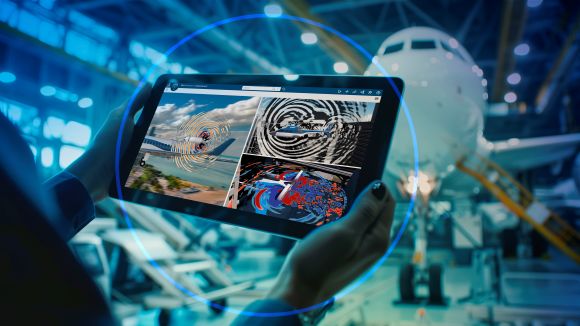
In 2026, the manufacturing industry faces supply chain disruptions, greater customer demands and increased competition. For manufacturing businesses to stay afloat, it is no longer an option to retain old business models. Digital transformation in the manufacturing industry – a concept also known as smart manufacturing – will require the application of artificial intelligence (AI), virtual twins and other emerging technologies to optimize processes, solve challenges and drive sustainable growth.
Key takeaways:
- Digital transformation in manufacturing uses AI, machine learning, AR, VR and 3D printing to optimize manufacturing processes. Supply chain disruptions, labor shortages and rising competition make it a necessity, not a choice.
- Manufacturers gain operational efficiency through automation, lower costs from smarter resource use, stronger sustainability and safer workplaces.
- Companies like Stekar, Airbus, Spirit AeroSystems, Jamco, CAREL, Robot at Work, American Hospital of Paris and automation.express are using 3D modeling, AR, VR and virtual commissioning to sharpen quality and accelerate delivery.
- Virtual twins let manufacturers simulate, test and optimize processes before building them, supporting predictive maintenance, waste reduction and continuous improvement across the lifecycle.
What is digital transformation in manufacturing? Meet Industry 4.0
Digital transformation in manufacturing involves the use of technologies such as AI, machine learning, virtual and augmented reality and 3D printing to guide your strategy, optimize your processes and provide a competitive edge.
Digital transformation is an essential component of Industry 4.0, which is based on embracing smart manufacturing solutions to create highly automated, integrated factories of the future.
Why is digital transformation necessary for manufacturers today?
Today’s manufacturers face unprecedented challenges. From supply chain disruptions and labor shortages to higher customer demands and increased competition across industries, digitally transforming business models is no longer optional – it’s a necessity.
By embracing the benefits of digital transformation and the concept of a “smart factory,” organizations can take operational efficiency to the next level, make smarter business decisions that provide a competitive edge, and even reduce costs. Without it, manufacturers risk falling behind their technology-savvy competitors.
What are the benefits of digital transformation in manufacturing?
Implementing digital tools into your daily manufacturing operations and workflows helps your company retain a competitive edge. Here are several other benefits of digital transformation in manufacturing.
Operational efficiency
Digitizing your manufacturing processes through automated tools eliminates the time spent doing repetitive tasks and reworking human errors. By automating routine tasks, workers can take on more creative endeavors, improve time-to-market, and increase customer satisfaction.
Enhanced product quality
Digital manufacturing tools can catch defects before they happen, giving companies peace of mind that products meet quality standards and comply with regulations.
Improved customer experiences
Customers these days are not only expecting quality products – they’re expecting customization, quick responses and traceability. By digitally transforming manufacturing processes, organizations can keep up with customer demands and boost satisfaction.
Cost savings
The cost savings and ROI your organization will receive by investing in digital technology are a huge benefit of a long-term digital transformation strategy. Thanks to greater resource utilization, improved time management, better-informed decisions and increased productivity, manufacturing organizations can expect higher profitability.
Sustainability
Often, technology like AI and virtual and digital twins is embedded with capabilities designed to reduce energy consumption and create a positive environmental impact. Facilities like modern sustainable factories are even being embraced, with promises to reduce water usage and carbon emissions while maintaining peak productivity.
Safer environment
Digital transformation in the manufacturing industry can significantly improve employee safety. Connected workers are using AI to help identify potential risks on the factory floor by leveraging historical and real-time data. IoT and sensors can monitor the state of manufacturing equipment and identify hazards before they occur, and automation helps reduce human error and accidents that can occur from manual labor.
Better decision-making
Tools like AR, virtual twins, and other Industrial AI solutions utilize historical data to provide manufacturing companies with real-time actionable insights. Using these insights, manufacturers can make smarter decisions and get ahead of problems before they arise.
Digital transformation examples in manufacturing companies
Successful manufacturing companies are using digital technology to transform their manufacturing operations. Here are some companies that have embraced digital tools and new systems to achieve a competitive advantage and their business goals.
1. Bold architectural statement sets a new standard in sustainable façade design
When Mouvement d’implication francophone d’Orléans (MIFO) – a hub promoting French culture in Ottawa, Canada – approached local engineering company Stekar to build a new $56 million USD (€47 million) building, it had two clear objectives: to make a bold architectural statement and to set new standards in sustainable façade design.
To pull off this challenge, the team at Stekar realized they needed a modern engineering solution to eliminate silos, improve design quality and prepare them for the future of digital manufacturing. They ditched the way they had produced designs in the past – primarily in 2D and manually creating each section of a facade, from insulation, panels, glazing, brickwork or aluminum framing- and started utilizing CATIA’s 3D modeling capabilities on the 3DEXPERIENCE platform on the cloud. Using 3D-based design, facade systems could be assembled, visualized and reviewed in a fully digital environment before fabrication. The result? Stekar dramatically improved engineering accuracy and quality and reduced the need for constant design revisions, even for the most complex design assemblies.
Learn more about how STEKAR uses 3D modeling.
2. End-to-end digitalization for the next generation of aircraft
It used to be enough to safely fly from one destination to the next. Today’s fliers are asking more from aircraft companies – expecting better costs, less stress and a greener experience. Airbus designs its planes with the customer experience in mind, and couldn’t have achieved its goal of creating its aerodynamic wings without the help of Dassault Systèmes. They’re using the 3DEXPERIENCE platform to streamline their design-to-operations workflow and revolutionize aircraft wing assembly through end-to-end digitalization.
“Digitalization is a key enabler that we are leveraging to support our core priorities, whether it is ramping up the production of our commercial aircraft, preparing the next generation of platforms that will further contribute to the decarbonization of our sector, or pioneering the defense and security solutions of tomorrow,” said Airbus CEO Guillaume Faury.
Learn more about Airbus and Dassault Systèmes’ strategic partnership.
3. Improving production quality with augmented reality
Manufacturer of aerostructures, Spirit AeroSystems, was looking to transform the way they build aircraft parts while ensuring safety, compliance and quality control – foundational elements of a manufacturing system. They turned to Dassault Systèmes for DELMIA’s Augmented Experience, a multi-device industrial AR solution designed to guide operators during assembly, quality inspection and maintenance tasks. It leverages virtual twin technology to display step-by-step instructions directly on the shop floor, eliminating the need for paper manuals and transforming Spir AeroSystems ‘ manual inspections into a fully digitized process.
Learn more about how Spirit AeroSystems is using augmented reality for manufacturing.
4. Turning aircraft interior design into a virtual experience
One of the world’s leading suppliers of aircraft interiors, Jamco, creates customized lavatories, galleys and seating for major aerospace equipment manufacturers. What was once a long, tedious process of proposing new design ideas, with a lot of back-and-forth, late-stage design changes, and longer lead times, has been transformed into a seamless virtual experience. Now, with virtual twins, aerospace engineers and customers can experience a full-scale aircraft cabin in a virtual reality (VR) environment that is so immersive that users can reach for handles, inspect finishes and test layouts without ever touching a single physical part.
Learn more about Jamco’s digital transformation.
5. Industrial company accelerates time to market for customizable smart thermostats
Mass production with one-size-fits-all is a thing of the past. Customers today expect customization and products tailored to their unique preferences and tastes. No industry is exempt from this, including the commercial refrigeration market, where refrigerators, freezers and wine coolers are expected to be tailored – from the color, size of displays and cases to unique buttons and icons.
Italian manufacturing company CAREL, which specializes in control solutions for air conditioning, refrigeration and heating, understands the importance of customization and has designed a highly customizable range of configurable smart thermostats. With so many ways to configure these thermostats in terms of their power supply, display, connector and packaging options, the team knew they would need to develop them in a new way, embracing the collaborative engineering and configuration management capabilities on the 3DEXPERIENCE platform on the cloud. Before, CATEL had to use spreadsheets to configure each product, taking around 100 days to design, produce and deliver to the customer. Now, with the platform, they’ve reduced the development cycle to just 10 days.
Learn more about how CAREL shortens manufacturing production times.
6. Virtual commissioning maximizes output on the factory floor
Italian production line solutions specialist Robot at Work is on a mission to solve complex production challenges on the factory floor. Originally, starting out by selling a robot arm that works alongside people in a production setting, carrying out tasks like loading, unloading, circuit board assembly, meta processing and packaging, customers began asking for more from its robots. Inspired by other automotive manufacturers that have moved toward virtual commissioning, Robot at Work set out to test its robots’ capabilities to evaluate customers’ production requirements, automation needs and unique challenges on the factory floor. They discovered that with virtual twins, also known as digital twins, customers can simulate manufacturing operations in a virtual environment before they commit to the full investment of setting it up physically.
Now, virtual commissioning is enabling Robot at Work to meet its customers’ increasingly complex requirements and to run its manufacturing processes more efficiently, maximizing output while maintaining high quality.
Learn more about how Robot at Work is improving operational efficiency.
7. Simulating hospital layouts before manufacturing to improve performance
American Hospital of Paris (AHP) has ambitious plans to expand its checkup center and operating rooms, with the objective not only of creating more space but also of creating care environments that better anticipate the needs of its patients and staff, enhance workflows and support better outcomes. And instead of following traditional manufacturing processes and design approaches, they’ve decided to involve staff far earlier in the development process to gain their feedback insights.
They partnered with Dassault Systèmes and brought their vision to life by leveraging its Virtual Twin as a Service approach, which gave them access to advanced modeling and simulation capabilities. Using these digital tools, the AHP team was able to create detailed virtual twins of the checkup center, operating rooms and recovery areas, including all their equipment. Healthcare professionals explored these designs using immersive virtual reality (VR) headsets, allowing them to engage with the designs hands-on and provide actionable design feedback. This kind of involvement allowed AHP to validate its choices before construction began, resulting in design changes that would positively impact future patients.
Learn more about AHP’s digital transformation initiatives.
8. Pushing the boundaries of automation with custom machines in 3D
Automation.express is a special machine builder that is pushing the boundaries of what is possible to automate in factories and manufacturing environments. Clients come to them with fully unique requests for a special machine – semi- or fully automatic machines that carry out specific, monotonous tasks like assembly, packing or machining – with a blank slate. With no idea of the parts required, how they will work, or how it all comes together, automation.express is tasked with designing and developing a highly complex machine from scratch.
To pull off this feat, they’re utilizing 3D modeling capabilities powered by CATIA on the 3DEXPERIENCE platform. The 3D models they create are the backbone of the entire design process, from the initial sales discussion through sharing with design and engineering stakeholders and sharing progress with their client. automation.express has not only found that these 3D models create a powerful connection with their clients and improve customer satisfaction, but also allows them to reduce the design effort per order, lower risks and shorten time to market.
Learn more about how automation.express is using 3D modeling to win sales.
How do you digitize manufacturing processes? Embracing digital manufacturing software
Digitizing manufacturing processes requires buying or licensing digital marketing software. At Dassault Systèmes, digital transformation is at the heart of all our manufacturing solutions. We offer virtual twin technology powered by AI to revolutionize product development, lifecycle management, supply chains and other key areas of manufacturing industries. Secure and sovereign, science-based and human-centered, our virtual twins help you address the challenges you’re facing by simulating real-world operations, optimizing processes and creating safer, more sustainable manufacturing environments.
Learn more about AI-powered manufacturing:
More frequently asked questions about digital transformation in manufacturing
A virtual twin is used for digital transformation in manufacturing by supporting every phase of the production lifecycle, from ideation to manufacturing and production. Manufacturers can simulate, test and optimize any product, process or system before it’s built, enabling innovation and sustainable decision-making from a singular, collaborative digital platform – the 3DEXPERIENCE platform.
Virtual twins on the 3DEXPERIENCE platform support digital transformation in the following ways:
Simulate, test and optimize any product or process before it’s built
Help reduce environmental impact and carbon emissions at every stage of production
Use real-world data, AI and analytics to optimize resource use, minimize downtime and improve product quality
Support continuous improvement by creating a feedback loop throughout a product’s lifecycle
Provide real-time monitoring and predictive maintenance
Improve production workflows, enhance quality control and minimize waste
Increase productivity and save costs
New trends in the manufacturing industry include the following:
The rise of AI and machine learning
A new focus on sustainability and a circular economy
Virtual twin and digital twin integration
The digitization of supply chains
An evolving workforce
Cybersecurity as a priority
When transitioning to a digital transformation strategy, there can be roadblocks along the way. Some of the common challenges include:
Resistance to change
High costs
Data security and privacy
Lack of digital workflows
Digital skills gap
Outdated machinery
Lack of a clear roadmap
Related resources

Gabby is a Communications Manager on the Corporate Publishing team here at Dassault Systèmes. With a background in marketing, communications, and SEO, her writing is intended to inspire and educate.