
Living Through an Innovation Revolution

Every so often, history forces us to rethink everything we thought we knew. Today, we are living in such a moment. The pace of technological disruption, shifting consumer values, and growing environmental imperatives is rewriting the rules of competition for consumer products companies.
A new Forrester Consulting study commissioned by Dassault Systèmes surveyed more than 500 business leaders across the US, UK, France, Germany, and Japan. The findings are clear: consumer expectations are evolving faster than most companies can keep up, leaving a widening “rethinking gap” between aspiration and delivery.
Companies know they must transform. But while they possess powerful technologies to accelerate change, they are held back by fragmented organizations, siloed data, and misalignment between stakeholders. Closing this gap requires not just new tools, but a new mindset—one that reimagines products, processes, and people around a shared vision of innovation.
This blog explores the key insights from the study and charts a path for becoming a true market-leading rethinker.
Consumers Are Moving Faster Than Companies

Great innovation begins with one simple question: is this what my customer needs? Today’s customers are increasingly digital, global, and conscious of sustainability. They demand personalization, seamless experiences, and products that align with their ethical values.
- 79% of decision-makers admit consumer demands are changing faster than they can keep up
- 68% believe changing preferences will critically impact their business within the next 12 months
Yet these demands can be paradoxical. Consumers expect companies to continuously launch new products, while simultaneously improving and extending existing ones. They want personalization at scale—but they also want ethical and sustainable sourcing.
This constant tension makes business-as-usual impossible. The companies that succeed will be those that rethink not just what they sell, but how they design, manufacture, and deliver it.
The Risks of Falling Behind
Failing to rethink has real consequences. The history of consumer products is filled with cautionary tales—Blockbuster, Kodak, and countless others who misread the winds of change.
Survey respondents reinforced these lessons:
- 94% reported significant repercussions when they failed to address past challenges
- The most common impacts included increased costs (68%), damage to brand reputation (63%), and missed market opportunities (58%)
Innovation at the wrong pace can be just as dangerous. Being first-to-market with a concept consumers aren’t ready for—think Google Glass or the Apple Newton—can waste valuable resources and erode trust. Balancing speed with quality remains one of the most consistent struggles.
External Pressures Reshaping Strategy
Consumer behavior doesn’t evolve in isolation. It is profoundly shaped by external shocks—pandemics, wars, geopolitical instability, and environmental crises.
- 71% of respondents expect geopolitical instability to critically impact their business in the next year, rising to 81% in Germany given its proximity to the Russia–Ukraine conflict
- 69% say sustainability expectations will have a critical impact, particularly in the US and in industries like food & beverage and personal care
- Regulatory changes add further complexity, cited as a high-impact concern by 65% of leaders
Events—from sugar price spikes in the 1970s to the COVID-19 pandemic—force companies to rethink portfolios and supply chains overnight. Those that pivot quickly, like Nowy Styl reorienting to home-office furniture, not only survive but thrive.
Technology: Both the Disruptor and the Solution
Technological disruption is both the greatest threat and the greatest opportunity. 73% of leaders say it will have a critical impact on their business within the next year.
At the same time, the tools to close the rethinking gap are already here:
- Computer-Aided Design (CAD): Adopted by 67% of respondents, CAD accelerates time to market and supports radical product innovation. Finnish firm Metsä Board, for example, cut packaging time-to-market by 85% through virtual testing
- Product Lifecycle Management (PLM): 66% plan to expand PLM adoption. By harmonizing design, manufacturing, and sales, PLM reduces waste, shortens development, and aligns stakeholders.
- Virtual Testing & Simulation: 63% are pursuing simulation tools to test product performance, materials, and processes virtually before committing costly physical resources
- Data Analytics: 65% are investing in advanced analytics to optimize production planning, inventory, and customer insights. Altaïr Group achieved a 99% service rate by integrating master production scheduling with packaging and raw materials planning
But eagerness must be matched with preparedness. While many companies claim to be undergoing digital transformation, fewer than 40% strongly agree that they are effectively leveraging analytics to drive decisions.
The Human Factor: Innovation’s Weakest Link

Perhaps the most striking finding of the study is that people, not technology, are the biggest barrier to progress.
- 60% of respondents highlight misalignment between stakeholders as a major challenge
- 75% say organizational silos make it difficult to achieve collaborative, data-driven projects
- 58% cite insufficient training and difficulties in recruiting or retaining skilled talent
These gaps create cascading inefficiencies: disconnected supply chains, poor data sharing, conflicting priorities, and wasted resources.
Even more concerning is the vertical misalignment between management levels. While 43% of C-suite leaders believe their organizations are “very prepared” for digital transformation, only 23% of managers agree.
This disconnect reveals a lack of shared vision, undermining both strategy and execution.
As Steve Jobs once said, “Technology is nothing. What’s important is that you have faith in people… if you give them the tools, they’ll do wonderful things with them.” The challenge for companies is to align talent, culture, and leadership around those tools.
The Blueprint for a New Industrial Revolution: Virtual Twins
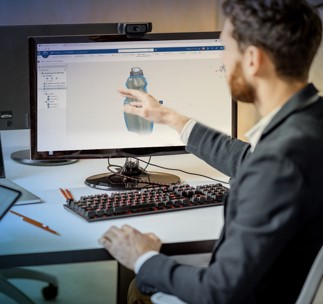
If the blueprint defined the second industrial revolution, virtual twins are defining the fourth.
Digital twins already allow companies to unify teams around a shared source of truth. But virtual twins add simulation, predictive modeling, and lifecycle optimization—enabling companies to anticipate the future, not just record the present.
- 95% of leaders confirm digital twins are already important to their product development process
- 63% are expanding adoption in the next 12 months.
- 23% plan to increase spending on digital twins by more than 10%
Virtual twins can replicate everything from supply chains to manufacturing plants, packaging systems, or even consumer experiences. They allow companies to run “what-if” scenarios at scale—testing everything from new recipes to sustainability impacts—before committing real resources.
The Swiss company Geberit used Dassault Systèmes’ virtual twins to test product performance in multiple environments, unite distributed teams across Europe, and launch new sustainable ceramic products faster than ever.
By aligning people, processes, and platforms, virtual twins close the innovation gap and enable the elusive “right-first-time” moment.
Becoming a Market-Leading Rethinker
What distinguishes the leaders from the laggards? The study identifies a few key behaviors:
- Consumer Obsession: Leaders relentlessly ask what their customer needs—and align portfolios accordingly.
- Balanced Innovation: They balance new product launches with enhancements to existing offerings, delivering personalization without overextension.
- Tech-Human Integration: They deploy CAD, PLM, analytics, and virtual twins not as isolated tools but as part of an integrated ecosystem aligned with people and processes.
- Workforce Transformation: They invest in training, collaboration, and cultural change to ensure technology is matched by talent.
- Future Readiness: They use virtual twins to model not only products but systems, anticipating future disruptions before they hit.
As Apple CEO Tim Cook has said, “A great product isn’t just a collection of features. It’s how it all works together.” The same applies to great innovation. Success lies not in individual technologies or teams but in how effectively they align to deliver transformative consumer experiences.
Conclusion: The Sky Is the Limit

Consumer products companies are at a crossroads. The pressures of technology, sustainability, and consumer demand are real—and they are accelerating. But so are the opportunities.
With virtual twins, collaborative platforms, and a reimagined approach to people and processes, the gap between aspiration and achievement can be closed. Those who rethink boldly will not only survive disruption but define the next generation of iconic products.
The revolution is here. The question is not whether to rethink, but how fast.
👉 Read the full report here: go.3ds.com/rethink

Brian Carboni is the Global Marketing Director for the CPG-Retail Industry at Dassault Systèmes.