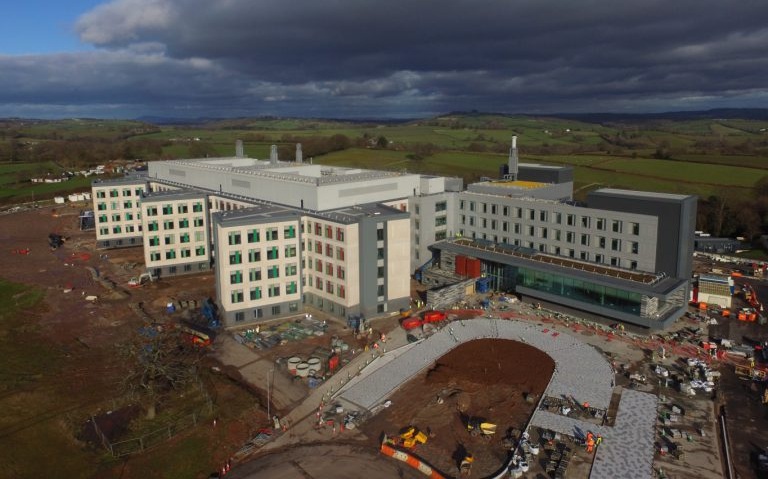

Through Design for Manufacture and Assembly (DfMA) and extensive off-site production, Laing O’Rourke delivered a £350 million specialist and critical care facility. Thousands of components were digitally engineered and manufactured away from the construction site before being brought together through a carefully planned assembly process.
But completing a successful project raises another important question: how can the knowledge developed by experienced construction teams be captured, tested and reused rather than disappearing into reports, meetings or individual memories?
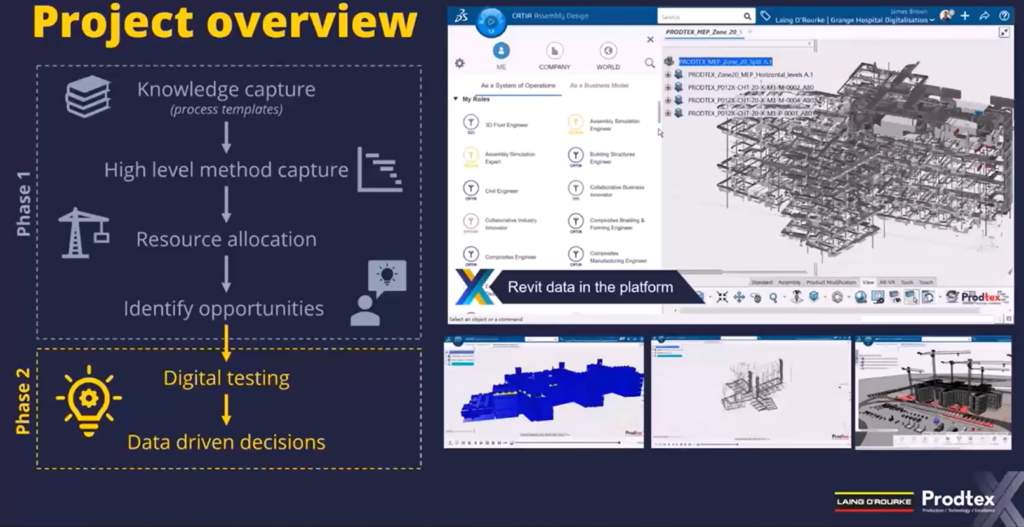
In a webinar, Prodtex explores how digital simulation and virtual construction rehearsal were applied retrospectively to the Grange University Hospital. The study shows how a Virtual Twin can reconstruct real installation processes, compare alternative construction methods and transform practical expertise into reusable digital knowledge.
Watch “From Construction Knowledge to Digital Twin: The Grange Hospital Case Study”
A hospital delivered through industrialized construction
Located in Cwmbran, Wales, the Grange University Hospital is a 450-bed specialist critical care facility designed to centralize complex and emergency services for communities across the Aneurin Bevan University Health Board region.
Healthcare projects are among the construction industry’s most complex undertakings. Clinical spaces must integrate structures, building services, equipment and specialist systems while meeting demanding requirements for safety, hygiene, reliability and future operation.
For the Grange University Hospital, Laing O’Rourke adopted a DfMA strategy that moved a substantial part of the construction process into a controlled manufacturing environment.
Approximately 4,000 components were digitally engineered and manufactured around 200 miles from the project site at Laing O’Rourke’s automated concrete-products facility. This industrialized approach helped accelerate on-site assembly and contributed to the hospital becoming available early during the COVID-19 pandemic.
The project demonstrated the value of connecting digital engineering, off-site manufacturing, logistics and construction. Yet its completion also created an opportunity to examine the delivery process in greater depth and ask how it could be improved for future projects.
Rehearsing construction before physical execution
Traditional 4D planning connects a three-dimensional model to a project schedule. Virtual construction rehearsal goes further by representing the detailed activities required to complete each operation.
In the Grange Hospital study, the 3DEXPERIENCE platform enabled to simulate installation sequences, worker access, material movements, lifting operations and site logistics such as:
- How should components arrive and move through the site?
- Which lifting equipment can reach each floor?
- Where will materials be positioned before installation?
- Do workers have sufficient space to carry out each task safely?
- Could an operation create a bottleneck elsewhere in the sequence?
- How would a different installation method affect labor, equipment and time?
Instead of discussing these questions theoretically, project participants could observe the proposed operations inside a realistic digital environment.
The Virtual Twin became a common reference for challenging assumptions. When participants described the same task differently, the simulation exposed those differences and enabled the team to agree on a precise process before repeating it on another project.

Industrializing construction knowledge
Construction knowledge often exists in fragmented forms. Some of it is contained in models, specifications and method statements. Much of it resides with the people who planned deliveries, operated equipment and installed components on site. Digital rehearsal captures how work had actually been performed and makes that knowledge explicit.
Using Dassault Systèmes’ 3DEXPERIENCE platform, construction geometry, equipment, workers, site constraints and installation sequences can be brought together in a shared virtual environment. CATIA provides the detailed spatial and product definition, while DELMIA makes it possible to simulate the construction process over time.
DfMA therefore becomes more than the prefabrication of building components. It becomes a knowledge-based approach connecting product design with manufacturing, logistics and assembly.
The resulting Virtual Twin describes not only what will be built, but how people, materials and equipment can come together to build it and convert the project team’s experience into a structured Virtual Twin.
A shared language across disciplines
Hospital construction brings together architects, engineers, manufacturers, planners, logistics specialists, site managers and installation teams.
Each participant sees the project from a different perspective. Drawings and schedules may describe the intended outcome, but they do not always communicate exactly how an operation will be performed.
A Virtual Twin gives these teams a shared visual and operational reference.
Stakeholders can review the same installation scenario, identify access or sequencing problems and contribute their expertise before a method is deployed. The simulation helps align people who may be using identical terminology but imagining different processes.
This shared environment also connects the large-scale project, in which decisions can be examined collectively and their consequences understood across disciplines. Teams can understand how an individual operation relates to floor-by-floor sequencing, logistics and the overall construction program.
Watch “From Construction Knowledge to Digital Twin: The Grange Hospital Case Study”
Discover how CATIA for Buildings and Infrastructure and DELMIA connect design, simulation and construction delivery on the 3DEXPERIENCE platform.
Learn more: