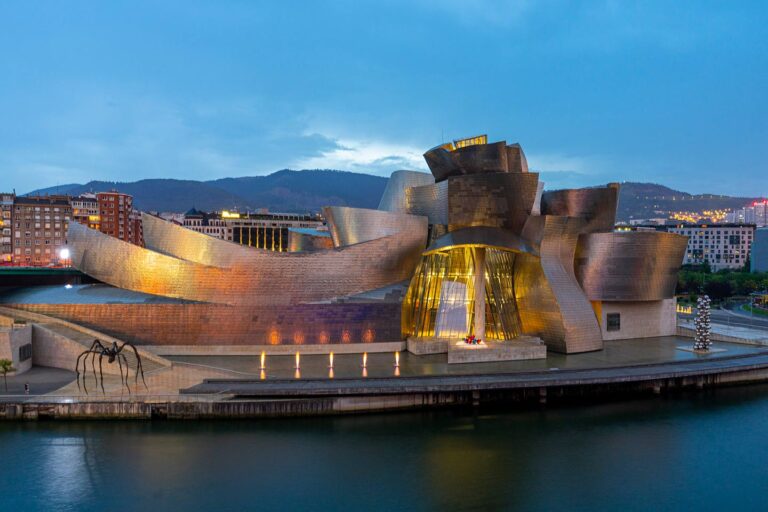

When the Guggenheim Museum Bilbao opened in 1997, its flowing titanium forms appeared to defy the conventions of architecture and perhaps even the practical limits of construction.
Frank Gehry’s building was more than a spectacular new museum. It demonstrated how digital technology could connect creative freedom with engineering precision and industrial execution. In doing so, the project helped change how some of the world’s most complex buildings would be designed and delivered.
Discover B1M documentary to learn more on this pivotal achievement and combination of ambition, technology and human expertise that made it possible:
A building conceived as part of a city’s transformation
In the early 1990s, Bilbao was confronting the decline of the heavy industries that had shaped its economy for generations. Shipyards and factories were closing, unemployment was high and the Nervión riverfront had become a visible reminder of the city’s industrial decline.
The Basque authorities responded with an ambitious regeneration strategy encompassing transportation, infrastructure, environmental improvements and culture. A new Guggenheim museum, designed by Frank Gehry, would become its most recognizable expression.
Gehry proposed a building composed of sweeping, irregular volumes rather than conventional straight lines and right angles. Its forms evoked ships, fish scales and the industrial character of Bilbao’s port. Yet the qualities that made the design so powerful also presented an extraordinary question: how could shapes conceived through sketches and physical models be described, engineered and manufactured with sufficient accuracy to be built?
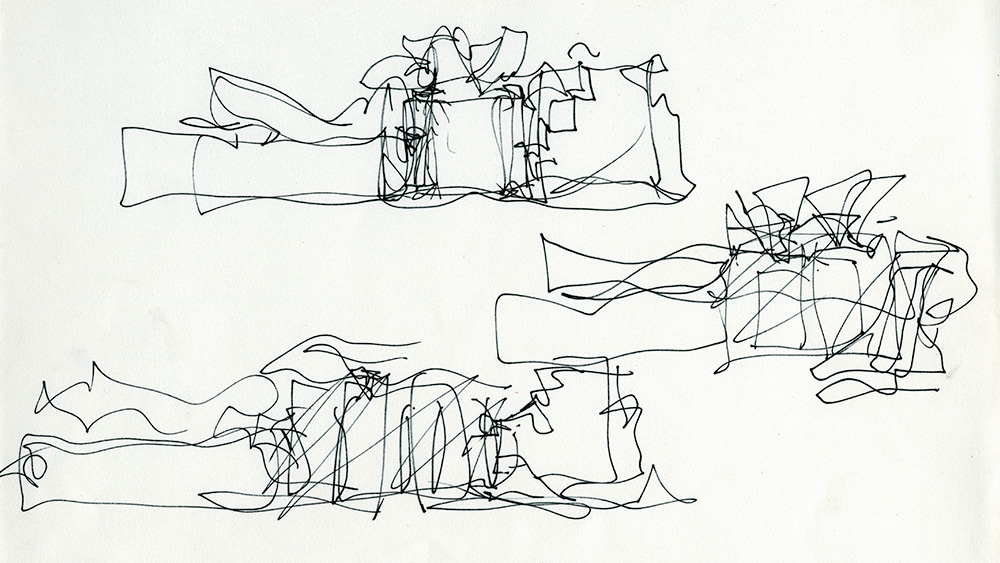
Frank Gehry’s concept sketches for the museum. Image courtesy of Gehry Partners, LLP.
From an expressive model to an exact digital definition
Gehry and his team found part of the answer in an unexpected industry.
They adopted CATIA, for Virtual Twin design and engineering, whose origins were in aerospace. The technology had already been used to develop highly complex aircraft, where curved surfaces, thousands of interconnected components and extremely precise manufacturing requirements must be managed as one coherent product definition.
For the Guggenheim Bilbao, this capability introduced a new relationship between architectural design and industrial engineering.
Gehry could continue to develop ideas through drawings and physical models, media central to his creative process. The resulting forms could then be translated into mathematically defined 3D surfaces. Instead of simplifying the architecture to suit conventional drawings and construction methods, the project team could use the digital model to preserve its geometric intent.
CATIA made it possible to view and analyze the building’s complex surfaces from every angle. More importantly, the model became a precise source of information for engineering, fabrication and assembly. The building was no longer represented only by a collection of drawings; it could be understood as an integrated system of constructible components.
CATIA did not merely visualize the shape. It helped break the design down into thousands of parts that could be produced and positioned with millimeter-level precision.
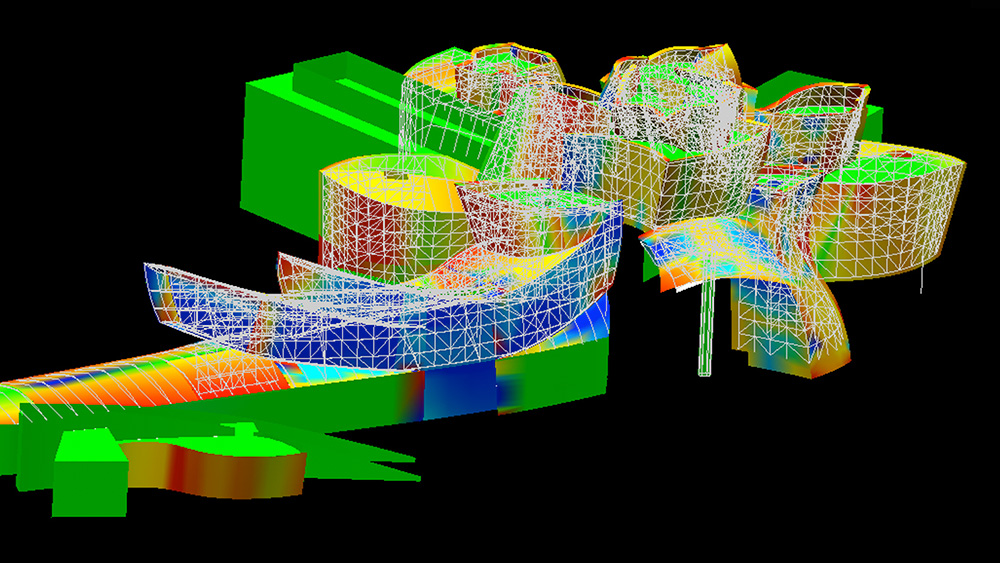
A CATIA model of the Guggenheim Museum, bilbao. Image courtesy of Gehry Partners, LLP.
Industrializing complexity
One of the Guggenheim’s most important lessons is that industrialization does not have to mean visual standardization.
Although the museum appears organic and spontaneous, its construction depended on rigorous control of geometry and information. CATIA enabled the project team to define unique components while maintaining their relationship to the complete structure.
This was particularly valuable for the building envelope. The museum would ultimately be covered with approximately 33,000 thin titanium panels. CATIA could digitally “unfold” the curved surfaces and produce two-dimensional definitions for the individual panels from which those surfaces would be assembled.
The process connected architectural geometry to fabrication data. Complex curvature could be rationalized into parts that manufacturers could cut, form, identify and deliver for installation. It was a powerful early demonstration of design-to-manufacturing continuity applied to construction.
Behind the titanium skin, however, was another level of complexity. Engineers developed a layered solution consisting of a primary steel structure, secondary curved framing and a tertiary mesh supporting the exterior surface. Many structural elements were unique, and their position had to correspond precisely to the digital geometry.
A shared language across disciplines
The Guggenheim Bilbao also foreshadowed a profound change in construction project collaboration.
Architects, engineers and builders traditionally worked through discipline-specific drawings and documents. Every translation between those documents created opportunities for information to be lost or interpreted differently.
A Virtual Construction Twin offered the project team a shared geometric reference. It allowed design intent to move more directly from Gehry’s studio to engineering and fabrication, even when stakeholders were working in different cities and countries.
This approach anticipated many principles now associated with (BIM) Building Information Modeling and virtual twins: multidisciplinary collaboration around shared data, continuity between project phases and the ability to connect design decisions to real-world production.
A lasting digital legacy
Frank Gehry’s pioneering use of CATIA created a continuous path from hand-drawn idea to physical model, digital definition, engineering and fabrication. It allowed the project team to preserve the expressive power of the original design while giving manufacturers and builders the precise information required to make it real.
Today, CATIA and the 3DEXPERIENCE platform take this principle further. Architecture, engineering, construction and manufacturing teams can work within a shared virtual environment, connecting design, simulation, collaboration and fabrication across the project lifecycle.
Gehry later founded Gehry Technologies, whose Digital Project applications used CATIA as their core modeling engine. The technology was subsequently applied to other highly ambitious buildings and infrastructure projects, extending these methods throughout the architecture, engineering and construction sector.
Discover how CATIA for Buildings and Infrastructure connects creative design with engineering and construction.