Introduction
Automotive and aerospace programs are under pressure to reduce development cycles, control costs, and meet aggressive sustainability and performance targets. At the same time, product architectures are becoming increasingly complex, driven by electrification, advanced propulsion concepts, stricter certification requirements, and higher expectations for efficiency, safety, and noise reduction.
As a result, the scale, fidelity, and urgency of Computational Fluid Dynamics (CFD) workloads continue to increase, even as available program timelines become increasingly compressed.
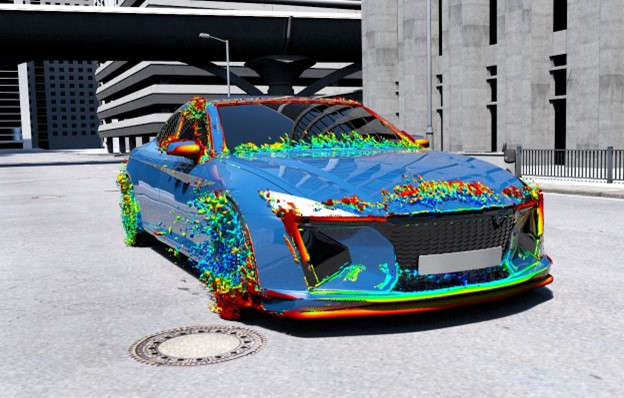
SIMULIA PowerFLOW has long been the industry benchmark for transient CFD, delivering validated accuracy for demanding applications including external aerodynamics, thermal management CFD, and aeroacoustics simulation.
However, conventional CPU-based HPC for CFD is increasingly challenged to efficiently support these workloads. Large cluster requirements, extended turnaround times, and high infrastructure and operational costs directly impact engineering throughput, limiting the agility required to support modern automotive and aerospace development programs.
To address these challenges, Dassault Systèmes developed a GPU-accelerated implementation of PowerFLOW supporting the latest NVIDIA GPU architecture. This innovation represents a significant advancement for high-performance, cost-effective CFD simulation workflows.
Graphical processing units (GPUs) are computer processors with an architecture that is especially well-suited to parallel processing and vector calculations. Although originally developed for computer graphics, they’ve proven to be versatile tools for a wide range of scientific and engineering calculations. GPUs offer several advantages, including increased speed, reduced cost, and enhanced sustainability. This is because a single GPU can perform the same calculations as many traditional CPUs while using less power. This results in a computing solution that performs better, uses less electricity, and generates fewer electrical waste products at the end of its useful life.
In this blog post, we’ll discuss the GPU capabilities of SIMULIA PowerFLOW, including the new multi-GPU code, and demonstrate how GPU acceleration for CFD provides a powerful, scalable, and cost-efficient solution for next-generation aerodynamics, aeroacoustics, and thermal CFD simulations.
What Is SIMULIA PowerFLOW and How Does It Work?

SIMULIA PowerFLOW is a high-fidelity CFD solution built on the Lattice Boltzmann Method (LBM), a physics-based approach that simulates fluid flow by tracking particle distribution functions on a lattice rather than directly solving the Navier–Stokes equations used in traditional finite-volume CFD solvers.
This fundamental difference allows PowerFLOW to naturally capture unsteady, transient flow phenomena, including separation, wake dynamics, and aeroacoustics, with exceptional robustness and accuracy, particularly around complex geometries and rotating assemblies.
Because the governing equations are evaluated locally on the lattice, the method is inherently well-suited for massively parallel computation, making it an ideal numerical foundation for GPU-accelerated CFD.
Unlike traditional finite-volume methods, which often require extensive meshing effort, turbulence modeling assumptions, and numerical stabilization techniques, PowerFLOW employs automated volumetric meshing and an inherently transient solution strategy. This significantly reduces preprocessing time while maintaining high predictive fidelity across a wide range of flow regimes.
Why Is High-Performance Computing Essential for Modern CFD?
High-performance computing (HPC) refers to using large groups of interconnected computers, often referred to as CPU clusters, to solve computationally intensive problems significantly faster than a single machine can. Traditionally, these simulation tasks are distributed across hundreds or thousands of cores through parallelization. As the model size grows, additional CPU cores are added to maintain reasonable turnaround times.
Scaling efficiency can diminish as communication overhead between cores increases, and maintaining large CPU clusters results in high infrastructure costs, energy consumption, and IT management overhead. These limitations directly impact engineering productivity.
Realistic industrial CFD workloads can take days or even weeks to complete on CPU-based HPC, slowing design iteration and delaying decision-making. This bottleneck has become increasingly critical in industries like automotive, aerospace, and rail transportation, where turnaround time, simulation accuracy, and design agility are essential to meet market and regulatory demands.
HPC is essential for CFD because realistic engineering problems require extremely large meshes, highly unsteady flow physics, and increasingly complex multiphysics interactions, such as thermal coupling or fluid-structure interactions (FSI).
The limitations of traditional HPC set the stage for GPU-accelerated CFD, which offers a fundamentally different computational architecture optimized for massively parallel, transient, high-fidelity simulations.
How Does GPU Computing Accelerate CFD Simulations in PowerFLOW?
GPU computation provides a range of compelling advantages over traditional HPC clusters, particularly for CFD workloads that depend on massive parallelism. GPUs are built with thousands of lightweight processing cores designed for simultaneous computation, making them naturally aligned with algorithms such as the Lattice Boltzmann method and particle-based methods. This architectural difference also delivers significantly better performance per watt: GPUs consume substantially less power for the same computational output, thereby reducing energy use, cooling demands, and data center footprint.
Compared to traditional CPU-based HPC for CFD, GPU-accelerated PowerFLOW delivers significantly higher performance per watt, reducing energy usage, cooling requirements, and overall data center footprint. A single GPU server can often replace dozens of CPU nodes, minimizing communication overhead and operational complexity while maintaining high scalability.
For engineers, this means faster turnaround for CFD. Rapid simulation enables earlier design evaluation, more iterations, and better-informed decisions, all without the need for large, complex CPU clusters.
PowerFLOW maintains numerical consistency across both CPU and GPU solvers, ensuring that simulations yield equivalent results regardless of the hardware used.
This flexibility enables organizations to deploy GPU CFD on local workstations, multi-GPU servers, or cloud GPU instances, depending on the project’s scale and the availability of their infrastructure. Through GPU acceleration, PowerFLOW enables engineers to perform industrial-scale, high-fidelity simulations faster, more sustainably, and more cost-effectively than ever before.
How Does PowerFLOW Scale Across Multiple GPUs for Large CFD Simulations?
While single-GPU acceleration enables rapid engineering iteration, industrial-scale CFD often requires higher throughput and expanded memory capacity. PowerFLOW 2025 introduces robust multi-GPU CFD support, allowing engineers to run full-vehicle simulations, large-domain aerodynamics, and complex transient workflows, including sliding mesh problems, with near-linear performance scaling.
Each additional GPU adds both processing power and local memory, enabling simulations that were previously constrained by CPU-only HPC clusters. Multi-GPU execution reduces turnaround time, increases simulation capacity, and allows engineers to explore larger and more detailed CFD scenarios.
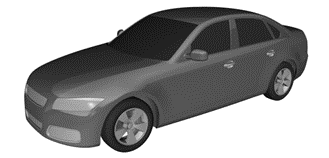
As shown in Figure 1, the multi-GPU solver offers excellent performance and scalability, doubling the number of GPUs almost halves the simulation time on various NVIDIA GPUs. Using the DrivAer for the 4th AutoCFD International Workshop benchmark, a simulation that would once have taken a full day or more can now be run in a matter of hours.
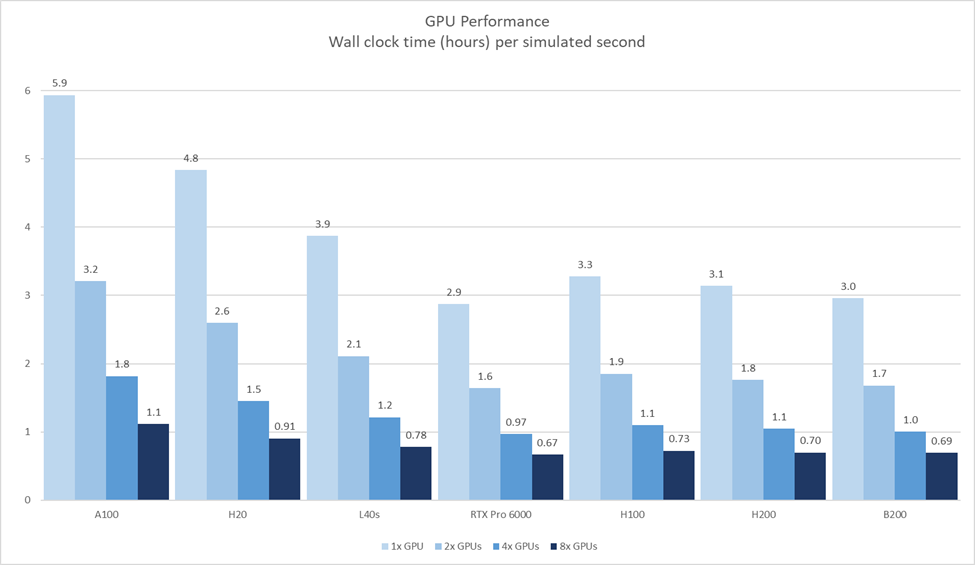
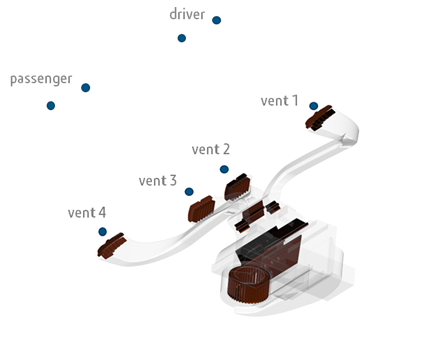
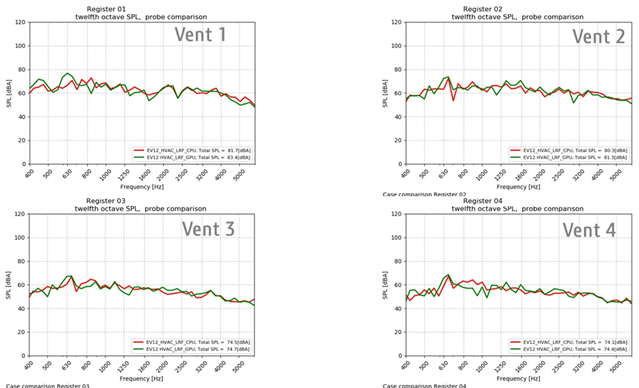
Figure 2 demonstrates the performance of an aeroacoustic simulation of the noise from a car HVAC system. To show how the same simulation can be performed on different hardware, the simulation was run twice – once on a CPU on the SIMULIA Cloud and once on a GPU on a workstation. The averaged results are the same (within the tolerances of the simulation). This means that engineers collaborating between different departments or companies can use the best hardware for them and trust that they will obtain comparable results.
How Does SIMULIA PowerFLOW Integrate with the 3DEXPERIENCE Platform?
High-performance computing is only one aspect of an efficient simulation workflow. As simulation becomes more deeply embedded in product development, organizations also need a collaborative environment that connects engineering teams, manages simulation data, and supports informed decision-making throughout the product lifecycle.
As part of the 3DEXPERIENCE platform, SIMULIA PowerFLOW extends beyond standalone CFD analysis to support connected engineering workflows. Engineers can manage simulation models, results, revisions, and related engineering data within a single collaborative environment, improving coordination across design and simulation teams while maintaining traceability throughout the development process.
The platform also provides flexible deployment options, allowing organizations to run simulations using the computing resources that best fit their needs. Whether using existing CPU-based HPC infrastructure, GPU-enabled systems for accelerated turnaround, or cloud computing resources for additional scalability, PowerFLOW delivers a consistent simulation experience across computing environments.
By bringing design, simulation, and product data together through a MODSIM approach, the 3DEXPERIENCE platform enables teams to evaluate performance earlier, iterate more efficiently, and make engineering decisions using a shared source of product information. This connected workflow improves collaboration, increases simulation productivity, and gives organizations the flexibility to adopt new computing technologies as their engineering requirements evolve.
Which Industries Benefit Most from High-Fidelity CFD with PowerFLOW?
GPU-accelerated PowerFLOW delivers transformative benefits across multiple industries where high-fidelity CFD directly influences performance, safety, and efficiency.
- Automotive: GPU PowerFLOW dramatically accelerates aerodynamics and aeroacoustics simulation, including drag reduction, lift balance, wind noise, and cooling fan noise. High-resolution transient simulations align perfectly with GPU parallelism, enabling engineers to evaluate more design concepts earlier and converge more quickly toward efficiency, comfort, and regulatory targets.
- Aerospace: GPU acceleration enhances turnaround times for high-fidelity aeroacoustics and drag reduction studies, including landing gear noise, high-lift devices, rotor and propeller noise, and wing–body interactions. Faster simulations allow design teams to optimize aerodynamic performance while reducing reliance on costly physical testing.
- Rail Transportation: Large-domain CFD problems, such as slipstream effects, crosswind stability, and pantograph noise, benefit from multi-GPU execution. GPUs efficiently handle transient phenomena over complex geometries, enabling engineers to enhance both safety and passenger comfort.
What Are the Engineering and Business Benefits of PowerFLOW?
Adopting GPU-accelerated PowerFLOW delivers measurable engineering and business value across various sectors. By replacing large CPU-based HPC clusters with multi-GPU servers, organizations can significantly reduce infrastructure costs, simplify IT management, and lower energy consumption while maintaining high-fidelity transient CFD capabilities.
Faster GPU CFD turnaround times enable engineering teams to iterate on designs more frequently, evaluate more concepts, and reduce reliance on costly physical prototypes. Improved predictive accuracy in management CFD enhances confidence in virtual testing and reduces late-stage design risks.
Additionally, performance per watt improvements translate into a more sustainable simulation workflow, minimizing power use and cooling requirements. The combination of multi-GPU scalability, flexible deployment on workstations or cloud GPU instances, and numerical consistency across hardware enables organizations to expand the scope of their simulations without increasing operational complexity.
Ultimately, GPU-accelerated PowerFLOW enables faster, more cost-effective, and more sustainable high-fidelity CFD, providing a strategic competitive advantage by allowing companies to deliver cleaner, quieter, and more advanced products to market sooner.
Why Is SIMULIA PowerFLOW Well Suited for the Future of High-Performance CFD?
GPU-accelerated SIMULIA PowerFLOW represents a transformative leap in how high-fidelity transient CFD is performed across automotive, aerospace, rail, and energy industries. By combining the Lattice Boltzmann Method (LBM) with massively parallel GPU architecture and robust multi-GPU scaling, PowerFLOW® delivers industry-leading accuracy, robustness, and performance while dramatically reducing infrastructure complexity, energy consumption, and IT overhead.
A single multi-GPU workstation or server can now replace entire CPU-based HPC clusters, enabling engineers to run larger, more detailed simulations faster and more cost-effectively. This capability supports broader design exploration, reduces the need for physical prototypes, and increases confidence in engineering decisions, thereby accelerating product development cycles and enhancing CFD ROI.
As simulation demands continue to grow, GPU CFD with PowerFLOW is not just an optimization, it is the foundation for sustainable, scalable, and high-performance CFD workflows, empowering organizations to develop cleaner, quieter, and more advanced products while maintaining a competitive edge.
Further Reading
Frequently Asked Questions
1. What is the difference between the Lattice Boltzmann Method (LBM) and traditional CFD?
LBM models fluid behavior differently from traditional finite-volume methods, making it particularly effective for capturing transient flow phenomena such as aerodynamics, aeroacoustics, and complex wake dynamics.
2. When should I use GPU acceleration for CFD simulations?
GPU acceleration is well suited for computationally intensive CFD workloads where faster turnaround and increased throughput can help accelerate engineering design iterations.
3. Can CFD simulations run on both CPUs and GPUs?
Yes. Many modern CFD solutions, including SIMULIA PowerFLOW, support both CPU- and GPU-based computing environments, allowing organizations to choose the architecture that best fits their workloads and infrastructure.
4. Which industries benefit most from high-fidelity CFD?
High-fidelity CFD is widely used in automotive, aerospace, rail, marine, and energy industries to improve aerodynamic performance, thermal management, aeroacoustics, and overall product efficiency.
5. How can I reduce CFD simulation time without compromising accuracy?
Simulation time can be reduced by selecting the appropriate computing architecture, using scalable HPC resources, efficient solver technologies, and optimizing simulation workflows without sacrificing predictive accuracy.

Interested in the latest in simulation? Looking for advice and best practices? Want to discuss simulation with fellow users and Dassault Systèmes experts? The SIMULIA Community is the place to find the latest resources for SIMULIA software and to collaborate with other users. The key that unlocks the door of innovative thinking and knowledge building, the SIMULIA Community provides you with the tools you need to expand your knowledge, whenever and wherever.
 Rick Shock
Rick Shock is a SIMULIA Transportation & Mobility Industry Process Director.
 Ritu Singh
Ritu Singh is a mechanical engineer from Auburn University, Alabama, with six years of experience. She excelled as a senior design engineer for three years before transitioning to a writer and team lead for three years, specializing in creating accessible content. Currently, Ritu serves as an Advocacy Offer Marketing Specialist in Global Marketing at Dassault Systèmes for the SIMULIA brand, where she combines her engineering acumen with her writing skills to craft compelling marketing content.