
Sagar Rahangdale, Industry Consultant and Solution Architect, Dassault Systèmes
Mine Operations Management (MOM) provides the operational layer that connects physical mining activities with planning, engineering, production and enterprise systems. Its purpose is to establish a consistent virtual representation of what is happening across the mining operation and to connect operational execution with the information required to manage production.
Dassault Systèmes positions MOM within the broader virtual-twin ecosystem of the 3DEXPERIENCE platform. The approach combines operational data integration, digital representation, execution and reconciliation to create a connected environment for managing mine production.
The objective is not simply to collect information. It is to establish a common operational source of truth.
Creating an operational layer
Mining operations generate information at multiple levels.
At the physical level are equipment and industrial systems that perform or measure production activities. These can include loaders, trucks, crushers, conveyors, weighbridges and other operational assets.
At higher levels are geological models, mine-planning applications, engineering systems and business applications that define requirements and expectations.
MOM sits between these worlds.
Its role is to connect information from the physical operation with information about what the organization intends to achieve.
This creates a continuous information chain between physical activity, operational data, production execution and business planning.
Instead of allowing each function to maintain an independent interpretation of production, MOM creates a shared environment in which information can be captured, integrated and made available across operational processes. Mining operations generate information at multiple levels.
At the physical level are equipment and industrial systems that perform or measure production activities. These can include loaders, trucks, crushers, conveyors, weighbridges and other operational assets.
At higher levels are geological models, mine-planning applications, engineering systems and business applications that define requirements and expectations.
MOM sits between these worlds.
Its role is to connect information from the physical operation with information about what the organization intends to achieve.
This creates a continuous information chain between physical activity, operational data, production execution and business planning.
Instead of allowing each function to maintain an independent interpretation of production, MOM creates a shared environment in which information can be captured, integrated and made available across operational processes.
Building a common operational data environment
A mine’s material does not exist digitally in one place.
Information about a particular material movement may originate in a geological model, be associated with equipment movement in a fleet system, be measured by a weighbridge, assessed through laboratory analysis and subsequently reflected in processing and enterprise systems.
The platform can integrate with geological and mine-planning systems, laboratory information systems and Fleet Management Systems. It can also receive information from weighbridges, conveyor systems and industrial historians. GEOVIA Mine Operations supports this connected operational approach.
MOM brings multiple data sources together through seamless integration of various operational systems. The purpose of these integrations is not simply to create a larger database. It is to establish relationships between the different pieces of information.
For example, material movement can be associated with a source and destination, equipment, time, tonnage and material characteristics. These relationships provide the foundation for understanding how material progresses through the operation.
This is what transforms operational data into an operational model.
Representing material as it moves
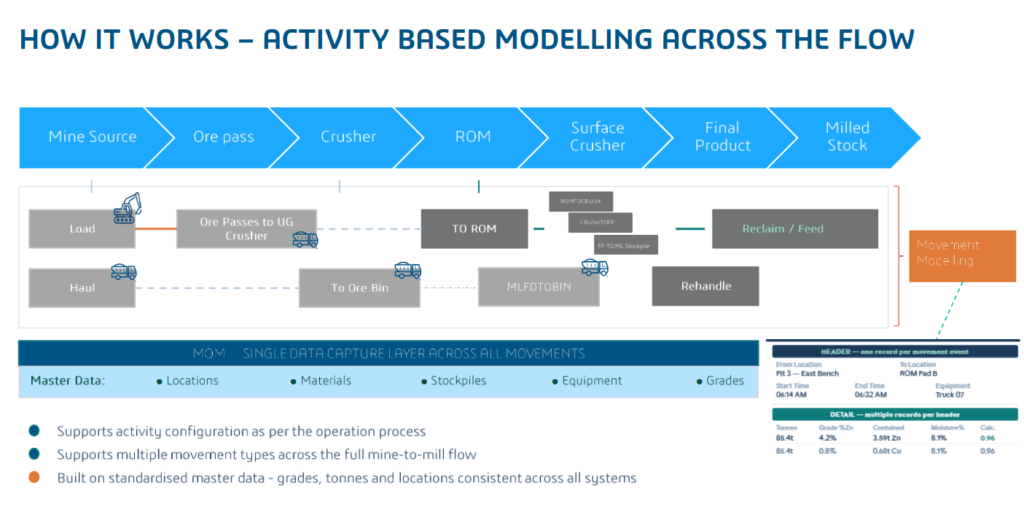
A central capability of MOM is the virtual representation of material movement.
Material can be modelled as progressing through a sequence of operational activities – from its source through loading and hauling to crushing, stockpiling, reclaiming, blending, processing and onward movement.
Each movement becomes an operational event.
The digital record can capture where the material came from, where it went, what equipment was involved, when the movement occurred, how much material was moved and what characteristics were associated with it.
This creates traceability across the production process.
Rather than treating stockpiles simply as static balances, MOM can represent the events that created those balances. It can provide context around material entering and leaving locations and connect those movements with the relevant quality and quantity information.
The result is a more complete digital picture of production.
Connecting planned and actual information
Another fundamental function of MOM is connecting expectation with execution.
Mine planning establishes what is expected to happen. Geological information establishes expected material characteristics. Operational systems record what actually happens.
MOM provides an environment in which these different information sets can be brought together.
Expected grades can be associated with material based on geological master data. Actual measurements can subsequently be incorporated from laboratory systems. Tonnage and movement information can be connected to these characteristics.
This enables organizations to compare planned, expected and actual performance.
The importance of this capability extends beyond reporting. When expected and actual information can be compared within the operational environment, discrepancies become visible sooner and can be investigated while the operation is still progressing.
Supporting stockpile management
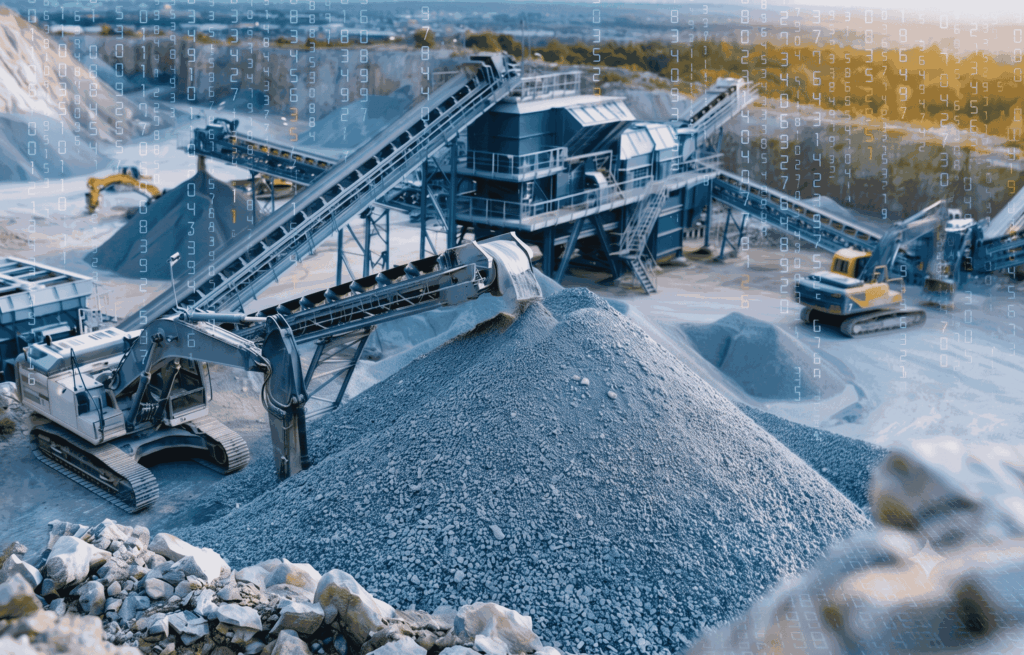
Stockpile management requires more than knowing how much material has accumulated.
Material quantity, location and quality all matter. Volumetric information and assay-grade data need to be considered together to understand the composition and balance of material.
MOM provides a digital environment for bringing these dimensions together.
Material entering a stockpile can be recorded against its source, tonnage and characteristics. Subsequent movements can be captured as material is reclaimed, transferred or blended.
This creates a digital history of the stockpile rather than relying solely on manually maintained balances.
The same information can support downstream reconciliation by providing a traceable relationship between material inputs and outputs.
Enabling reconciliation
Reconciliation is one of the most important operational functions supported by MOM.
A mine needs to establish whether the material that was expected to move actually moved, whether the quantity was consistent with expectations, and whether its characteristics correspond with the available measurements.
When information is distributed across spreadsheets and independent systems, reconciliation can become a periodic and labor-intensive exercise. MOM changes the process by bringing the relevant information into a common environment.
Material inputs and outputs can be tracked across equipment and operational locations. Stockpile information can be monitored using volumetric and assay-grade data. Planned and actual movement can be compared.
This creates the basis for continuous reconciliation.
Instead of discovering discrepancies only at the end of a reporting period, teams can identify deviations earlier. The operational system therefore becomes part of the control loop rather than simply the repository used to explain performance afterwards.
Supporting a single source of operational truth
A major principle behind the MOM approach is to capture information once and make it available to the functions that need it.
In fragmented environments, the same information may be copied between systems, spreadsheets and reports. Each transfer creates an opportunity for delay, inconsistency or error.
A unified operational environment reduces this dependency.
The MOM platform can establish a standardized data model in which information is managed according to defined ownership and business rules. Once captured and validated, information becomes available across the relevant operational processes.
This helps create a common operational view.
The benefit is not simply technical consistency. It changes how teams interact with information. Instead of spending time determining which version of a number is correct, teams can focus on understanding what the information means and what action should follow.
Connecting multiple levels of the operation
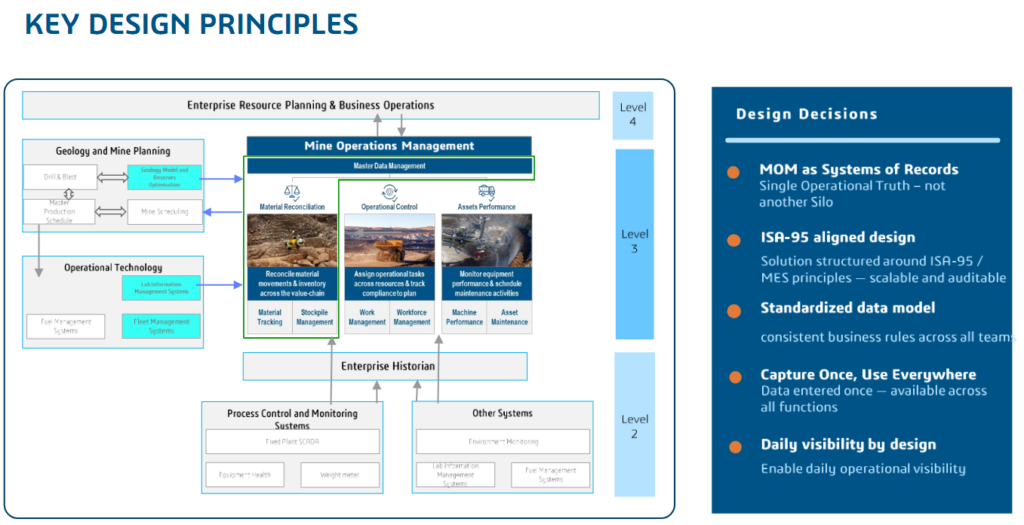
MOM operates as a bridge between operational technology and higher-level applications.
At ISA Level 2, the environment can connect with instrumentation and real-time control solutions. At Level 3, MOM manages and contextualizes operational execution information. At Level 4, it exchanges information with planning, enterprise and other higher-level business applications.
This positioning enables MOM to integrate information across the operational hierarchy.
The physical operation generates data. MOM contextualizes and connects that data. Planning and enterprise systems provide higher-level requirements and business direction.
The resulting architecture supports a more continuous flow of information between what is happening physically and what the organization needs to accomplish.
Moving beyond historical reporting
The immediate value of MOM is operational visibility. Its longer-term potential comes from using that visibility to support prediction and optimization.
Once the organization has a reliable representation of material flow, historical and current information can be used to identify deviations, potential bottlenecks and operational trends.
The digital environment can also provide a basis for evaluating alternative scenarios.
Questions around material sequencing, stockpile priorities, blending, equipment availability, rehandling and downstream production impacts can potentially be explored through models and simulations before changes are made physically.
This is where MOM begins to align closely with the broader concept of virtual-twin experiences.
The virtual representation is not merely a record of the physical operation. It becomes an environment in which relationships can be understood and alternative decisions can be evaluated.
The role of the virtual twin
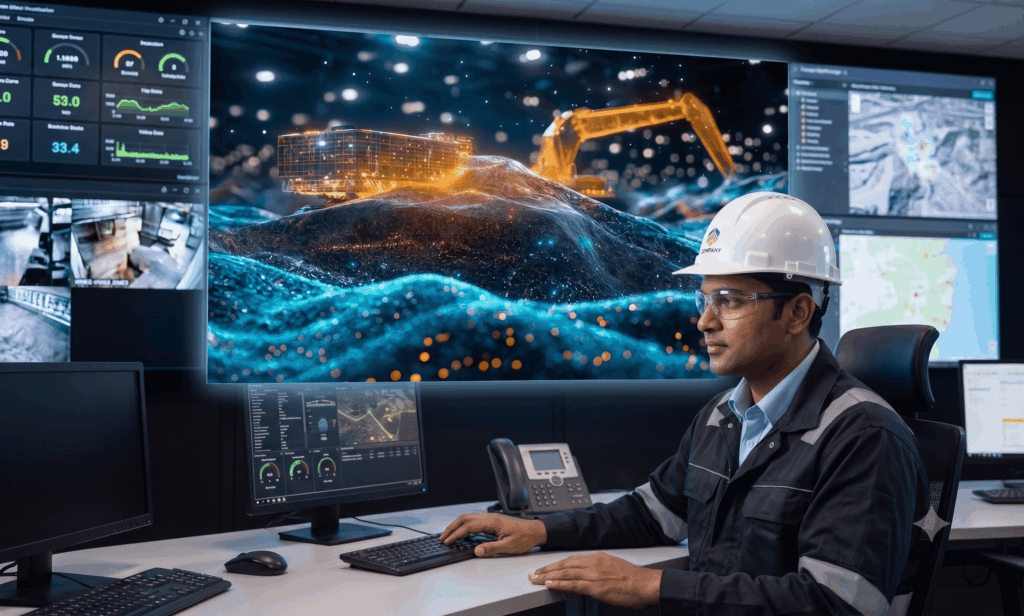
A conventional data platform collects and organizes information. A virtual twin goes further by representing relationships between the physical and digital worlds.
Dassault Systèmes’ 3DEXPERIENCE platform provides collaborative virtual environments for creating virtual-twin experiences of real-world products, processes and systems.
Within this broader environment, MOM can provide the operational representation required to connect production data, material movement, execution and reconciliation.
The progression can be understood in six stages.
First, processes are digitized by replacing paper-based and spreadsheet-driven activities with structured digital records.
Second, operational systems are integrated so that geology, planning, fleet, laboratory, weighing, historian and plant information can contribute to the same environment.
Third, the physical production process is represented digitally.
Fourth, expected and actual material movement, quantity and quality are reconciled.
Fifth, historical and current information can support prediction of potential deviations.
Finally, the digital environment can be used to simulate and optimize alternative operational decisions.
This progression transforms MOM from an information-management capability into a potential decision-support environment.
Establishing the foundations for transformation
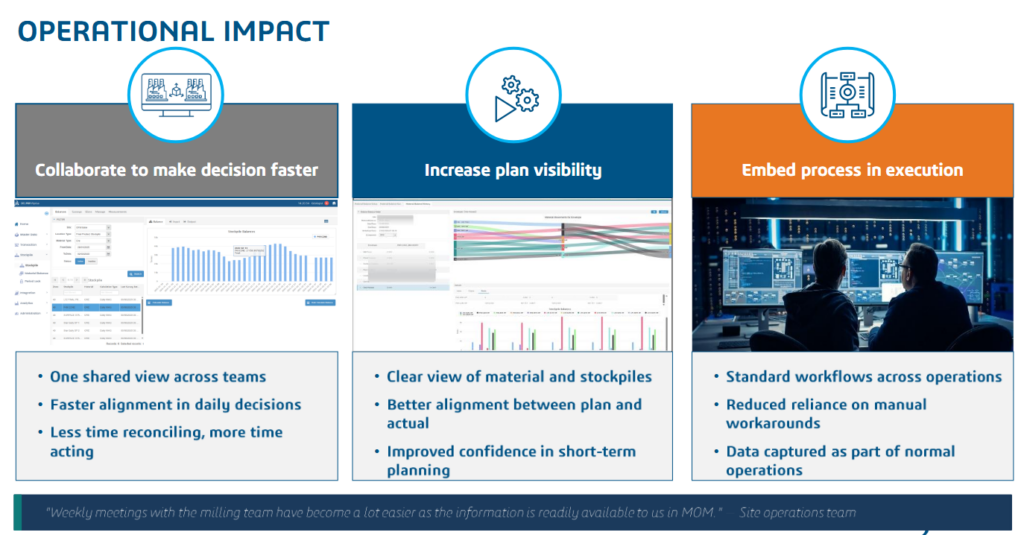
Technology is only one component of MOM implementation.
A virtual operational environment needs clearly defined processes, data ownership and business rules. Different functions must agree on the meaning and ownership of the information being brought into the system.
This is particularly important because digital models reproduce the assumptions and rules that underpin them. If business processes are undefined or departments interpret information differently, those inconsistencies can become embedded in the digital environment.
A structured readiness process is therefore essential.
Organizations need to understand the operational problem they are trying to solve, define requirements and ownership, establish business rules, design and configure the solution, test it with users and then deploy it.
User adoption is equally important. Teams accustomed to spreadsheets and manual processes need confidence that the new system accurately represents the operation and that its information can be trusted.
From system of record to system of decision
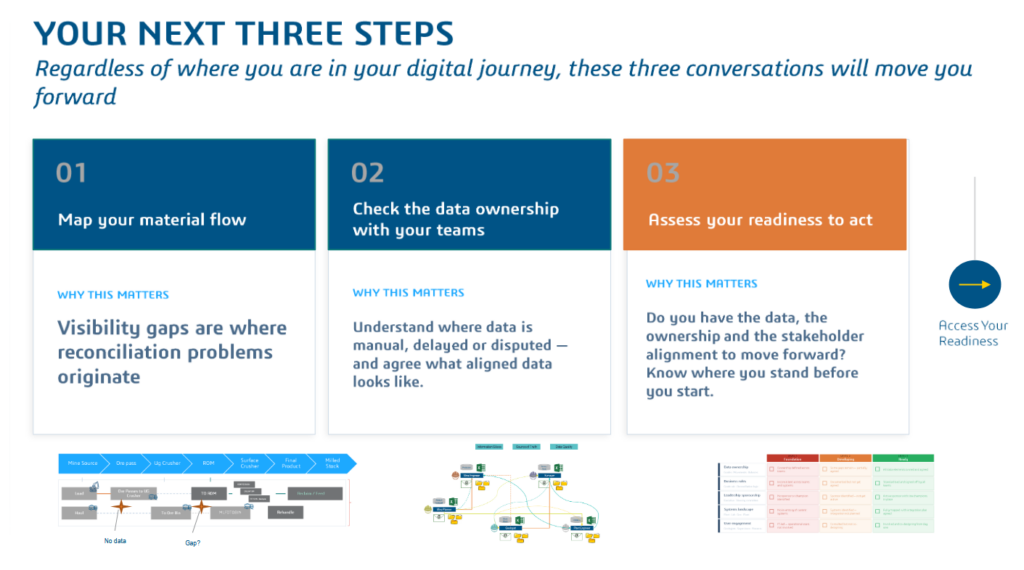
The ultimate purpose of Dassault Systèmes MOM is not simply to provide another application for recording production.
Its role is to establish an operational system of record supported by a standardized data model, integrated information and a common digital representation of material flow.
The foundational progression is straightforward: capture information, connect it, represent the operation, reconcile performance and use the resulting information to improve decisions.
As this virtual foundation matures, MOM can evolve from describing the mine’s operational history towards helping shape its future.
That is the significance of connecting MOM with virtual-twin technologies. The virtual environment can increasingly connect material, equipment, processes, planning and operational information within a coherent model.
The result is a shift from fragmented operational information towards a trusted digital foundation for production execution.
In practical terms, MOM enables the organization to move from “What happened?” towards “What is happening?”, and ultimately towards “What should happen next?”
That progression defines the broader role of Mine Operations Management within a digitally transformed mining operation.
For more information
Learn more about GEOVIA Mine Operations, explore the Mine Operations Management e-book or read more about how virtual twin principles are being applied to mining in How it Works: Transplanting the Manufacturing Virtual Twin Experience to Mining.