
Virtual reality (VR) and augmented reality (AR) are two of the most transformative technologies reshaping the way industries operate today. Though often used interchangeably, they refer to two fundamentally different experiences. Virtual reality immerses users in a fully simulated, computer-generated environment, while augmented reality overlays digital information onto the real world. Understanding the distinction between these two technologies — and how they work together — is essential for any organization looking to drive digital transformation across its operations.
What Is Virtual Reality?
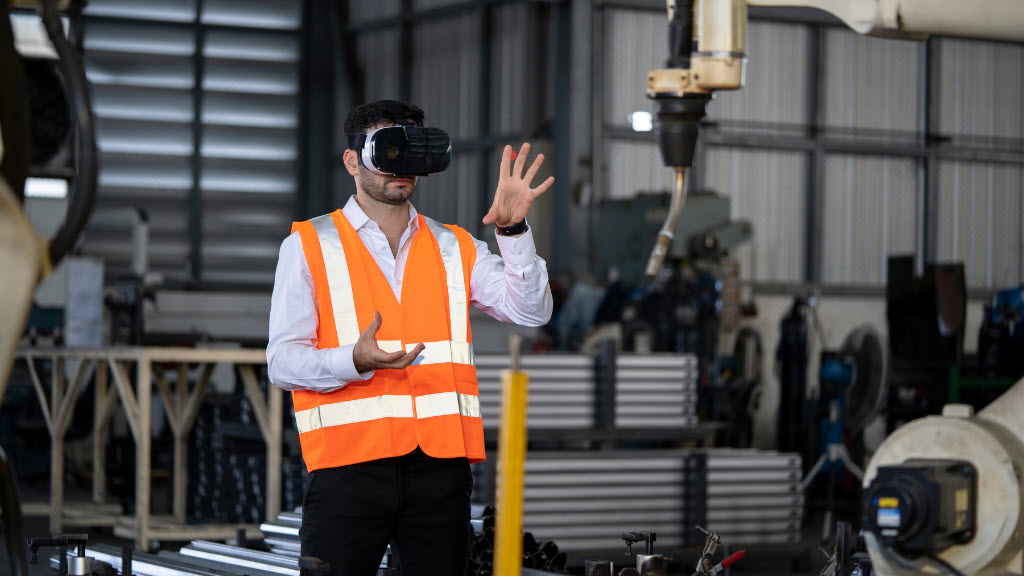
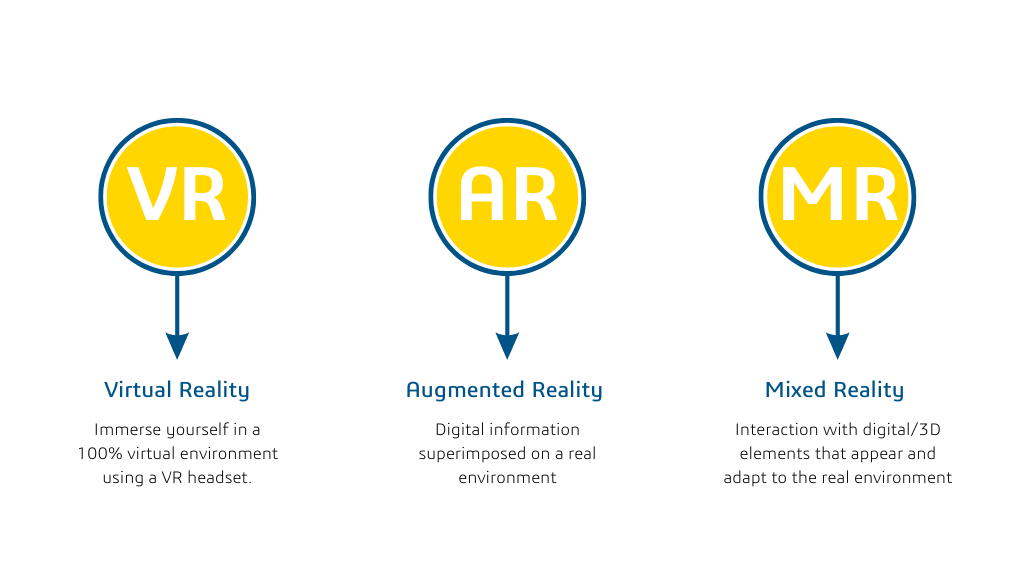
Virtual reality (VR) is a simulated experience that employs 3D head-mounted displays and pose tracking to give the user an immersive feel of a virtual world. In a VR environment, users are completely cut off from the physical world and placed inside a fully computer-generated space where they can move, interact and explore as if it were real.
In industry, VR technology is widely used for worker training, product design and simulation. It enables engineers to visualize virtual prototypes before physical production, and allows operators to practice complex or hazardous procedures in a safe, controlled environment. In sectors such as Transportation & Mobility, Aerospace & Defense and Industrial Equipment, the ability to simulate work environments without real-world risk translates directly into safer operations and faster onboarding. VR typically requires a dedicated headset equipped with sensors that track head and body movements, making it a more hardware-intensive solution compared to AR.
What Is Augmented Reality?
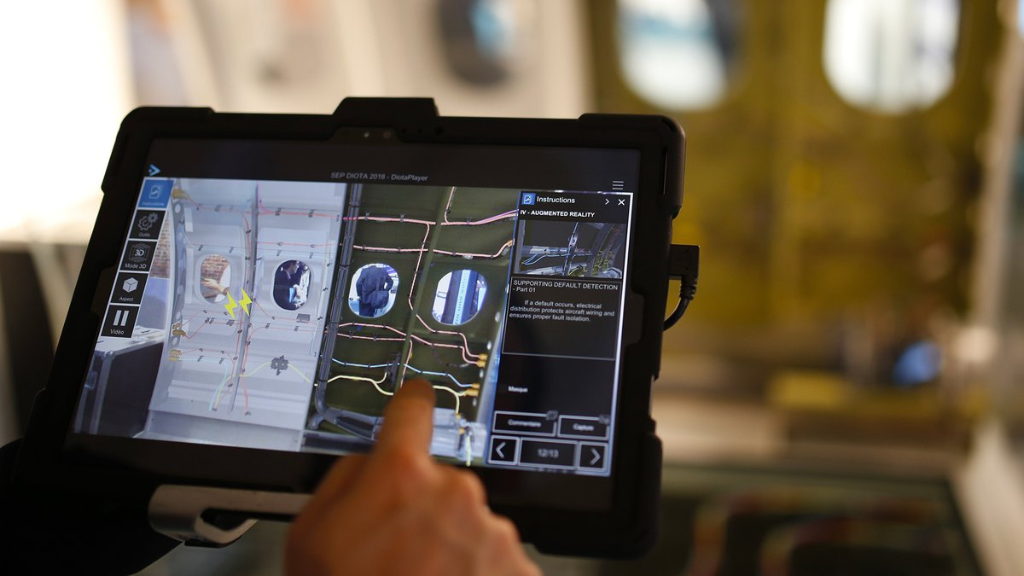
Augmented reality (AR) is a technology that overlays digital information — including images, text, 3D models, sounds and contextual data — onto the real world in real time. Rather than replacing the user’s environment, AR enhances it, providing interactive digital instructions that blend the virtual and physical worlds seamlessly.
AR can be accessed through a variety of devices, including smartphones, tablets, smart glasses, cameras and projection systems, making it far more accessible than VR in many operational settings. On the manufacturing shop floor, AR guides operators through assembly tasks, quality inspections and maintenance procedures by displaying step-by-step digital instructions in the worker’s actual field of view. This capability is especially powerful in industries such as Life Sciences & Healthcare, Architecture, Engineering & Construction and Home & Lifestyle, where precision and real-time guidance are critical to performance.
What Is the Difference Between Virtual Reality and Augmented Reality?
The main difference between virtual reality and augmented reality lies in how users interact with their environment. In VR, the user is fully immersed in a computer-generated world, completely isolated from physical surroundings. In AR, the user remains grounded in the real world, with virtual elements layered on top of it.
A second key distinction is hardware. VR requires a specific headset equipped with sensors to track head movements, while AR can function through a simple smartphone or tablet. In terms of industrial applications, VR is most commonly used for training and simulation, while AR is primarily deployed for operator guidance during live execution processes, including assembly, maintenance and quality control.
A third technology — Mixed Reality (MR) — sits between the two. MR combines AR and VR concepts to create environments where users interact with both virtual and physical objects simultaneously. Unlike standard AR, MR establishes a more significant interaction between digital content and physical space, enabling virtual content to conform precisely to real-world geometry.
| Technology | Immersion Level | Hardware Needed | Primary Industrial Use |
| Virtual Reality (VR) | Full | VR headset | Training & simulation |
| Augmented Reality (AR) | Partial | Smartphone, tablet, smart glasses | Operator guidance, quality control |
| Mixed Reality (MR) | Hybrid | MR headset | Complex interactive environments |
VR and AR: Key Applications Across Industries
Both AR and VR serve as powerful tools across a wide range of industries, each unlocking distinct operational benefits.
In Transportation & Mobility, VR enables engineers to design and evaluate vehicle components in an immersive virtual environment before any physical prototype is built, dramatically reducing development cycles. AR, meanwhile, guides technicians through complex maintenance procedures on the assembly line, ensuring first-time-right quality and minimizing costly rework.
In Aerospace & Defense, the stakes of training are extraordinarily high. VR provides a risk-free environment to simulate complex flight operations, machinery repairs and emergency procedures. AR complements this by projecting real-time technical data onto aircraft components during maintenance, guiding technicians with precision at every step.
In Life Sciences & Healthcare, AR allows medical professionals and device manufacturers to visualize and validate complex procedures by overlaying digital guidance onto real-world environments, supporting compliance and reducing human error. VR is increasingly used for surgical simulation and medical device training.
In Industrial Equipment and Infrastructure, Energy & Materials, AR and VR are deployed to accelerate onboarding, reduce downtime and support the growing complexity of modern manufacturing operations. Workers trained in VR environments transition seamlessly to AR-guided shop floor execution, creating a continuous and powerful learning loop.
How DELMIA Leverages Virtual Reality and Augmented Reality
DELMIA Augmented Experience is Dassault Systèmes’ industrial AR solution, purpose-built to optimize manufacturing operations through real-time digital guidance. By integrating AR into production and maintenance workflows, DELMIA helps manufacturers achieve measurable gains in quality, productivity and workforce capability.
DELMIA solutions leverage AR to guide operators through assembly tasks — from the drilling of large structural panels and positioning of brackets to the routing of cables and paint masking activities. The results are significant: customers using DELMIA Augmented Experience have reported up to 84% reduction in inspection time, a direct reflection of how AR-powered operator guidance eliminates guesswork and reduces non-conformities on the shop floor.
On the VR side, DELMIA provides immersive training capabilities that allow workers to practice operations in a simulated environment before setting foot on the factory floor. This approach — often referred to as “door-to-floor” training — accelerates skill development, helps organizations address the manufacturing labor shortage and ensures that new employees reach operational proficiency faster and more safely.
The combination of AR and VR within the 3DEXPERIENCE platform creates a powerful Extended Reality (XR) continuum. VR is used to define, validate and train on processes; AR then operationalizes those same processes on the shop floor, using the same 3D virtual models as a shared foundation. This closed-loop approach streamlines digital transformation and reinforces the connection between engineering and operations.
What Are Some Examples of AR, VR and MR?
Augmented reality examples in manufacturing include AR-guided assembly operations where operators receive digital overlays on tablets or smart glasses, showing exactly where to place a bracket, rivet or cable. DELMIA Augmented Experience brings this to life in complex production environments across Aerospace & Defense, Transportation & Mobility and Industrial Equipment.
Virtual reality examples include fully immersive training environments where workers simulate operating heavy machinery, responding to equipment failures or learning new production processes — all without interrupting live operations or exposing new hires to real-world risk.
Mixed reality creates environments where physical and digital objects coexist. An MR-equipped technician can, for example, interact with a virtual 3D model of a machine component overlaid on the actual equipment in front of them, manipulating both the real and the digital simultaneously.
Experience the Real-World Value of Virtual Reality and Augmented Reality
Manufacturers across sectors are already unlocking the transformative potential of AR and VR with DELMIA solutions.
Empowering the Manufacturing Workforce: Organizations facing the global manufacturing labor shortage have turned to AR/VR technologies to accelerate workforce development. By using VR for immersive onboarding and AR for guided shop floor execution, companies are closing the skills gap left by retiring workers and improving retention among new hires. Read more about empowering manufacturing teams with AR/VR →
Revolutionizing Manufacturing with Extended Reality: In Industrial Equipment, manufacturers are using DELMIA’s Extended Reality capabilities to streamline design reviews, complex assembly operations and maintenance workflows. XR enables immersive, scale-1 collaboration among engineering and operations teams, reducing the reliance on physical prototypes and accelerating time to production. Read more about Extended Reality in manufacturing →
Six Proven Benefits of AR in Industry: From training and assembly guidance to quality control and maintenance, companies integrating DELMIA Augmented Experience have demonstrated measurable improvements in throughput, accuracy and operator autonomy. Discover the six benefits of AR in industry →
For more customer stories, visit 3ds.com/insights/customer-stories.
Frequently Asked Questions
The core difference lies in the user’s relationship to the real world. Augmented reality (AR) keeps the user in their physical environment and layers digital information on top of it, while virtual reality (VR) replaces the real world entirely with a computer-generated simulation. AR users can control their presence in the real world; VR users are fully controlled by the system.
Virtual reality (VR) is a simulated, computer-generated experience delivered through a head-mounted display and pose-tracking technology. It creates a fully immersive environment in which users can interact with virtual objects and move naturally, as if in a real physical space.
Augmented reality (AR) is a technology that overlays digital content — including 3D models, text and contextual data — onto the real-world environment in real time. AR can be experienced through smartphones, tablets, smart glasses or projection systems, making it highly versatile for both consumer and industrial applications.
Neither is universally better — each serves different purposes. VR provides full immersion, making it ideal for training simulations where isolating the user from distractions is critical. AR offers partial immersion, allowing users to remain present in their real environment while receiving digital guidance, which makes it better suited for live operational tasks such as assembly, maintenance and quality inspection.
Mixed Reality (MR) sits between AR and VR on the extended reality spectrum. It integrates virtual and physical elements into a single interactive environment, where digital content conforms to and interacts with real-world objects. MR headsets are capable of identifying hands, walls, tables and other physical elements, enabling a richer level of interaction than standard AR.
AR/VR training systems use digital media to enhance or simulate training scenarios. VR training systems immerse workers in a fully virtual version of their work environment, allowing them to practice complex tasks safely before entering a live operation. AR training systems superimpose step-by-step digital instructions over the user’s real-world view, guiding them through procedures in context. DELMIA solutions offer both, enabling a seamless transition from immersive VR training to AR-guided execution on the shop floor.
The first virtual simulator — called The Sensorama — was developed in 1957 by American filmmaker and inventor Morton Heilig. The first VR/AR headset in history was created by Harvard Professor Ivan Sutherland and his student Bob Sproull in 1968. Since then, both technologies have evolved rapidly, moving from research labs into mainstream industrial applications.
Both AR and VR introduce learners to immersive digital experiences that cannot be replicated through traditional teaching methods. VR allows students and workers to engage with environments and procedures they would otherwise never encounter, while AR provides real-time contextual guidance that supports learning at the point of task execution. Together, they enable a more personalized, effective and scalable approach to workforce development across industries.
To learn more about DELMIA’s augmented and virtual reality solutions for manufacturing, contact our experts or explore DELMIA Augmented Experience.

DELMIA Strategic Business Development and Marketing Director, DELMIA Marketing