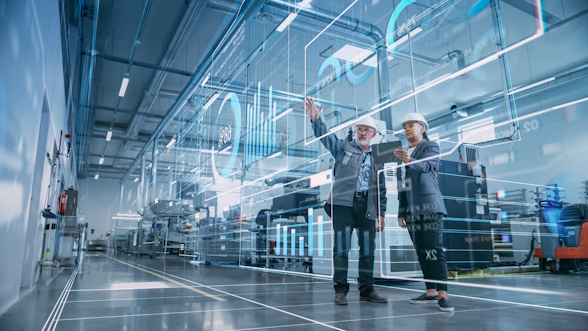
Artificial intelligence (AI) is fundamentally reshaping the manufacturing sector. By integrating intelligent systems into production lines and supply chains, companies are unlocking unprecedented levels of efficiency, precision and innovation. This evolution goes beyond simple automation, introducing systems that learn, adapt and predict outcomes. The result is a smarter, more resilient and more sustainable manufacturing landscape.
This article identifies five key areas where AI is making a significant impact, then goes further to cover the broader use cases, benefits and challenges manufacturers are navigating today. We’ll examine how these technologies drive cost savings, improve product quality and create more efficient manufacturing operations — from predicting equipment failure to optimizing energy consumption, AI is a powerful force for industrial transformation.
What Is AI in Manufacturing?
AI in manufacturing applies technologies including machine learning, generative AI and agentic AI to industrial data, models and knowledge to improve analysis, decision-making and execution. Unlike general-purpose AI, Industrial AI can operate in the context of products, processes, production systems and supply chains, helping manufacturers predict outcomes, explore alternatives and take informed action. .
A commonly cited AI use case in manufacturing is predictive maintenance, but the applications extend far beyond it: AI enables manufacturers to offer mass customization, allowing products to be tailored to individual customer preferences without slowing down the line, and it increasingly touches nearly every stage of production, from initial design to final quality inspection.
Why AI Matters Now: Industry 4.0 and the Data Explosion
AI is crucial to the concept of “Industry 4.0” — the trend toward greater automation in manufacturing settings and the massive generation and transmission of data on the factory floor. In essence, the Fourth Industrial Revolution is the trend toward automation and data exchange in manufacturing technologies and processes, encompassing cyber-physical systems, the Internet of Things (IoT), cloud computing, cognitive computing and artificial intelligence together.
Industrial IoT and smart factories now generate large amounts of data every single day — from vibration sensors on a motor to cameras watching a weld seam. That volume is exactly why AI has become necessary rather than optional: it’s the only practical way to turn that firehose of sensor data into decisions a human can act on in real time.
1. Predictive Maintenance: Preventing Failures Before They Happen
Unexpected equipment failure is a primary cause of costly downtime in manufacturing. Traditional maintenance schedules, based on fixed intervals, often result in servicing equipment too early or too late. Predictive maintenance, powered by AI, offers a more intelligent solution. It uses machine learning algorithms to analyze data from sensors on equipment, identifying subtle patterns that signal an impending failure.
By monitoring variables like temperature, vibration and performance metrics, AI can predict when a component is likely to fail. This allows maintenance teams to intervene proactively, scheduling repairs during planned downtime and avoiding catastrophic failures. This data-driven approach significantly reduces unplanned operational stoppages, extends the lifespan of expensive equipment and lowers overall maintenance costs. The shift is from a preventive “maintain it on a fixed schedule” and reactive “fix it when it breaks” model to a predictive, strategic one that optimizes maintenance time and effort and minimizes equipment failures.
Some manufacturers take this further by using a digital twin — a virtual model kept in sync with real-time sensor data — to assess patterns in equipment behavior and performance. These systems can alert operators about potential issues early, allowing them to prevent breakdowns before they escalate. Automobile manufacturers, for example, widely employ predictive maintenance on assembly-line robots, significantly reducing unplanned downtime and resulting in substantial cost savings.
2. Process Optimization: Enhancing Quality and Throughput
Achieving peak efficiency on the production line requires constant monitoring and adjustment. AI excels at this complex task by analyzing vast datasets from the manufacturing process in real time. Machine learning models can identify bottlenecks, inefficiencies and deviations from optimal parameters that might be invisible to human operators.
For instance, in precision manufacturing, AI can analyze images captured by cameras on the production line to detect microscopic defects in products, thereby ensuring higher quality control standards. In chemical production, algorithms can adjust ingredient mixtures or temperature settings to maximize yield and minimize waste. Food and beverage manufacturers similarly use AI-powered systems to track ingredient usage in real time.
By continually learning from production data, AI systems refine processes to achieve greater speed, consistency and quality, leading to higher throughput and reduced operational expenses. Another example is generative AI in machining, where AI can “learn” from machining history and automatically generate NC machining programs based on the starting dimensions of the raw material and the 3D model of the part to be machined, helping to address the increasingly critical shortage of skilled workers in manufacturing. Similar AI capabilities can be applied in additive manufacturing and in electronics manufacturing, intelligent detection systems powered by machine learning are already being used to reduce preparation time in tasks like PCB layer identification.
3. Intelligent Automation and Robotics
Automation in manufacturing is not new, but AI is making it smarter and more flexible. Traditional industrial robots are programmed to perform a single, repetitive task with high precision. AI-powered robots, or “cobots” (collaborative robots), are different. They can perceive their environment, make decisions and work safely alongside human employees.
Equipped with advanced sensors and machine vision, these robots can handle more complex and varied tasks, such as assembling intricate products or sorting mixed items. They learn from experience, improving their performance over time. This new generation of automation enables manufacturers to adapt quickly to changes in product design or demand, resulting in more agile production lines. It also frees human workers from dangerous or monotonous tasks, allowing them to focus on more creative and strategic responsibilities.
This capability can be extended into the virtual world using generative AI. For manufacturers that need to relocate a production line, add a new line, or even build a new plant, a virtual model can be created based on a point cloud generated by scanning the existing facility. AI can then be used to identify specific robots in the point cloud and replace them with precise 3D engineering models of those robots. The robots can then be moved, reprogrammed and tested virtually to ensure optimum performance before the physical line or plant is set up. This can save significant time and cost.
4. AI-Driven Inventory Management
Effective inventory management is a delicate balance. Too much stock ties up capital and increases storage costs, while too little risks production delays and lost sales. AI is revolutionizing this area by providing highly accurate demand forecasting. Machine learning algorithms analyze historical sales data, market trends, supply chain disruptions and even weather patterns to predict future demand with remarkable precision.
This allows companies to optimize their stock levels and supply plans, ensuring they have the right parts and products at the right time. AI-powered systems can also automate the reordering process, triggering purchase orders based on a combination of stock levels, production activity and demand plans. The result is a leaner, more responsive supply chain that minimizes waste, reduces carrying costs and improves cash flow.
Within a digital factory twin, AI can go a step further — dynamically adjusting inventory levels, optimizing throughput time and fine-tuning buffer sizes across an entire production system, not just a single warehouse. This capability helps avoid potential production bottlenecks and reduces waste from overstocking, while still ensuring manufacturers have the right materials at the right time.
5. Energy Consumption Optimization
Energy is one of the largest operational costs for many manufacturers. AI offers a powerful tool for reducing this expense and improving sustainability. By analyzing data from plant-wide sensors, AI systems can build a comprehensive model of a facility’s energy usage. This model can identify equipment, processes and times of day that consume the most power.
With this insight, machine learning algorithms can recommend or even automate adjustments to optimize energy consumption. This could involve shutting down non-essential machinery during periods of low production, adjusting HVAC systems based on real-time occupancy and weather conditions, or optimizing machine settings to run at their most energy-efficient levels. These incremental improvements can lead to substantial cost savings and a significant reduction in a company’s carbon footprint — combining material, process and equipment data to suggest ways to reduce energy costs, optimize labor and improve reliability across the operation as a whole.
More Ways AI Is Reshaping the Factory Floor
Beyond the five core areas above, AI is showing up in a growing list of more specialized manufacturing use cases.
- Generative design: AI-driven generative design technology explores a wide array of design options based on parameters such as materials and manufacturing constraints, giving engineers a starting point that would take far longer to reach manually.
- Agentic AI: rather than simply answering questions or flagging anomalies, agentic AI can reason across multi-step workflows, coordinate actions and help automate tasks such as maintenance scheduling, quality workflows and supply chain adjustments, while operating within defined rules and appropriate human oversight.
- Electronics and semiconductor manufacturing: AI-driven automation reduces repetitive tasks for CNC programmers and accelerates programming for complex parts, while agentic AI is increasingly used to manage decision-heavy workflows across the fab.
- Aerospace, pharmaceutical and automotive manufacturing: sector-specific applications range from predictive maintenance on assembly-line robots in automotive plants to optimizing maintenance schedules and automating quality checks in pharmaceutical production.
- AI video analytics: cameras and trackers monitoring the manufacturing process, paired with AI models for advanced analytics, can catch quality and safety issues that a human watching a live feed would likely miss.
- Augmented and virtual reality: AR and VR enable in-depth problem-solving by displaying complex process or quality data in immersive new ways, often layered directly onto the physical equipment a technician is looking at.
- Virtual Companions and generative AI assistants: natural-language interfaces can make Industrial AI accessible across the workforce, allowing users to interact with manufacturing knowledge and operational information in the context of their work. More advanced virtual companions can also assist with actions, helping employees resolve issues, build skills and accelerate complex tasks.
Benefits of AI in Manufacturing
Across these use cases, a consistent set of benefits keeps showing up in manufacturer results.
- Innovation and competitive advantage: with faster prototyping, generative design and digital twin simulations, AI empowers manufacturers to innovate quickly and efficiently.
- Cost reduction: by applying AI to manufacturing data, companies can better predict and prevent machine failure, cutting both maintenance and downtime costs.
- Flexibility: AI-powered systems can be easily and quickly adjusted if designs change or to accommodate order customization, without the retooling delay traditional automation requires.
- Sustainability: AI’s ability to optimize resource allocation, reduce energy use and limit waste contributes directly to more environmentally friendly manufacturing practices.
- Workforce empowerment: by providing data-derived insights and advanced analytics, AI helps human workers make informed decisions faster and more confidently — and existing employees can use AI-enabled learning and development tools to build new skills rather than being displaced by the technology.
- Supply chain agility: AI optimizes supply chains by analyzing vast datasets to predict demand, manage inventory and streamline logistics, strengthening resilience against disruption.
The Size of the Opportunity
The market reflects how quickly this shift is happening. According to Markets and Markets, the value of AI in manufacturing is projected to reach roughly $20 billion within the next few years, growing at a pace well above the broader industrial software market. That growth is being driven less by novelty and more by measurable results: predictive maintenance programs consistently reduce unplanned downtime, and quality-inspection systems built on computer vision routinely catch defects that human inspectors miss on a fast-moving line.
Despite that momentum, adoption still varies significantly by company size and sector. Larger manufacturers with more mature data infrastructure tend to move faster, while smaller manufacturers are more likely to start with a single, narrowly scoped use case — often predictive maintenance or inventory forecasting — before expanding further. Even with that adoption lag in parts of the industry, the broader trend is unmistakable: manufacturing as a whole is likely to continue embracing artificial intelligence, not retreat from it.
Common Challenges When Implementing AI in Manufacturing
AI’s applications in manufacturing are diverse and ever-evolving, but adoption is not without real obstacles.
- Cybersecurity concerns: AI integration increases digital connectivity across the plant, opening more potential points for cyberattacks that need to be actively managed.
- Data integration: many manufacturers still run data in silos across MES, ERP and legacy shop-floor systems; comprehensive business platforms can help handle this integration, but it rarely happens automatically.
- • Trust, governance and intellectual property: manufacturing AI may operate on some of a company’s most valuable knowledge, including product definitions, manufacturing methods and process history. Organizations therefore need clear governance over how AI accesses and uses that information, along with traceability, security and appropriate human oversight.
- Skill gaps: research from MIT Sloan Executive Education has observed that the majority of companies exploring Industry 4.0 either struggle to reach their objectives or fail to do so outright, often because the skill set needed to implement and sustain AI initiatives hasn’t been built internally.
- Scaling beyond the pilot: many AI projects prove value in a single line or plant but struggle to scale, since the concept’s full potential depends on further advances in automation, modular design and data integration to become a mainstream, repeatable solution.
None of these challenges are reasons to avoid AI adoption — they’re simply what separates manufacturers who see a lasting return from those who stall after an initial pilot. A forward-thinking factory can find an AI application for every important job, but only if the underlying data foundation and workforce skills are built deliberately alongside the technology itself.
How to Get Started with AI in Manufacturing
Manufacturers who see lasting results rarely try to deploy AI everywhere at once. A staged approach tends to work far better.
- Pick one decision-heavy, data-rich process. Predictive maintenance on a single critical machine, or defect detection on one production line, are common starting points because the value is easy to measure.
- Audit the data you already have. Sensor feeds, quality logs and MES records are often more usable than teams expect, once someone has actually gone looking for them and checked their quality.
- Run a contained pilot with a clear success metric. Downtime avoided, defects caught earlier, or hours saved on programming are all concrete, defensible numbers to bring back to leadership.
- Bring operators into the rollout, not just IT. The people who will act on an AI system’s alerts need to trust it, which means involving them while the system is being tuned, not after it’s already live.
- Scale deliberately. Once a pilot proves its value, expand using a common platform, governed data and reusable models and knowledge, rather than recreating the solution for every line or plant.
This sequence mirrors how successful digital transformation efforts play out more broadly: start narrow, prove the value with real numbers, and only then invest in the platform and skills needed to scale across the wider operation.
The Future of Manufacturing Is Intelligent
The integration of artificial intelligence is not a distant concept; it is a present-day reality that is delivering tangible benefits. From predictive maintenance that reduces unplanned downtime to intelligent robotics that enhance human capabilities, AI is fostering a new era of industrial productivity.
The next step is not simply adding more AI to manufacturing. It is applying AI in the context of trusted industrial knowledge, models, simulation and real-world operations. That combination can turn AI from a general-purpose technology into Industrial AI capable of helping manufacturers understand what is happening, explore what could happen next and act with greater confidence.
Frequently Asked Questions
AI in manufacturing is the use of machine learning solutions and deep learning neural networks to optimize manufacturing processes through improved data analysis and decision-making. The most commonly cited use case is predictive maintenance, but AI is also widely used for process optimization, quality inspection, intelligent robotics, inventory forecasting and energy management.
AI in manufacturing refers to intelligent systems — built on machine learning and, increasingly, generative and agentic AI — that are integrated into production lines and supply chains to improve efficiency, quality and decision-making. It goes beyond traditional automation by learning from data, adapting to change and predicting outcomes rather than following fixed rules.
Most successful electronics manufacturing AI programs start by identifying decision-heavy workflows — such as quality inspection, CNC programming or fab scheduling — mapping the data available for that workflow, running a contained pilot, and only then expanding to agentic AI capabilities that can manage more of the process autonomously once the data foundation and results are proven.
AI-powered robots, or cobots, increase efficiency by taking over repetitive tasks, reducing human error and optimizing workflows, while working safely alongside human employees rather than behind a safety cage. Because they can perceive their environment and learn from experience, they also make production lines more agile when a product design or order mix changes.
AI enhances manufacturers’ ability to analyze data, predict outcomes and automate processes — all of which can improve efficiency, reduce costs and enable innovation at an unprecedented pace. Its applications are diverse and continually evolving, though implementing it well requires addressing real challenges around data integration, cybersecurity and workforce skills.
By enhancing manufacturing processes, generative AI can reduce downtime, improve output, realize cost savings and boost end-user satisfaction. Concrete examples include generating NC machining programs directly from a part’s 3D model, exploring design options based on material and manufacturing constraints, and building virtual factory models from a scanned point cloud to test line changes before they happen physically.
AI in manufacturing is linked with the Fourth Industrial Revolution, or Industry 4.0 — the trend toward automation and data exchange in manufacturing technologies and processes, which includes cyber-physical systems, the Internet of Things, cloud computing, cognitive computing and artificial intelligence working together.
Additional Resources

Director of Strategic Business Development for the DELMIA brand at Dassault Systèmes since 2021. Responsible for developing new and innovative business markets and reinforcing the company position as an innovative leader in the Transportation & Mobility and Industrial Equipment industries.