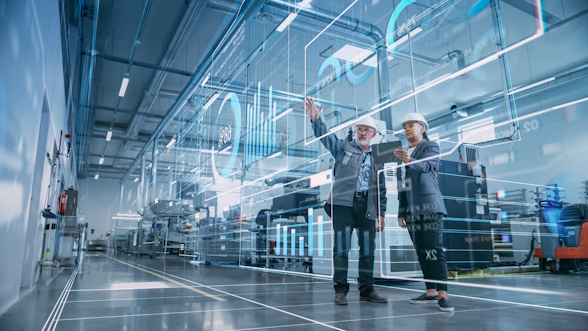
Artificial intelligence (AI) is fundamentally reshaping the manufacturing sector. By integrating intelligent systems into production lines and supply chains, companies are unlocking unprecedented levels of efficiency, precision and innovation. This evolution goes beyond simple automation, introducing systems that learn, adapt and predict outcomes. The result is a smarter, more resilient and more sustainable manufacturing landscape.
This blog identifies five key areas where AI is making a significant impact. We will examine how these technologies drive cost savings, improve product quality and create more efficient manufacturing operations. From predicting equipment failure to optimizing energy consumption, AI is a powerful force for industrial transformation.
1. Predictive Maintenance: Preventing Failures Before They Happen
Unexpected equipment failure is a primary cause of costly downtime in manufacturing. Traditional maintenance schedules, based on fixed intervals, often result in servicing equipment too early or too late. Predictive maintenance, powered by AI, offers a more intelligent solution. It uses machine learning algorithms to analyze data from sensors on equipment, identifying subtle patterns that signal an impending failure.
By monitoring variables like temperature, vibration and performance metrics, AI can predict when a component is likely to fail. This allows maintenance teams to intervene proactively, scheduling repairs during planned downtime and avoiding catastrophic failures. This data-driven approach significantly reduces unplanned operational stoppages, extends the lifespan of expensive equipment and lowers overall maintenance costs. The shift is from a preventive “maintain it on a fixed schedule” and reactive “fix it when it breaks” model to a predictive, strategic one that optimizes maintenance time and effort and minimizes equipment failures.
2. Process Optimization: Enhancing Quality and Throughput
Achieving peak efficiency on the production line requires constant monitoring and adjustment. AI excels at this complex task by analyzing vast datasets from the manufacturing process in real time. Machine learning models can identify bottlenecks, inefficiencies and deviations from optimal parameters that might be invisible to human operators.
For instance, in precision manufacturing, AI can analyze images captured by cameras on the production line to detect microscopic defects in products, thereby ensuring higher quality control standards. In chemical production, algorithms can adjust ingredient mixtures or temperature settings to maximize yield and minimize waste. By continually learning from production data, AI systems refine processes to achieve greater speed, consistency and quality, leading to higher throughput and reduced operational expenses. Another example is generative AI in machining, where AI can “learn” from machining history and automatically generate NC machining programs based on the starting dimensions of the raw material and the 3D model of the part to be machined, helping to address the increasing critical shortage of skilled workers in manufacturing. Similar AI capabilities can be applied in additive manufacturing.
3. Intelligent Automation and Robotics
Automation in manufacturing is not new, but AI is making it smarter and more flexible. Traditional industrial robots are programmed to perform a single, repetitive task with high precision. AI-powered robots, or “cobots” (collaborative robots), are different. They can perceive their environment, make decisions and work safely alongside human employees.
Equipped with advanced sensors and machine vision, these robots can handle more complex and varied tasks, such as assembling intricate products or sorting mixed items. They learn from experience, improving their performance over time. This new generation of automation enables manufacturers to adapt quickly to changes in product design or demand, resulting in more agile production lines. It also frees human workers from dangerous or monotonous tasks, allowing them to focus on more creative and strategic responsibilities. This capability can be extended into the virtual world using generative AI. For manufacturers that need to relocate a production line, add a new line, or even build a new plant, a virtual model can be created based on a point cloud generated by scanning the existing facility. AI can then be used to identify specific robots in the point cloud and replace them with 100% accurate 3D models of these robots. The robots can then be moved, reprogrammed and tested virtually to ensure optimum performance before the physical line or plant is set up. This can save significant time and cost.
4. AI-Driven Inventory Management
Effective inventory management is a delicate balance. Too much stock ties up capital and increases storage costs, while too little risks production delays and lost sales. AI is revolutionizing this area by providing highly accurate demand forecasting. Machine learning algorithms analyze historical sales data, market trends, supply chain disruptions and even weather patterns to predict future demand with remarkable precision.
This allows companies to optimize their stock levels and supply plans, ensuring they have the right parts and products at the right time. AI-powered systems can also automate the reordering process, triggering purchase orders based on a combination of stock levels, production activity and demand plans. The result is a leaner, more responsive supply chain that minimizes waste, reduces carrying costs and improves cash flow.
5. Energy Consumption Optimization
Energy is one of the largest operational costs for many manufacturers. AI offers a powerful tool for reducing this expense and improving sustainability. By analyzing data from plant-wide sensors, AI systems can build a comprehensive model of a facility’s energy usage. This model can identify equipment, processes and times of day that consume the most power.
With this insight, machine learning algorithms can recommend or even automate adjustments to optimize energy consumption. This could involve shutting down non-essential machinery during periods of low production, adjusting HVAC systems based on real-time occupancy and weather conditions, or optimizing machine settings to run at their most energy-efficient levels. These incremental improvements can lead to substantial cost savings and a significant reduction in a company’s carbon footprint.
The Future of Manufacturing is Intelligent
The integration of artificial intelligence is not a distant concept; it is a present-day reality that is delivering tangible benefits. From predictive maintenance that eliminates downtime to intelligent robotics that enhance human capabilities, AI is fostering a new era of industrial productivity. Companies that embrace these technologies are building more efficient, resilient, and sustainable operations. As AI continues to evolve, its capacity to innovate and optimize will further solidify its role as a cornerstone of modern manufacturing.
Additional Resources

Director of Strategic Business Development for the DELMIA brand at Dassault Systèmes since 2021. Responsible for developing new and innovative business markets and reinforcing the company position as an innovative leader in the Transportation & Mobility and Industrial Equipment industries.