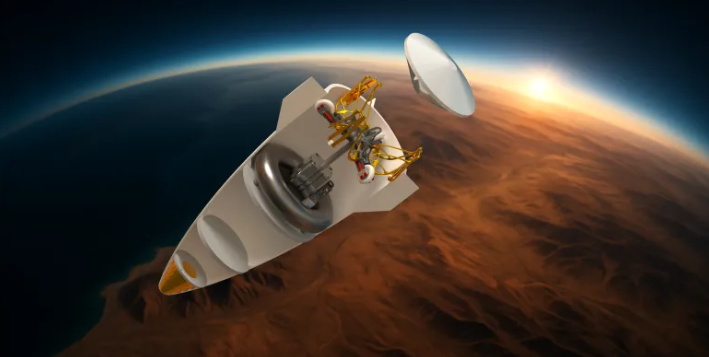

CATIA Champion Fabien Chancel is a designer and engineer whose work bridges intuition and precision, blending physics, emotion, and imagination into a single creative language. Guided by a deep curiosity for the hidden connections between nature, structure, and motion, he sees engineering as the skeleton and design as the soul. This mindset shapes every project he touches.
A NASA-awarded aerospace mechanism didn’t start in a laboratory or with complex equations. It started on a mountain trail, with a bag of chips swelling under low pressure. For Fabien, curiosity is not a soft skill, it is a design method. Through the Static Pressure Launch (SPL), he demonstrates how CATIA, MODSIM, and Generative Design can translate a simple physical law into a flight-ready system, without stored energy, pyrotechnics, or complexity.
Curiosity as a Design Engine: Where SPL Really Began
Fabien Chancel’s work has always lived at the intersection of intuition and calculation. Trained as both a designer and an engineer, he never separated emotion from precision.
Engineering gives me the skeleton, and design gives me the soul.
That mindset shaped SPL long before any CAD model existed. The breakthrough came from observation: a bag of chips inflating at altitude, quietly demonstrating the power of pressure differential.
What I was holding wasn’t just a bag of chips. It was a perfect little physics experiment.
Instead of fighting the environment, SPL was conceived to use the atmosphere itself as an energy source, turning a natural pressure difference into controlled motion. No stored energy. No added force. Just physics, doing what it already wants to do.
From Hands to Numbers: Prototyping, AI, and Physical Truth
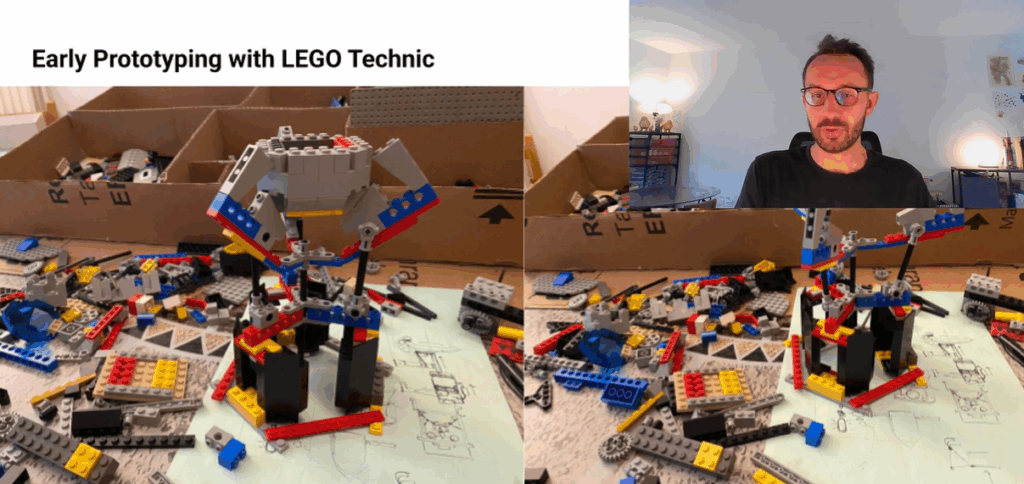
Before launching CATIA, Fabien built SPL with LEGO Technic, a deliberate choice.
Sometimes, the best way to understand a concept is to think with your hands.
The LEGO prototype revealed movement, friction, and balance. But intuition needed magnitude. That’s when AI entered the process, not as an answer engine, but as a quantification partner.
AI is not the painter. It’s the mirror.
Together, they explored pressure curves, Boyle’s law, altitude effects, and force conversion. The results were clear and elegant:
- ~10 kPa pressure difference at 27 km
- ~150 N of force on a 50 mm piston
- 11 m/s ejection speed for a 1.3 kg probe
At that point, intuition and physics aligned. SPL was ready to become geometry.
CATIA, MODSIM, and Generative Design: Turning Physics into Form
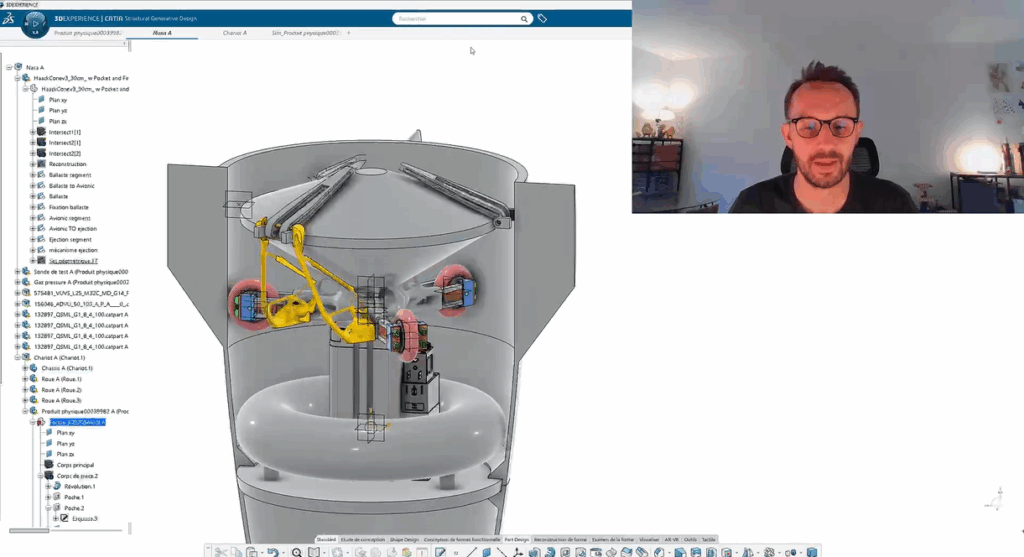
Launching CATIA marked the transition from concept to reality.
CATIA is more than a design tool. It’s a laboratory of imagination.
Using MODSIM, Fabien modeled and simulated SPL as a single, continuous process, adjusting air volume, piston travel, and friction while watching the mechanism move in real time.
To ensure industrial feasibility, Festo off-the-shelf components were integrated directly into the CATIA assembly. No speculative parts. No fantasy engineering.
Simulation validated performance.
Generative Design shaped the structure, light, skeletal, efficient.
The best designer in the room is still nature.
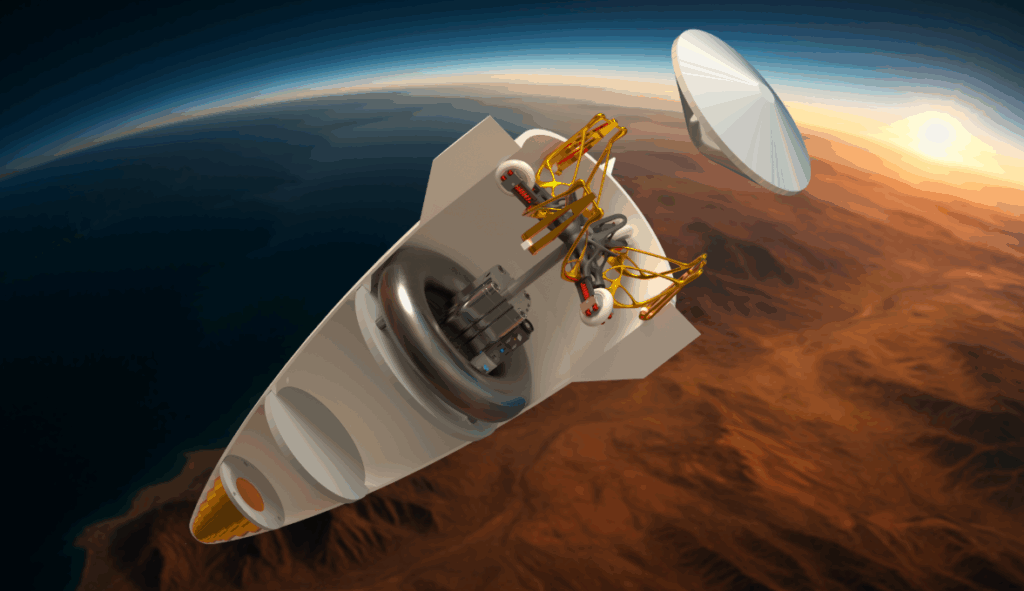
The final system was compact, silent, and buildable: a sealed chamber that naturally stores energy during ascent and releases it in less than 0.1 seconds, without explosions, gas cartridges, or risk.
Conclusion
The Static Pressure Launch is more than a mechanism. It is a statement. A reminder that innovation does not always come from adding power, but from listening more carefully to the laws already in place.
With CATIA, simulation, and a philosophy rooted in curiosity, Fabien Chancel turned an everyday observation into a NASA-winning design. From pressure to release. From Earth to sky. From curiosity to creation.
FAQ
- How can we define MODSIM ?
MODSIM unifies the power of CATIA modeling and SIMULIA simulation on a common data model within a single user experience on the 3DEXPERIENCE Platform.
- How was CATIA used in the Static Pressure Launch project?
CATIA was used to model, simulate, and validate the SPL mechanism using MODSIM, enabling real-time interaction between geometry and physics.
- What role did simulation play in the SPL design?
Simulation confirmed that atmospheric pressure differences at altitude could generate enough force to eject a probe safely and predictably.
- Why is MODSIM critical for this type of project?
MODSIM allows modeling and simulation to evolve together, reducing iteration time and ensuring physical accuracy early in design.
- How did generative design contribute to SPL?
Generative design optimized the structure for strength and weight, creating an organic geometry aligned with physical loads.
- What makes SPL different from traditional aerospace launch mechanisms?
SPL uses no stored energy, no pyrotechnics, and no compressed gas, only natural atmospheric pressure, controlled through design.
Want to see the behind-the-scenes of Fabien’s work ?
Click here to see his approach and workflow
Who is Daniel Pyzak?
Daniel Pyzak is graduated in Mechanical Engineering.
He has more than 42 years of experience in CAD/CAM/CAE/PLM.
After positions held in technical support and product management in various CAD/CAM/CAE companies (Cisi, Cisigraph, Matra Datavision), he joined Dassault Systèmes Provence in 1999 to manage the Competency Center. The main activities of DSP Competency Center are around Tooling, Manufacturing both Substractive and Additive, Reverse Engineering, Rapid Prototyping, Data Exchanges.
21 years ago, he started to manage a European CATIA Technical team, dealing with the full spectrum of CATIA Engineering solutions… and since the beginning of 2020, he’s part of the worldwide CATIA Industry Process Success organization in charge of CATIA Mechanical Engineering with a special focus on Lightweighting (Generative Design , Composites, Mold & Die….), MODSIM (Modeling & Simulation), Additive Manufacturing and Sustainability.