Imagine Starting from Nothing
Imagine starting with nothing. No CAD data, no engine specs, no defined volumes. Just an ambition: build a world-class hypercar from scratch, on a brutal timeline, with a lean team spread across multiple companies and continents.
That is exactly the challenge Managing Composites faced on the Zenvo project — and at JEC World 2026, CEO Lluc Marti stood on stage to explain how they turned complexity into execution using CATIA and the 3DEXPERIENCE platform.
Who Is Managing Composites?
Founded in 2018 in Madrid, Managing Composites has grown from a company of one to over 100 employees in just eight years. They cover the full composites lifecycle — from concept development and engineering to production control, training, and quality, and have built a reputation as the partner you call when the challenge is genuinely complex.
Lluc Marti, their CEO, did not follow the standard playbook. He started as a CATIA hotliner and teacher, refining his craft as a composite designer, and advancing through project management, he ultimately built one of the fastest-growing composites consultancies in Europe.
If you are not doing hands-on, you don’t have the proper feeling.
A Hypercar Designed Through Concurrent Engineering
The Zenvo project is not a typical automotive program. There is no legacy platform. No baseline architecture. Every decision is interconnected.
The engine defines packaging.
Packaging defines the monocoque.
The monocoque defines crash performance.
And crash loops feed back into design.
At the same time, teams are distributed globally, engine suppliers, CFD experts, chassis engineers, all working simultaneously.
You cannot start something when the other has finished. You need to be working in parallel. And here is where the magic of 3DEXPERIENCE happens.
What we built on Zenvo is not a bespoke solution. It’s the operating system we now apply to every complex composites program.
This is where concurrent engineering becomes essential, and where CATIA, combined with the 3DEXPERIENCE platform, enables real-time collaboration across disciplines.
Before vs After: From File-Based Chaos to a Unified Data Model
Before adopting the 3DEXPERIENCE platform, the Zenvo project relied on a traditional file-based CAD workflow (CATIA V5 + local drives): a setup that introduced inefficiencies and risks.
a) Before: Traditional CAD Workflow
- Weekly STEP exports and re-imports
- Up to 9 GB data exchanged manually
- Engineers working on outdated geometry
- Fragmented BOM across multiple Excel files
- Simulation and CAD disconnected
- No traceability across disciplines
b) After: 3DEXPERIENCE Platform
- Real-time collaboration across all stakeholders
- Single source of truth for design, simulation and manufacturing
- Full lifecycle traceability per component
- Unified data model linking CAD, simulation and documentation
- Elimination of redundant tools and parallel trackers
- Continuous visibility on monocoque evolution
This transition reflects a broader shift in the industry: moving from file-based engineering to platform-based engineering.
MODSIM: Connecting Design and Simulation in Real Time

At the core of this transformation is MODSIM (Modeling & Simulation), the seamless integration of design and simulation within a single environment.
Instead of treating CAD and simulation as separate processes, the 3DEXPERIENCE platform connects them as part of a unified data model.
As Daniel Pyzak, Composites Expert at Dassault Systèmes, explained:
The CAD model is an object. The simulation model is an object. And they are linked together in the database.
This means:
- No file conversions
- No version mismatches
- No delays between design changes and simulation updates
For the Zenvo project, this was critical. When engine cooling requirements changed, the geometry update propagated instantly across all related simulations and components.
MODSIM enabled faster iteration loops, improved design confidence, and reduced risk across the entire development cycle.
From Typewriters to Real-Time Collaboration
Lluc described the transformation with a powerful analogy:
Moving from disconnected tools to 3DEXPERIENCE is like going from five people writing a book on separate typewriters to a shared live document.
It is not just a CAD platform. It has become our project management platform — the single place where every company, every discipline, every decision lives.
This shift is not just technical: it is cultural.
Design, simulation, and project management are no longer siloed. They operate as a continuous digital thread.
A Carbon Monocoque Built Through Digital Continuity
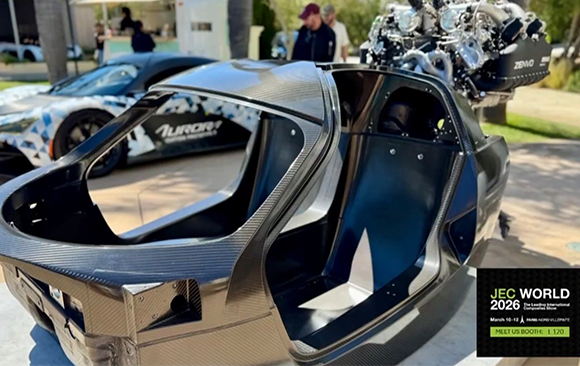
At the heart of the Zenvo hypercar lies its carbon fiber monocoque, a structure that evolved continuously throughout the project.
With over 40 parameters linked to suspension systems and multiple dependencies across subsystems, managing changes manually would have been nearly impossible.
Within the 3DEXPERIENCE platform:
- Changes are tracked automatically
- Dependencies are managed in real time
- History is fully auditable
The result is true digital continuity, from design to validation to manufacturing.
A Rolling Prototype. On Time.
Thousands of components. Multiple suppliers. One assembly.
No second chances.
You have one chance. If one of them is not matching, you are out.
The Zenvo prototype came together successfully, a fully functional hypercar, assembled and validated on time, and driven uphill at Goodwood.
Behind that success: a connected digital environment, where every component, every simulation and every decision were aligned.
What Composites and Automotive Teams Can Learn
- Concurrent engineering is no longer optional
Modern vehicle programs require parallel workflows across disciplines.
- Digital continuity drives performance
Connecting CAD, simulation and manufacturing reduces iteration cost and risk.
- MODSIM is a game changer
Integrating modeling and simulation accelerates development and improves decision-making.
- The transition is progressive
Moving from CATIA V5 to 3DEXPERIENCE is a journey — not an overnight switch.
Designing a hypercar isn’t magic. It’s brutal clarity, relentless cadence, uncompromising craft and a platform that doesn’t break when reality hits.
Tools enable speed. Experience prevents mistakes.
Conclusion
Designing a hypercar is not magic.
It is the ability to manage complexity, across teams, disciplines and systems — while maintaining speed and precision.
With CATIA, MODSIM and the 3DEXPERIENCE platform, Managing Composites transformed a highly fragmented process into a connected, collaborative and traceable engineering workflow.
In today’s automotive and composites industry, that shift is not just an advantage. It is a necessity.
What’s next ?
🎥Watch the full session replay: Dassault Systèmes @ Jec World 2026 | Dassault Systèmes®
👉Learn more about Managing Composites: http://managingcomposites.com
FAQ
- What is MODSIM on the 3DEXPERIENCE platform
MODSIM is the integration of modeling and simulation within a unified environment on the 3DEXPERIENCE platform. It links CAD and simulation data so updates propagate instantly, eliminating file conversions, version mismatches, and delays between design and validation.
- How does CATIA Composites help design hypercars
CATIA Composites enables engineers to manage complex carbon‑fiber structures with real‑time updates, parameter control, and full traceability. For the Zenvo hypercar, it ensured continuous alignment between design, simulation, and manufacturing.
- Why is concurrent engineering essential for hypercar development
Hypercar programs involve tightly linked decisions across packaging, monocoque design, crash performance, and cooling. Concurrent engineering allows all disciplines to work in parallel, reducing delays and ensuring faster, more reliable iteration cycles.
- What are the benefits of moving from CATIA V5 to the 3DEXPERIENCE platform
Transitioning to 3DEXPERIENCE replaces file‑based workflows with a unified data model. Teams gain real‑time collaboration, a single source of truth, lifecycle traceability, and seamless CAD‑simulation integration — dramatically reducing risk and rework.
- How did Managing Composites deliver the Zenvo hypercar on time
By centralizing all design, simulation, and project data on the 3DEXPERIENCE platform, Managing Composites ensured every supplier and discipline worked from synchronized information. This digital continuity enabled the successful assembly of a fully functional prototype on schedule.
Who is Olivier Nallet?
Olivier NALLET is a senior consultant working at Dassault Systèmes since 1999. Since 2007, as a member of the CATIA team, he is technically supporting the sales of the Dassault Systèmes solution dedicated to Composites parts design. He is acting for customers in Aerospace & Defense, Transportation & Mobility, Energy and Marine & Offshore industries, helping them deploy CATIA 3DEXPERIENCE on their Composites process.

Olivier Nallet is a CATIA Engineering Industry Process Expert Senior Specialist within CATIA Multi Discipline Engineering organization.