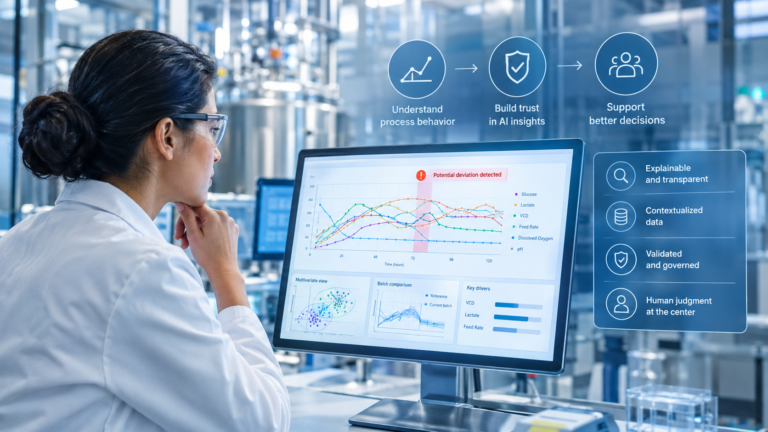
Imagine an AI model that flags a potential process deviation hours before a conventional alarm would trigger. The prediction looks convincing. But can the process scientist explain why the model raised the alert? Can the team tell whether the signal is meaningful? And what evidence is needed before anyone acts? These questions show that AI adoption in pharmaceutical manufacturing is not just a technology problem. It is a problem of scientific confidence and operational trust.
Accuracy is only the beginning
Pharmaceutical manufacturers generate enormous volumes of process data, and AI can help find the patterns in it. But a highly accurate prediction is not automatically suitable for a manufacturing decision. Relying on accuracy alone has three limits.
Prediction is not explanation. A model may correctly flag an unusual batch without revealing the process relationships behind it. Knowing that something is different is not the same as knowing why.
Past performance is not a guarantee. A model is only as dependable as the conditions it was trained on. When raw materials, equipment, scale, or data collection change, its reliability can erode without anyone noticing.
An anomaly is not automatically a problem. Normal variation, data-quality issues, and genuine process shifts can produce similar signals. Telling them apart takes scientific judgment.
Accuracy measures one aspect of performance. It does not establish scientific validity or fitness for a particular manufacturing use.
What does it mean to trust an AI insight?
In practice, trust rests on four pillars:
Scientific interpretability (Explainable AI). Can the scientist see which variables or patterns drove the result, and does the explanation make sense for the process?
Data integrity and context. Is the data contextualized by batch, process stage, equipment, and operating conditions? Are missing values and changes in data sources understood? A sophisticated model built on poorly contextualized data is only sophisticated at being wrong.
Reliability and governance. Has the model been evaluated for its intended use, with limitations, version, and conditions of applicability documented? Can the organization tell when performance deteriorates?
Human judgment and accountability. Can scientists review the evidence, challenge a recommendation, and make a reasoned decision, with clear responsibility for the outcome?
Trust doesn’t mean accepting an AI answer without question. It means having enough evidence to judge when that answer should, and should not, be used.
From black-box predictions to process understanding
Consider a biologics batch. A model flags an unusual trajectory across glucose, lactate, viable cell density (VCD), feed rate, dissolved oxygen and pH, even though every parameter is within its operating limits. Univariate alarms stay silent. The model is seeing something in the combination.
A scientist’s investigation might follow five steps:
- Identify the deviation. Which variables contributed to the alert?
- Establish context. At what stage did the pattern emerge, and how does it compare with reference batches?
- Evaluate the evidence. Is it repeatable? Could it be measurement error, an operational difference, or a real process change?
- Investigate explanations. What mechanisms could account for the behavior?
- Decide on a response. Does the evidence call for further investigation, increased monitoring or action under established procedures?
Notice what the model did and didn’t do. It found a pattern consistent with a potential issue. It did not prove a cause. Causal conclusions need additional evidence and rigorous analysis. This is where multivariate monitoring, reference-batch comparison and explainable machine learning support, rather than replace, scientific reasoning.
Trust must be designed into the workflow
Not every AI application carries the same regulatory weight. An exploratory tool a scientist uses to investigate historical data is very different from a system supporting a GMP quality decision. That is the difference between generating an AI insight and using it in a regulated workflow.
Four considerations matter most:
- Intended use. Define what the model does, which decisions it supports and what happens if it’s wrong.
- Validation and lifecycle management. Evaluate for the intended application, document limitations and reassess as conditions change.
- Traceability. Preserve the link between source data, model outputs, evidence and human decisions.
- Risk-based oversight. Match controls and human review to the risk, especially where product quality is affected.
Trustworthy AI is a lifecycle responsibility spanning data, models, processes, people, and governance. It cannot be bolted on after development.
The next frontier: AI-assisted investigation
Analytics is moving from static dashboards toward tools that detect patterns, explain contributing factors and ultimately assist investigations by letting scientists question contextualized data, test competing hypotheses and identify what evidence is still missing. AI agents may be the next step, orchestrating analytical workflows and retrieving process evidence. But they raise the stakes. An agent must not simply produce a convincing narrative. Its claims should be grounded in traceable evidence, its uncertainty visible and its actions constrained by the permissions and controls of its role. The goal is not to replace the process scientist. It is to help that scientist investigate faster and decide with more confidence.
The goal is better decisions, not more AI
Predictive performance matters, but it is only one component of responsible deployment. Interpretability, contextualized data, appropriate validation and human accountability determine whether an insight can actually be used. The ultimate measure of AI in pharmaceutical manufacturing won’t be how sophisticated its algorithms become. It will be whether scientists can use its insights to understand their processes more deeply, investigate problems more effectively, and make decisions with greater confidence.
 Larry Fiegland
As the Discoverant Product Manager, Larry is part of the Research and Development organization within BIOVIA and is responsible for sales activities and product development for the BIOVIA Discoverant solution. Larry obtained his Ph.D. from Virginia Tech under the direction of Professor John R. Morris, working on ultrahigh vacuum studies of the reaction mechanisms of ozone with saturated and unsaturated self-assembled monolayers. Prior to graduate school, Larry’s industrial experience includes four years as a New Process and Development Chemist working on scale up of chemical processes from pilot plant to full-scale manufacturing.
 Jaya Tikhe
Jaya Tikhe has extensive experience in early drug discovery and project management. As a medicinal and organic chemist, she has a proven track record of delivering high-quality drug candidates across CNS, immunology, inflammation, and oncology. She currently leads product marketing for Dassault Systèmes’ Manufacturing, Quality, and Regulatory solutions.