Design the Impossible
Artificial intelligence (AI) is reshaping how organizations approach drug discovery and materials innovation. Dassault Systèmes’ expanded partnership with NVIDIA represents a significant advancement in these areas, combining NVIDIA-accelerated AI with BIOVIA’s science-based Virtual Twins to help researchers discover novel drug candidates and chemicals with unprecedented speed and accuracy.
This collaboration builds on the broader partnership between Dassault Systèmes and NVIDIA, extending advanced AI capabilities directly into BIOVIA’s scientific solutions on the 3DEXPERIENCE platform. The result is an immersive scientific environment where computational power meets scientific rigor, enabling researchers to explore possibilities that were previously out of reach.
How NVIDIA’s Generative AI Enhances BIOVIA’s Scientific Experiences
The partnership integrates NVIDIA’s AI infrastructure, accelerated computing and open generative models with BIOVIA’s Virtual Twin technology, creating a unified industrial AI architecture that boosts capability, speed, and accessibility across drug discovery and materials science. This approach creates what both companies call “trustworthy Industrial AI.” These systems not only generate possibilities but also produce scientifically valid candidates that are more likely to succeed in real-world applications.
In drug discovery, NVIDIA’s BioNeMo models are seamlessly integrated into BIOVIA’s drug discovery solutions on the 3DEXPERIENCE platform, working alongside BIOVIA’s established generative AI and physics-based modeling tools to generate and optimize novel molecular candidates at scale, significantly expanding the chemical and biological space while maintaining physics-based validation.
For materials science applications, the partnership enables atomistic simulation with machine-learned interatomic potentials (MLIPs) and GPU-accelerated molecular dynamics through NVIDIA BatchedMD, combined with BIOVIA Materials Studio. This combination helps researchers simulate complex, heterogeneous materials systems with quantum-level accuracy while maintaining production-scale speed—a balance that classical force fields struggle to achieve for mixed organic-inorganic and reactive chemistries.
Expanding BIOVIA’s Virtual Twin Offerings
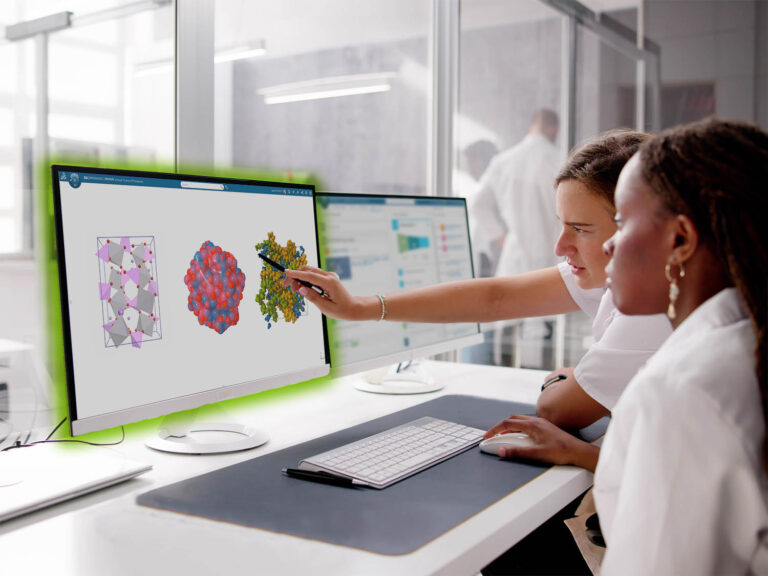
Dassault Systèmes’ expanded partnership with NVIDIA extends BIOVIA’s 3D UNIV+RSES, the collaborative environment where scientists work with AI-powered Virtual Twins.
Virtual Twins are dynamic, science-based digital representations grounded in the fundamental laws of physics, chemistry and biology that allow researchers to simulate complex molecular and biological systems, explore vast design spaces, and predict behavior with high fidelity, minimizing the need for physical experimentation.
NVIDIA accelerates these Virtual Twins in three critical ways:
- Scale: GPU acceleration enables larger systems and broader design exploration.
- Speed: High-performance computing dramatically reduces simulation time.
- Intelligence: Generative AI proposes novel candidates that Virtual Twins can immediately evaluate and refine.
The integration of NVIDIA Inference Microservices (NIM) into the 3DEXPERIENCE platform democratizes access to state-of-the-art science. Chemists and biologists can now tap into advanced AI capabilities through intuitive interfaces, removing the technical barriers that once limited who could use these tools.
From Discovery to Market: Shortening Development Cycles
The impact extends across the entire innovation pipeline.
In therapeutics, the platform accelerates every stage from ideation to therapy by unifying multimodal data to predict safety, efficacy and manufacturability earlier in the process. This early insight reduces costs, shortens timelines and improves success rates, helping biopharma companies bring breakthrough therapies to patients faster.
For materials innovation, the collaboration transforms simulation into a data engine for innovation. By generating large simulation datasets, researchers can support surrogate modeling and AI-driven property prediction for batteries, photoelectric materials, catalysts, polymers and sustainable products. The ability to explore materials design spaces at scale enables efficient screening and optimization across diverse application areas, including energy, automotive and pharmaceutical R&D.
Enterprise-Ready Industrial AI
Enterprise adoption requires more than computational power. The Dassault Systèmes-NVIDIA partnership addresses critical concerns about data security, intellectual property protection and sovereign deployment requirements through enterprise-grade infrastructure and secure cloud options.
The partnership also emphasizes making advanced AI accessible to every scientist, not just computational specialists. BIOVIA’s Virtual Advisors augment workflows and enhance early-stage discovery across all scientific disciplines, allowing domain experts to focus on scientific questions rather than technical implementation.
Driving the Next Era of Scientific Innovation
The collaboration between Dassault Systèmes and NVIDIA reflects a fundamental shift in R&D. By merging BIOVIA’s chemistry and materials science expertise with NVIDIA’s accelerated computing and AI capabilities, the partnership transforms Virtual Twins into scalable, AI-augmented discovery engines.
Organizations seeking life-saving therapies or sustainable new materials now have a digital foundation that helps them see what was once invisible and design what seemed impossible. Whether you’re developing breakthrough therapeutics or engineering high-performance materials, the Dassault Systèmes-NVIDIA partnership provides the tools to transform how your organization innovates. Thousands of scientists and engineers are already using these capabilities to drive discovery forward. The question is no longer whether AI will reshape scientific R&D, but how quickly your organization can harness its potential.

Stephen Hayward is a PhD in Chemical Engineering, with a background in laboratory informatics, chemical modeling, and environmental analysis. Originally from Toronto, Canada, he currently leads product marketing efforts for informatics solutions at Dassault Systèmes BIOVIA in San Diego.