A promising synthetic route is only the beginning
Imagine this familiar situation: you’ve identified a promising compound, launched a retrosynthetic analysis, and obtained several plausible synthetic routes. The chemistry looks convincing, the number of steps is reasonable and the proposed transformations are familiar.
But before heading to the laboratory, several practical questions remain.
How expensive are the required starting materials? Are they already available in your organization’s inventory? Is there enough material to perform the experiment? And how much time will it take to transfer the target reaction into your electronic laboratory notebook?
These questions are critical to successful and efficient synthesis planning, yet answering them often requires switching between applications, consulting commercial catalogs, checking inventory systems and manually recreating reaction schemes.
A chemically feasible route is not necessarily the most practical or economical route.
With new enhancements to BIOVIA Reaction Planner, chemists can address these challenges earlier in their workflow, making more informed decisions and moving more efficiently from retrosynthetic analysis to laboratory execution.
1. Make cost part of your synthesis decisions
When comparing synthetic routes, chemists naturally consider reaction feasibility, route length and transformation complexity. However, the cost of starting materials can significantly influence which route is worth pursuing.
Consider two alternative routes to the same target compound. Both involve three synthetic steps and rely on established transformations. Yet one requires an expensive building block, while the other uses more affordable commercially available reactants.
Without cost information, the difference may only become apparent after selecting a route and investigating suppliers.
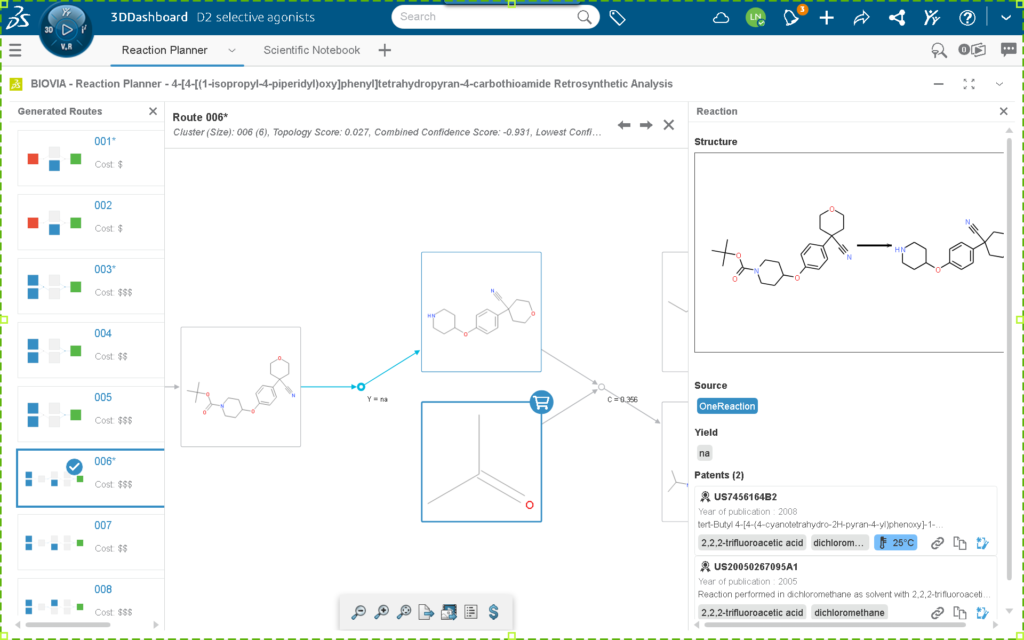
BIOVIA Reaction Planner now displays cost categories for commercially available molecules, helping chemists assess the economic implications of their synthetic choices directly within the retrosynthesis workflow. These cost categories are derived from chemical supplier information available in the BIOVIA ACD and SCD catalogs
Simple dollar-sign indicators represent estimated cost ranges, from $ to $$$$,$$$$ (from less than $10/g to more than $1000/g), with unknown pricing clearly identified. Cost information can be explored at the molecule level, while each route is characterized by the highest cost category among its starting materials.
In the route comparison grid, chemists can sort and filter routes according to these categories, quickly identifying potentially expensive alternatives.
This enables a more practical approach to route selection: prioritize affordable building blocks, identify cost-sensitive routes earlier and avoid spending time investigating options that may be economically unattractive.
Rather than replacing detailed purchasing quotations, these indicators provide an early assessment of material costs—exactly when such information can have the greatest influence on synthesis planning.
2. Know what is actually available in your laboratory
Finding a molecule in an internal materials database is encouraging. But does that mean it is ready to use?
Not necessarily.
A registered material may have been consumed in previous experiments, exist in insufficient quantities, or be stored at another laboratory location. Materials Management provides visibility into substance and lot information, including material availability and location.
For chemists planning synthesis, the distinction between a material being registered and being physically available is essential.
BIOVIA Reaction Planner addresses this challenge by providing direct visibility into available inventory quantities and storage locations for materials matching molecules in a synthetic route.
When investigating a target, intermediate, or starting material, chemists can access the Molecule Information panel to view matching registered materials and their aggregated available quantities by location.
Importantly, inventory information is retrieved when the panel is opened, reflecting the latest accessible inventory data rather than relying on potentially outdated information captured during route generation.
Imagine identifying two alternative starting materials for a synthesis. One is commercially available but requires purchasing. The other is already present in your laboratory, with sufficient quantities for the planned experiment.
With inventory visibility integrated into route investigation, the choice becomes much easier.
Chemists can prioritize materials already on hand, reduce unnecessary purchases, avoid delays associated with sourcing, and make better use of existing laboratory resources.
For teams managing multiple projects and shared compound collections, this also helps connect synthesis planning with day-to-day laboratory operations.
3. Turn a selected reaction into an experiment without starting from scratch
Once a suitable synthetic route has been selected, the next challenge is translating the plan into an experiment.
Traditionally, this involves opening an electronic laboratory notebook, drawing or importing the reaction, identifying its participants and populating the experiment’s stoichiometry table.
These repetitive steps consume valuable time and introduce opportunities for transcription errors.
BIOVIA Reaction Planner now connects route exploration directly with experiment creation in BIOVIA Scientific Notebook.
From a selected reaction, chemists can create a new experiment with its reaction participants automatically transferred into the notebook.
Reactants and products populate the experiment’s stoichiometry table. For known reactions, chemists can select a specific documented reaction condition so that associated catalysts, solvents, and reagents are also transferred and correctly classified.
The experiment is automatically titled, created within the selected secure collection, and opened in Scientific Notebook for further editing.
For predicted reactions, the reactants and products provide the initial experimental framework, which chemists can then complete with appropriate conditions.
The result is a smoother transition from digital synthesis planning to practical experimental preparation.
Instead of manually reconstructing the chemistry, researchers can focus on what matters most: reviewing the proposed transformation, defining experimental parameters, and preparing the experiment.
A more connected synthesis workflow
Individually, these enhancements address three everyday challenges. Together, they support a more efficient and informed approach to synthesis planning.
Chemists can now evaluate the cost implications of alternative routes, investigate the actual availability of required materials, and initiate experiments directly from selected reactions.
This brings practical considerations into the decision-making process earlier, helping teams reduce avoidable purchasing, minimize repetitive data entry, and spend less time moving information between systems.
For medicinal chemistry teams working under tight project timelines, these improvements can make a meaningful difference to daily productivity.
Because the value of retrosynthesis is not simply in predicting how a molecule could be made. It is in helping chemists decide how to make it—and take the next step toward making it happen.
Explore our Generative AI for Science solutions to learn more about how BIOVIA leverages AI to accelerate generative therapeutics, synthetic chemistry, and scientific innovation.

Product Manager for the BIOVIA Reaction Planner application, Laurent joined Dassault Systèmes in 2017 to foster the development of a portfolio of Life Science products. With a dual systems biology and informatics background, he has spent 20 years in the pharma industry developing bioinformatics pipelines to support scientists in drug discovery and translational sciences R&D projects. Laurent is also involved in the development of innovative virtual twin approaches for helping doctors fighting cancer.