What does it take to turn a scientific idea into a solution that meets the needs of industry?
During my first year as an apprentice at Dassault Systèmes, in Vélizy, France, I began exploring this question from two complementary perspectives: scientific research and industrial applications. Working at the intersection of materials science and digital technologies, I discovered how simulation can help us better understand materials, predict their properties and support the development of more sustainable products.
As part of the Solution Experience team, supporting the Consumer-Packaged Goods & Retail (CPG-R) and Home & Lifestyle (H&L) industries, my apprenticeship offered me a unique opportunity to connect scientific knowledge with the practical challenges faced by industrial companies.
It was a year of discovery, learning and collaboration that changed the way I look at materials science and its role in innovation. My role within Solution Experience placed me at the intersection of science, technology and business needs. Beyond understanding the capabilities of the software, I learned to consider how these capabilities could address real industrial questions and how scientific concepts could be communicated in a clear and meaningful way.
Connecting Molecular Science with Industrial Challenges
Materials are at the heart of countless everyday products from cosmetic packaging and household products to food and beverage packaging and personal care items. Behind each product lies a series of challenges [1]:
- selecting the right raw materials
- achieving the desired performance
- controlling costs
- responding to increasingly important sustainability requirements
Addressing these challenges often requires extensive experimentation. Digital simulation offers another perspective by helping scientists investigate materials behaviour before moving to physical testing. And this is where BIOVIA comes in.
BIOVIA provides scientific software solutions that enable researchers and engineers to model, simulate and better understand complex material systems.
Sustainable Packaging Through Molecular Simulation – MATERIALS STUDIO®
One of the highlights of my first year was a research project focused on the development of more sustainable packaging materials.
Conventional multilayer packaging can offer excellent protection, particularly against gases such as oxygen. However, combining different materials can make recycling more challenging [2]. This raises an important question:
Can alternative materials deliver the required performance while supporting more sustainable packaging solutions?
To explore this question, I used BIOVIA Materials Studio® to investigate polymer nanocomposites based on polylactic acid (PLA), a bio-based polymer, and sodium montmorillonite, a type of nanoscale clay [3].
Polylactic acid (PLA) is a polymer with potential applications in more sustainable packaging. Its polymer chain is composed of repeating lactic-acid units (Figure 1). Understanding its molecular structure and interactions with other materials is important for investigating its properties and developing packaging solutions with improved performance. One key challenge is improving the barrier properties of PLA, particularly its ability to limit gas diffusion. Incorporating sodium montmorillonite clay may help address this challenge: the clay platelets can potentially increase the tortuosity of the diffusion pathway, (Figure 2) forcing gas molecules to follow a more winding route through the material [4]. Understanding how the polymer and clay interact, and how these interactions influence gas diffusion, can therefore provide valuable insights into the design of such packaging materials.
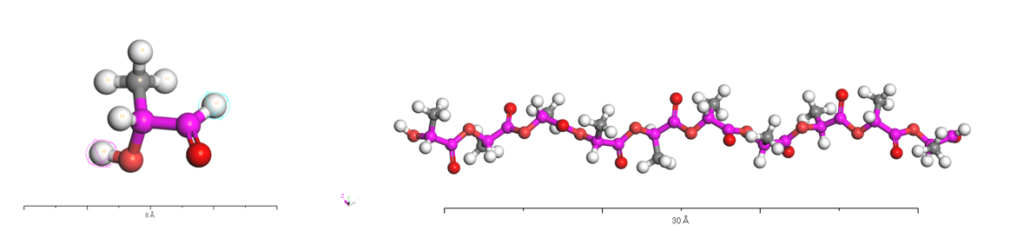
Figure 1: Chemical structure of the lactic acid repeat unit (left) and the polymer chain of polylactic acid (PLA) (right)
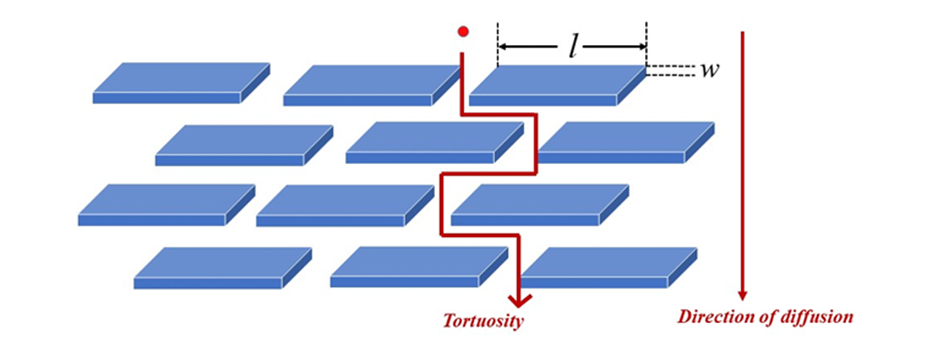
Figure 2: Tortuous path effect [4]
To study these systems, molecular models were constructed using BIOVIA Materials Studio Amorphous Cell (Figure 3) [3]. Molecular dynamics simulations were then performed with MS Forcite Plus, using the COMPASS III force field [5] and both NVT (constant volume) and NPT (constant pressure) ensembles to investigate the behavior of the different polymer/clay systems. To evaluate molecular mobility, mean square displacement (MSD) calculations were performed allowing diffusion coefficients to be estimated [6]. Comparing these values across systems can help assess how chemical modifications to the polymer and clay surface influence diffusion and provide insights into the potential barrier performance of the resulting materials.
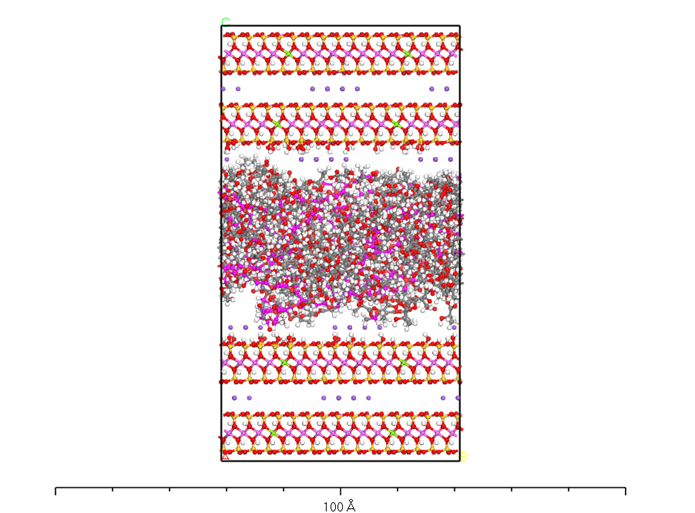
Figure 3: Molecular representation of the PLA/nano clay composite system
A key objective was to understand how modifications to the polymer and the clay surface could influence the movement of gas molecules through the material. In simple terms, the challenge was to investigate whether we could restrict the movement of gas molecules to travel through the packaging material, potentially improving its barrier performance. Using molecular dynamics simulations, I built and compared nine virtual material systems with different levels of chemical modifications. This made it possible to examine how changes in materials composition and interactions between the components could influence diffusion.
To me, this project illustrated the value of computational materials science:
Rather than relying exclusively on trial-and-error experimentation, we can use virtual models to investigate different material designs, identify promising directions and guide future experimental work. It also highlighted an important principle: improving a material is not always about changing one component alone. Understanding how different components interact can be just as important.
— Mathuravahini Archchuthan
From Research to Industrial Applications
While the research project allowed me to explore materials at the molecular scale, my experience within Solution Experience helped me understand the broader industrial context in which digital technologies are used.
Working across the CPG-R and H&L industries exposed me to a variety of challenges related to product formulation, raw material substitution, performance optimization and environmental considerations.
Scientific modelling helps us understand what happens at the material level. Industrial applications help us determine why that understanding matters and how it can contribute to better decisions in product development. My apprenticeship gave me the opportunity to develop this dual perspective: learning to investigate scientific questions in depth while considering how digital solutions can support the needs of industrial teams.
Explore the Dassault Systèmes careers page to discover current internship and full-time opportunities. Whether you’re beginning your professional journey or seeking your next career step, find opportunities to learn, grow, and contribute in an innovative, collaborative environment.
SOURCES:
[1] Dassault Systèmes. BIOVIA Materials Studio – Consumer Packaged Goods: Speeding up CPG R&D. https://www.3ds.com/products/biovia/materials-studio/consumer-packaged-goods
[2] Soares, C. T. D. M., Ek, M., Östmark, E., Gällstedt, M., & Karlsson, S. (2022). Recycling of multi-material multilayer plastic packaging: Current trends and future scenarios. Resources, Conservation and Recycling, 176, 105905.
[3] Singha, S., & Hedenqvist, M. S. (2020). A Review on Barrier Properties of Poly(Lactic Acid)/Clay Nanocomposites. Polymers, 12(5), 1095.
[4] Cui, Y., Kumar, S., Rao Kona, B., & van Houcke, D. (2015). Gas barrier properties of polymer/clay nanocomposites. RSC Advances, 5(78), 63669–63690.
[5] Akkermans, R. L. C., Spenley, N. A., & Robertson, S. H. (2021). COMPASS III: Automated fitting workflows and extension to ionic liquids. Molecular Simulation, 47(7), 540–551.
[6] Lightfoot, J., et al. (2023). A molecular dynamics approach to modelling oxygen diffusion in PLA and PLA clay nanocomposites. Materials Advances, 4, 2281–2291.

Mathura Archchuthan is pursuing a master’s degree in chemistry and Materials Science at Université Paris-Saclay, specializing in Computational Chemistry, while working as an Apprentice Solutions Engineer at Dassault Systèmes. As part of the CPG and H&L industries, her work focuses on developing more sustainable packaging materials, with the aim of improving their barrier properties through atomistic simulations. She uses Materials Studio® to model and simulate sustainable packaging designs. Her work contributes to a multiscale project that connects molecular-level insights with larger-scale material simulations, helping bridge the gap between atomistic modelling and macroscopic material properties.