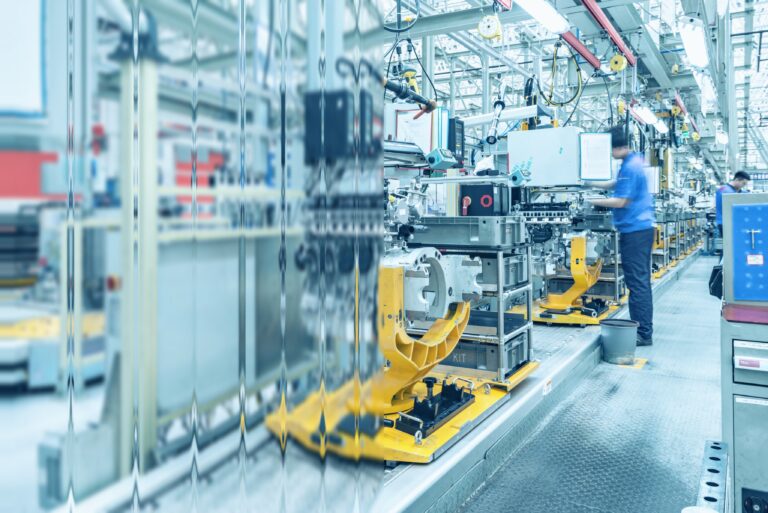

Half a million auto components. Every day. Shipped to original equipment manufacturers across India and beyond. That is the operational reality of the JBM Group – a three-billion-dollar enterprise spanning ten nations, and one of the most quietly consequential companies in India’s industrial story. Its founding vision, set in the 1980s, was straightforward and bold in equal measure: ensure that every vehicle made in India carries a JBM component.
In this episode of 3DEXPERIENCE Innovation Matters, Dassault Systèmes India’s thought leadership podcast series, Vivek SALVI, Sr. Sales Director, Dassault Systèmes, sits down with Ranganathan IYER, Group CIO of JBM Group, to explore what it takes to lead digital transformation at this scale – and what the next decade of manufacturing will demand from India’s industrial organisations.
“Digitisation is a mandate. If you are not going to adapt, you will not exist”.
– Ranganathan Iyer
India Manufacturing at a Defining Moment
India’s manufacturing sector is at an inflection point. The country is attracting unprecedented global attention as a production base, driven by supply chain diversification trends, a growing domestic market, and policy tailwinds that have placed manufacturing at the center of India’s economic ambitions. Yet with scale comes complexity: supply chains are more volatile, product cycles are shortening, customer expectations for quality and customization are rising, and the workforce must evolve alongside every shift.
The organizations that will navigate this complexity successfully are not simply those that invest most heavily in technology. They are the ones that understand how technology, organizational capability, and people development must move together. Getting any one of the three right while neglecting the others produces a transformation that stalls. Getting all three in alignment is what separates manufacturers that lead from those that follow.
Digitisation as Standardisation: Navigating Manufacturing Complexity
Perspective from Ranganathan Iyer, Group CIO, JBM Group
The most significant shift that digitization enables for a manufacturer of JBM’s scale is standardization, or the ability to run multiple product variants on a single production line without sacrificing quality or speed. As model proliferation accelerates across the automotive sector, manufacturers who can adapt their processes rapidly and reliably will define the next tier of global competitiveness.
Iyer frames the digitization landscape across three organizational archetypes: technology-native businesses where digital systems are core to operations; legacy-heavy environments where transformation must be sequenced carefully; and organizations that are digitizing primarily to remain competitive rather than from an inherent technology mandate. The approach to R&D, innovation investment, and data quality must be calibrated to each context, but the direction of travel is the same for all three.
At the foundation of all of it is data quality. AI-driven decision-making is only as reliable as the data that feeds it and that data is only as clean as the systems that capture it. Replacing manual data entry with automated and QR-code-based collection, building human-machine interface systems that reduce transcription error, and ensuring that insights flow directly from production systems to management dashboards: these unglamorous disciplines are, in Iyer’s view, the true prerequisites for meaningful digital transformation.
“The quality of data is paramount. When you collect data directly from systems rather than from humans, you get the precision that enables reliable decision-making dashboards, and that is the foundation everything else builds on“.
– Ranganathan Iyer
The EV Transition: Software, Safety, and the New Manufacturing Mindset
Perspective from Vivek Salvi, Sr. Sales Director, Dassault Systèmes India
The electric vehicle transition is not simply a powertrain change. It is a fundamental reconstitution of what a vehicle is, and, by extension, what it means to manufacture one. Mechanical, electrical, electronics, and embedded software disciplines now converge in ways that have no precedent in conventional automotive production. When software accounts for roughly half the value of an EV ecosystem, an automotive manufacturer that thinks primarily in materials and tolerances is operating with an incomplete map.
This convergence redefines the role of R&D and the value of the startup ecosystem. Established manufacturers have production discipline, supply chain depth, and regulatory expertise. Startups have software fluency, speed, and the freedom to think from first principles. The manufacturers who will lead the EV era are those who learn to integrate both by building the organizational capability to collaborate with them effectively, which requires genuine knowledge transfer in both directions.
The shift also changes the relationship between a product and the data it generates. An electric vehicle in service is a continuous source of operational intelligence, from battery health and usage patterns to predictive maintenance signals. The factory that built it and the field in which it operates are no longer separate domains. Manufacturers who close that loop, mining asset-in-motion data to improve both their products and their service models, are building a competitive advantage that compounds over time.
“The EV ecosystem demands a completely different mindset at the R&D stage. It is pushing manufacturers to think about innovation as something that shows up at every stage, from design through to how the asset performs in the field“.
– Vivek Salvi
Workforce of the Future: Cobots, Knowledge Transfer, and the Human Edge
Within five to ten years, collaborative robots, or cobots, will work alongside humans on production floors as a matter of course. This is a planning assumption that every serious manufacturing organization should already be considering, if not already acting on. But will the workforce be ready when it does?
Preparing that workforce requires thinking across three distinct segments simultaneously. New recruits entering from educational institutions need practical manufacturing skills built into their induction before they reach the floor, as a structured curriculum developed in partnership with government skill development programs. Existing employees navigating digitization need hands-on training that builds confidence with new systems. And the senior engineers who carry decades of tacit process knowledge need mentorship structures that transfer that knowledge before it retires with them.
The third segment is the most easily overlooked and the most consequential: the senior engineers whose 25-plus years of domain expertise represent an irreplaceable asset. Pairing them with younger colleagues in structured mentorship programs does two things simultaneously: it preserves institutional knowledge that would otherwise be lost to retirement, and it accelerates the development of younger engineers into leadership roles at a pace that the pace of digitization now demands.
“Younger people embrace technology with less fear and bring different thought processes that help us improve. HR plays a vital role in identifying the right people to shoulder higher responsibilities because digitization calls for this“.
– Ranganathan Iyer
Collaboration, Digital Twins, and the Road Ahead
Across this conversation, three themes surface consistently as the defining imperatives for India’s manufacturing organizations in the decade ahead: collaboration, digital twin adoption, and a culture of continuous learning.
Collaboration between OEMs and tier-one and tier-two suppliers during the design phase, between humans and machines on the production floor, and between established manufacturers and the startup ecosystem is the variable that determines whether innovation translates into competitive advantage or remains locked in the R&D lab. Digital twin technology is the infrastructure through which that collaboration becomes actionable: enabling concurrent design, virtual validation, and supply chain simulation before a single physical component is produced. Without it, the coordination costs of complexity consume the efficiency gains that digitization is supposed to deliver.
India’s manufacturing sector is stepping onto the global stage at a moment when the rules of competition are being rewritten by software, data, and speed. The organizations that will define what Indian manufacturing means to the world are those that treat technology, innovation, and people not like separate workstreams but as a single integrated capability that must be built deliberately and maintained continuously.
“Collaboration has to happen at every stage – when you are conceiving the concept, designing the product, and manufacturing at scale. Digital twins and simulation are the tools that make that collaboration real“.
– Ranganathan Iyer
3DEXPERIENCE Innovation Matters continues to spotlight the people and ideas shaping India’s manufacturing future, from digitisation and data-driven decision-making to digital twins and the evolving role of technology in building a globally competitive industrial ecosystem.
More Ways to Engage:
🎬 Watch on YouTube
🎧 Listen on Spotify
👥 Follow us on LinkedIn
📩 Get in Touch