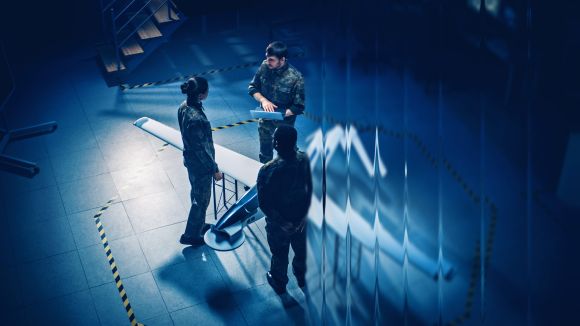
Most of what we hear about AI revolves around chatbots, image generators and recommendation engines. They’re helpful to everyday citizens, but they address very different needs than the ones facing the engineers, scientists and manufacturers who build the physical world around us. That’s where Industrial AI comes in. It’s what happens when artificial intelligence steps out of the chat window and into the real world, helping design products, run factories and push scientific research forward. And because the stakes are real, it can’t just look or sound right. It has to respect the laws of physics, understand industrial processes and meet regulations.
Dassault Systèmes has been preparing for this moment for 45 years, building the simulation and virtual twin technology that makes Industrial AI possible, long before the term became popular.
What Is Industrial AI?
Industrial AI is artificial intelligence applied to the physical world: product design, manufacturing, infrastructure and scientific research. It differs from the consumer AI tools most people already use, such as chatbots or content recommendation engines.
The stakes are higher. Industrial AI must account for physics, safety, regulations and real-world performance. It must be precise; it can’t simply produce a plausible answer. A chatbot that gets a fact wrong is an inconvenience. An AI model that miscalculates structural stress or drug interactions carries far greater consequences.
How Dassault Systèmes’ Approach to Industrial AI Is Different
Since 1981, Dassault Systèmes has built a foundation in three-dimensional design and simulation software. Our Virtual Twins give AI models grounding in real-world science rather than data patterns alone. Combining physics-based simulation with AI produces models that are both accurate and trustworthy, a distinction that matters in everything from manufacturing to engineering to healthcare.
Our Industrial AI is unique thanks to five key attributes:
Transformative AI
Productivity gains are welcome, but they’re not what sets our approach apart. Our three Virtual Companions are built to work alongside people, not just speed up a task they already do. AURA, LEO and MARIE each play a different role: AURA pulls together knowledge and context, LEO brings engineering reasoning and MARIE adds scientific expertise. Behind them are Industry World Models, which understand the physics and consequences of real-world decisions. For engineers, that’s like having a teammate who can help them explore ideas they might never have had the time, or the confidence, to consider.
This takes us out of the “faster, cheaper” race. The goal isn’t to do the same work a little quicker. It’s to open up possibilities that weren’t within reach before.
Scientific AI
Generative AI has earned some healthy skepticism: hallucinations, black boxes and results nobody can verify. Our Industrial AI is based in science and our ontologies prove a framework for delivering results you can trust. Industry World Models are designed to understand the physics, behaviors and consequences of real-world actions, so our Virtual Companions can run internal simulations and test ideas before making recommendations. They’re grounded in our Virtual Twin technology, which brings scientific validation, along with 45 years of industrial know-how. That gives us a robust modeling and simulation foundation that guards against approximation.
Actionable AI
Our Industrial AI is built for the problems engineers and manufacturers actually face, like designing a part that holds up under real loads or catching a production issue before it stops the line, and for delivering improvements you can measure. That’s the job of our Virtual Companions on the 3DEXPERIENCE agentic platform: to turn everything our Industry World Models know into concrete decisions and actions, right in the flow of work. They’re there to augment human expertise, not replace it, so people can make better-informed and more reliable decisions.
Say you’re working on a car design. Based on the mission, program requirements and context, your companion reasons, plans and orchestrates actions between virtual and real experts on the vehicle’s virtual twin, while the human in the loop updates and validates the plan as needed. Here’s how that works:
With its Mechanical Engineer competency, LEO may identify the best doors for the car program using the customer’s own knowledge. After human validation, it generates design alternatives that fit the car envelop, then assesses them through simulation, including crash impact and manufacturability, dynamically updating its plan as execution unfolds.
AI built on Openness
The AI landscape is changing fast, with new models emerging almost constantly. That’s why we built our approach on openness, so our customers aren’t tied to just one.
Picture a scientist searching for a new medicine. They might need one model to predict how a protein folds and another to design a molecule. Our 3DEXPERIENCE agentic platform can connect with other AI models, and bring the right one to each task. Whichever model is used, it always works within our customers’ industrial context, grounded in their Virtual Twin and Industry World Model, and people stay in control of the decisions that matter. That’s what openness means to us: more choice, without losing relevance.
Trusted AI
You can’t put AI at the heart of critical industrial processes without trust, and trust starts with answers to some basic questions: where is my data, how is it being used and what is this AI actually relying on? Our approach is built to answer these questions, keeping industrial data, knowledge and AI secure, controlled and traceable through OUTSCALE’s sovereign cloud environment. And because our AI is grounded in Virtual Twins and scientific validation, it’s trustworthy by design.
Almost Right is Wrong
In the real world, one tiny approximation can change everything. That’s the idea behind Dassault Systèmes’ new campaign, Almost Right is Wrong, and it’s why Industrial AI leaves no room for approximation.
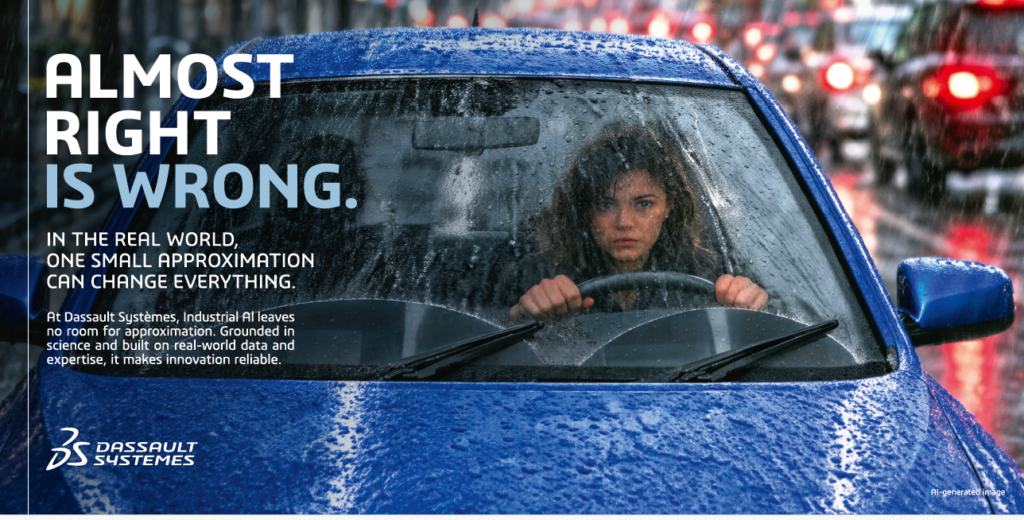
As industries adopt AI at scale, trustworthy, science-based models are going from a nice-to-have to a must-have, and we’ve spent decades investing in simulation and Virtual Twin technology to be ready for that shift. The payoff goes well beyond any single product: safer vehicles, faster drug development and factories that catch problems in the virtual world before they happen in the real world.
We want everyone to understand what that means, not just engineers and scientists, so our Almost Right is Wrong campaign is rolling out through video, social media and live events.
Related Questions About Industrial AI
Industrial AI is artificial intelligence applied to the physical world, from product design and manufacturing to infrastructure and scientific research. Because it works where mistakes have real consequences, it has to account for physics, safety and regulations.
Everyday AI tools like chatbots and image generators produce content that can be wrong without much consequence. Industrial AI has to be precise. It’s used for things like structural simulation, predictive maintenance and materials discovery, where a plausible-sounding answer isn’t good enough.
No. AURA, LEO and MARIE are built to work alongside people, not replace them. They bring knowledge, engineering reasoning and scientific expertise to the table so people can make better-informed decisions and explore ideas they might not have had time to consider.

Dassault Systèmes is a catalyst for human progress. Since 1981, the company has pioneered virtual worlds to improve real life for consumers, patients and citizens. With Dassault Systèmes’ 3DEXPERIENCE platform, 370,000 customers of all sizes, in all industries, can collaborate, imagine and create sustainable innovations that drive meaningful impact. For more information, visit: www.3ds.com. For more information, visit https://www.3ds.com