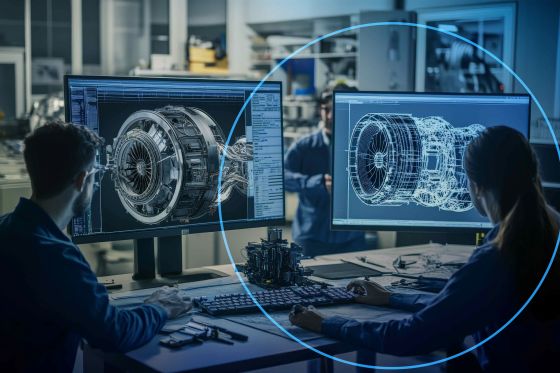
Artificial intelligence has a clear foothold in the world of engineering. From vibe coding to workflow automation and beyond, the technology has found a home for itself among coders, programmers and developers. But not all AI tools and systems are built equally, and not all of them can accomplish the tasks that engineering teams need them to.
For highly complex drawing, design, modeling and simulation tasks, a purpose-built AI system is critical. Engineers require highly specialized and trustworthy tools that understand all the physics and machinations behind the digital drafting of physical components. For these tasks, an industrial and generative AI tool made for engineers is the way to go.
What’s missing with general-purpose LLMs?
LLMs are exhibiting more and more intelligence. They can source vast amounts of information, interpret data, simplify complex concepts and sometimes correctly count the number of “Rs” in strawberry. But when it comes to specialized engineering tasks, they can fall short.
“While LLMs have demonstrated outstanding reasoning, they remain inherently world-blind. They lack a fundamental grasp on physical reality. These models perceive the world mostly through text, leading them to hallucinations when you face them with real-world constraints,” explained Eloi Mehr, 3D MODSIM & AI technologies director at Dassault Systèmes.
In fact, a recent study found that multimodal language models – those that can generate videos and images, not just text – “encounter considerable challenges in spatial reasoning tasks,” particularly “in accurately inferring three-dimensional spatial positions and orientations, resulting in geometric construction errors.” On an individual basis, those errors can be frustrating; at scale, they’re an impediment to progress.
For the general public, a chatbot is a useful, simple tool. For an engineer, it might be helpful in some regards, but it won’t necessarily be a helpful addition to complex workflows. It’s an add-on that can be nice to have, but it won’t be the feature that enables physics-backed CAD, particularly not in an environment that’s trained on and familiar with the unique product design, component supply, environmental conditions or other constraints that a purpose-built tool might be.
AI chatbots, despite their intelligence, do still hallucinate and make mistakes. When users point this out, the models typically apologize and may correct their previous outputs, or at least attempt to do so. For many interactions, those missteps can be annoying, but for conversations around mechanical engineering principles or product development and design, they can have an outsize effect.
What are the crucial components of a purpose-built AI engineering tool?
A purpose-built AI tool for engineers relies on our Industry World Models, specialized training data from domain expertise and industrial-world reasoning to generate reliable outputs. Dassault Systèmes’ Industry World Models rest on three pillars informed by decades of engineering expertise.
First, industry world understanding is essential. This refers not to a single model, but an entire ecosystem of specialized, industrial AI models.
“We elevate AI from simple pattern matching to structured synthesis, plus physics-aware behavior,” said Mehr. This serves to ensure that outcomes generated through these models are consistent with real-world behavior. Decades of domain expertise lend themselves well to this part of the equation. Knowing that the constraints on temperature and torque will be considered and correctly applied to a generation within a virtual twin creates a real sense of trust in a model’s outputs.
Next, we contextualize our models with each customer’s knowledge and our own industrial know-how, with full traceability. This information is fed into our models to create trustworthy virtual twins that are, you guessed it, compliant with real-world behavior. Domain fluency, tolerance stacking and material behavior–all of this is considered when building and training models. It’s this aspect that sets apart general-purpose AI tools from those created specifically with mechanical engineers in mind. Users don’t need to train their tool on FEA boundary conditions or geometric dimensioning and tolerancing; these key competencies are baked in.
Lastly, there’s the crucial component of industrial world reasoning. This aspect leverages the reasoning capabilities that LLMs are known for to orchestrate AI models, physics solvers and modeling engines together, achieving complex workflows.
“We are moving past speculative AI – we are building a multi-modal framework that elevates AI to the level of complex industrial scenarios, making it not just generative but truly trustworthy and actionable in the real industrial world,” Mehr said.
Why does trust matter in AI for engineering?
In fields like engineering, design and manufacturing, the stakes are incredibly high. A small error in a design calculation or a flaw in a manufacturing process can lead to catastrophic failures, costly recalls and significant safety risks. There is no room for error. Accuracy, precision and reliability are non-negotiable. When a bridge is being designed, a new medical device is being developed, or an aircraft is being assembled, every single component and calculation must be flawless. The source of information and the tools used must be unequivocally trustworthy.
This is where Industry World Models demonstrate their true value. The Dassault Systèmes approach to industrial AI is grounded in building and maintaining trust through several key pillars:
- Specialized and curated training data: Instead of relying on the open internet, the AI models are trained on highly specialized, proprietary data from decades of scientific research, industry-specific simulations and real-world engineering projects. This ensures that the AI’s knowledge base is both relevant and verified, leading to outputs that can be depended on.
- Decades of research and domain expertise: Dassault Systèmes has been at the forefront of engineering and design software for over 40 years. Our growing portfolio of AI solutions is the result of decades of accumulated knowledge and expertise. This deep-rooted understanding of the physical world is embedded in our AI, allowing it to grasp the complex nuances of engineering that general models cannot.
- Alignment with industry standards and practices: Our AI is designed to operate within the strict frameworks and regulations that govern the engineering and manufacturing industries. It understands and adheres to established standards, ensuring that its suggestions are not only technically sound but also compliant and practical for real-world application.
By focusing on these core principles, we deliver an AI that acts as a reliable partner—one that enhances the capabilities of engineers and designers without compromising the integrity and safety of their work.
“Reaching 60, 70 or even 80 percent of the expected result is far from enough,” Mehr said. “It is only by connecting generative AI with knowledge and semantics in an integrated MODSIM environment, namely the 3DEXPERIENCE platform, that you can expect to reach a strong business value.”
The future of AI in industry & engineering
Artificial intelligence, and specifically industrial AI, is and will continue to be a crucial part of engineering in the years to come. When used correctly, it has the potential to power progress faster than ever before, but that correct usage truly is conditional. For an experience that’s less headache-inducing than a back-and-forth conversation with a chatbot, there are purpose-built AI tools specifically for engineers.
With domain fluency in mechanical engineering and trustworthy outputs that can be confidently passed to manufacturing, AI platforms built specifically for engineers will prevail in the industry.
Take Dassault Systèmes’ newly announced Virtual Companions, for example. There’s LEO, named for polymath Leonardo da Vinci, which was created specifically to address and assist with complex engineering challenges. There’s MARIE, named for Marie Curie, who was trained with deep scientific expertise across domains like chemistry and materials science to ensure in-depth knowledge to empower breakthroughs. These companions were designed specifically to promote progress in their respective industries, acting as sources of truth and knowledge for engineers, scientists, designers and more.
General-purpose LLMs will continue to have their place in the field, too, of course. But that place may ebb and flow as specific offerings tailored to various specialties emerge. For tasks that require high levels of trust and consistency, those designed with engineers in mind will continue to dominate.
Frequently Asked Questions
Purpose-built AI systems train on specialized, industry-specific data rather than the open internet. In engineering, this means the AI understands physical constraints, material behavior and strict industry regulations that general LLMs fail to grasp.
General-purpose AI tools can assist with basic text generation or coding, but they are not suitable for complex mechanical engineering tasks. They lack physics-aware behavior and often generate inaccurate outputs when faced with real-world engineering constraints.
AI improves product development by helping teams create more optimal, performance-driven products faster. Purpose-built AI can evaluate not only physical behavior, but also manufacturing processes, cost considerations, design rules, material choices and industry standards. By accounting for real-world constraints earlier in development, it helps reduce rework, streamline decision-making and improve product quality before manufacturing begins.

Shoshana is a Senior Communications Manager on the Corporate Publishing team here at Dassault Systèmes. With experience in journalism, marketing, and PR, her work has been published around the world and across the internet.