The power of digital transformation was on display this March in Boston, as Dassault Systèmes hosted 360 customers and two dozen business partners at the 3DEXPERIENCE FORUM in North America, an invitation-only leadership event.
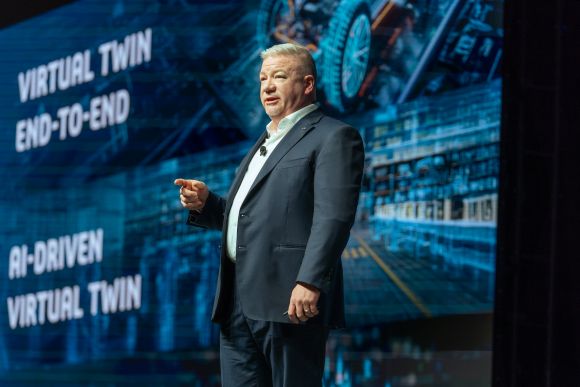
Morning plenaries were a window into the future of industry. Dassault Systèmes Chairman and CEO Pascal Daloz dove into industrial AI and introduced our new agentic AI assistants, called Virtual Companions, to the audience. Leaders from brands who made an indelible mark on 20th-century America discussed how a virtual-first transformation is helping modernize legacy operations and drive innovation in the 21st-century global economy.
We watched as:
- Ford Motor Company revealed its “Universal Electric Vehicle” will be the automotive giant’s first-ever vehicle fully conceived, engineered and validated on a unified digital platform.
- Textron Aviation, the maker of Cessna and Beechcraft airplanes, shared its approach to using augmented reality to improve efficiencies while adapting to key challenges, including workforce experience level and supply chain disruptions.
- PepsiCo described using the 3DEXPERIENCE platform to transform packaging innovation, including predicting optimal packaging size, and support the company’s sustainability goals.
Let’s dive in.
Digital Transformation is Driving Ford’s Universal Electric Vehicle
Ford says it’s “meeting the electric vehicle market where it is” with the new Universal Electric Vehicle platform, a highly flexible architecture designed to support a family of affordable electric vehicles. The first will be a mid-sized electric truck, slated for availability in 2027.
That truck won’t just be the first entry from the Universal Electric Vehicle platform, it will be Ford’s first-ever vehicle conceived, engineered and validated on a unified digital platform – from concept to production floor. It’s not just a reimagining of electric vehicles, it’s a reimagining of how Ford brings vehicles into the world.
Rekha Wunnava, CTO – Industrial System at Ford, said the UEV was designed on the 3DEXPERIENCE platform, with native data sharing and manipulation. The unified digital thread replaces hundreds of disconnected tools and compresses time-to-market. Integrated 3d model-based engineering is eliminating rework that used to add 12+ months, she said.
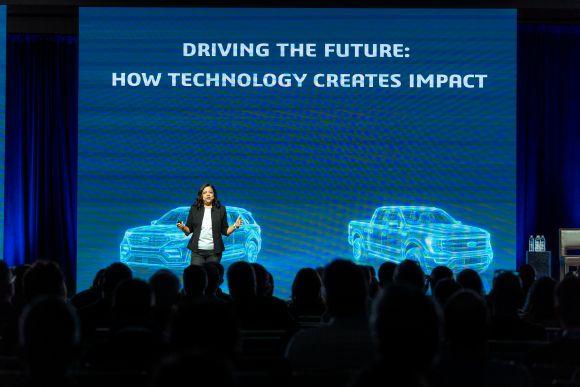
It’s a complete reconceptualization of how Ford brings products to life, unencumbered by legacy processes. Wunnava described modernizing tech stacks across three dimensions: engineering with product lifecycle management, material management with enterprise resource planning and manufacturing execution systems.
“Think about what it takes to do that,” Wunnava said. “A lot of courage, confidence and a little bit of crazy. You have to have that little bit of crazy to even think that this is possible.”
Ford created its Industrial System function a few years ago, and Wunnava acts as the technology lead for that function. They consider their mission to be delivering a vehicle program, not an IT project. Wunnava said Dassault Systèmes has been a significant partner in the digital transformation journey and described the 3DEXPERIENCE platform as the “connective tissue” and connected data layer essential to realizing the benefits of AI and other technologies.
“We’re no longer just implementing systems,” she said. “We’re creating impact. We’re creating generational impact for Ford. What we’re doing here is going to sustain for a long time.”
For Ford and Wunnava, the reimagined Universal Electric Vehicle platform is only the beginning. “Once you’ve shown that this is possible, you can extrapolate it to the rest of the organization,” she said.
How Textron is Updating Airplane Manufacturing with Augmented Reality
The makers of Beechcraft and Cessna Airplanes, Textron is an established company with a strong order book. They’re looking to improve efficiencies and manufacture planes faster, but are experiencing workforce turnover in which they’re losing tenured employees with valuable institutional knowledge.
Presenters Robbie Parker, a senior manager for quality assurance at Textron, and Jeff Schiesser, director of IT, said they identified Augmented Reality (AR) after a mid-2024 demonstration from Dassault Systèmes’ Augmented Experience. A year later, Textron had assembled a small, cross-functional team focused on using AR to address three key challenges: workforce experience level, manufacturing viability and supply chain disruptions.
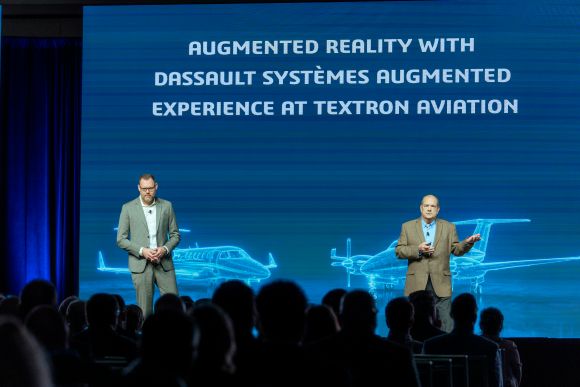
Parker and Schiesser shared three different use cases:
- Tablets for mobile and flexible check – from details to assembly – investigation and validation.
- Projectors to lay out stripe patterns on planes before they’re painted by hand.
- Camera-and-monitor for small-part verification and localized process aids.
Like Ford, the Textron team emphasized that having leadership support and a dedicated cross-functional team are integral to the success of any digital transformation initiative. As for next steps, Schiesser said they’ll focus on increasing utilization, scaling up use cases and doing training and enablement.
PepsiCo’s Using ModSim to Perfect Product Packaging
From EVs and airplanes the 3DEXPERIENCE FORUM moved on to Cheetos, Doritos and Lays potato chips. Prasad V. Joshi, vice president of global foods packaging at PepsiCo, discussed how the company is using the 3DEXPERIENCE platform to transform packaging innovation and support the company’s sustainability goals.
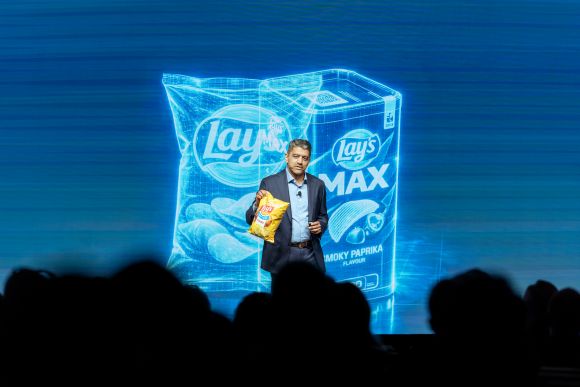
Joshi described the “flex bags” used for the popular chip brands as a “master class in engineering” that are highly efficient, flexible, lightweight and deliver optimal product freshness. Those flex bags are the current focus of PepsiCo’s transformation from physical prototypes, testing and factory trials to adopt a “virtual-first” approach.
“Our focus is to deliver efficiency, topline growth, consumer experience and associate experience,” Joshi said, adding they want to improve results at half the cost and greater efficiency.
The digital transformation process began in 2024 with setting the strategy and will continue through 2030 and beyond. PepsiCo laid the foundation in 2025. This year, 2026, they’re starting to use the first wave of apps to deliver value to the business, Joshi said.
A few early examples:
- Optimal package size: Using modeling and simulation, PepsiCo can predict the most optimal package size for a product, allowing the company to use less plastic and ship less air. This has a direct impact on PepsiCo’s sustainability goals of reducing the use of virgin plastic and cutting down on greenhouse gas emissions.
- Simulated shelving: The company can simulate how the flex bags will show up on real retail shelf environments before they ever leave the lab.
- Optimized shipping: Before the bags appear on shelves, they’re shipped in cases. PepsiCo is using modeling and simulation to see how many cases fit optimally on a pallet and how many pallets can fit on a truck. “All of this generates a significant impact in a business of our size,” Joshi said.
- Showing shopper experience: Finally, PepsiCo is using AR and VR tools to get an early read on shopper experience as their product hits the shelves.
“All of this is only a fraction of what we have on our roadmap,” Joshi said.
Dassault Systèmes’ Approach to Industrial AI
In early 2025, Dassault Systèmes introduced the concept of 3D UNIV+RSES, a new category of representation of the industrial world, combining modeling, simulation, data science and AI-generated content and experiences. This year, the vision is becoming a reality.
Daloz’s opening remarks invited the 3DEXPERIENCE FORUM crowd to imagine an enterprise in which every product, factory, supply chain and customer experience has its own virtual twin. The system – a 3D UNIV+RSE – learns, improves and predicts the future of a business before it happens. This will be the new architecture of a “generative economy,” and industrial AI, he explained, is at the center of it all.
“There is a lot of noise around AI now,” Daloz said. “Most of the conversation focuses on the language models, which are extremely powerful, but they generate only text. You do not design aircraft, validate factories or certify medical therapies with text. The large language models generate answers. The world model will generate industry knowledge.”
The world model Daloz was referring to are industry world models, a result of our expanded partnership with NVIDIA that combine Dassault Systèmes’ virtual twin technologies and decades of knowledge and know-how with NVIDIA’s AI infrastructure, open models and accelerated software libraries.
This new foundation for industrial AI includes new categories of solutions: virtual companions, generative experiences and Virtual Twin as a Service. It will be a force multiplier, according to Daloz.
““The future will not belong to those who react faster,” he said. “The future will belong to the one who knows how to simulate first.”
Meet Your Virtual Companions
Following the morning plenaries, Dassault Systèmes EVP and Geo Managing Director for the Americas Erik Swedberg and Manish Kumar, CEO of Dassault Systèmes’ SOLIDWORKS brand, introduced the three new Virtual Companions with a demonstration of their competencies.
The Virtual Companions are agentic AI assistants designed to address business challenges through natural conversations. They’re trained on decades of scientific knowledge, industry experience and technical know-how, combining Dassault Systèmes’ science with your own enterprise-level knowledge and information.
Our three Virtual Companions feature distinct personas and domain expertise, bringing complementary approaches to industrial business challenges:
- Aura orchestrates knowledge and context across requirements, projects and changes to help teams navigate complexity and maintain alignment.
- Leo solves complex engineering challenges across engineering disciplines, from design to production.
- Marie applies deep scientific expertise—including materials, chemistry, formulations and therapies—to investigate complex phenomena, formulate frontier questions and explore breakthrough hypotheses.
One part of the demo was designed to show how each companion would approach the same prompt from its unique perspective. The second half involved Leo creating a sketch from a drawing, making it into a parametric 3D model and using predictive analytics to do performance analysis.
All three companions will be available on the 3DEXPERIENCE platform. Aura has been available since last year, Leo has been available in beta since February and Marie will be released in April, according to Swedberg.
“We’re releasing them with lots of competencies, but this is only the beginning,” Kumar said.
Frequently Asked Questions
Available on premise and on cloud, the 3DEXPERIENCE platform is a business and innovation platform that provides organizations with a holistic, real-time view of their business activity and ecosystem. It connects people, ideas, data and solutions in a single collaborative environment. And so it empowers businesses – from the newest startup to the most established large enterprise – to innovate, produce and trade in entirely new ways.
3D UNIV+RSES are science-based environments that bring together modeling, simulation, data science and AI. They represent the seventh generation of innovation in Dassault Systèmes’ 40-plus years.
Virtual companions are AI-driven capabilities that assist professionals by leveraging validated world models and industrial knowledge. They support a new way of working, by augmenting human expertise rather than replacing it and enabling more informed and reliable decision-making.
Related content
- How Augmented Reality is Transforming Quality Assurance in Aerospace Manufacturing
- Introducing Industry World Models: The Dassault Systèmes – NVIDIA partnership explained
- Combining Industrial AI and Virtual Twins
- Ford Motor Company Enhances NVH Performance with SIMULIA
- The Key to Achieving Eco-Friendly Packaging
 Patrick Ball
Patrick is a Senior Communications Manager on the Corporate Publishing team here at Dassault Systèmes. An experienced journalist, marketer, speechwriter and storyteller, Patrick's words have appeared on pages and stages around the world.