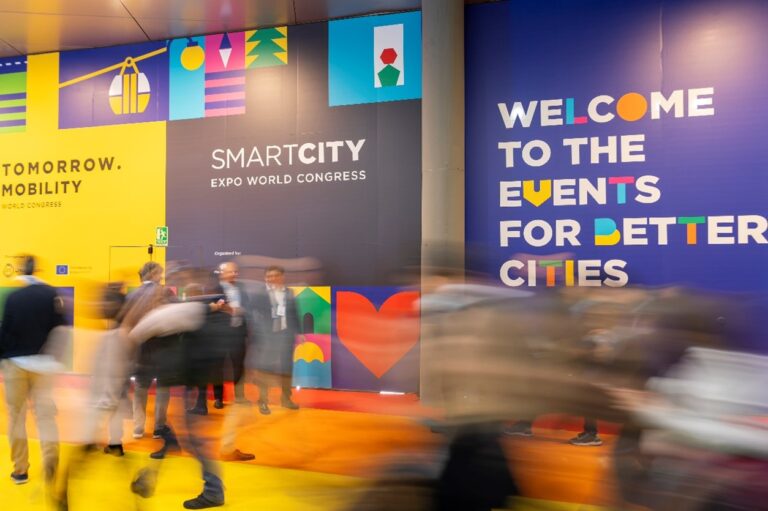

From November 4th to 6th, 2025, more than 27,000 people from 138 countries convened in Barcelona for the Smart City Expo World Congress to discuss the future and digital transformation of cities.
The major trend centered on AI-driven urban transformation and the use of virtual twins, also known as digital twins to model, simulate, anticipate and optimize city planning and operations. However, the event also addressed themes beyond technology, including public interest, human perception, social participation, solutions for vulnerable areas, public-private collaboration within multi-stakeholder ecosystems, low-tech environmental risk-mitigation solutions, governance and sustainable innovation enabled by algorithms and analytics.
From resource efficiency to urban transformation: What digitalization can really deliver
Among more than 1,000 exhibitors presenting solutions in geospatial and earth observation, climate and environmental intelligence, mobility and transport analytics, artificial intelligence, and data science, a common trend emerged: AI and Digital Twins are increasingly used to optimize processes, analyze data, and generate cost savings for public territorial administrations. This represents an important advancement given the significant resource constraints many local governments face.
However, presentations from entities such as Metropole du Grand Paris, Salt Lake City, and the City of Santiago de Chile emphasized that these technologies extend far beyond operational efficiency. Discussions highlighted fundamental issues related to public interest, citizen participation, and public-private collaboration. The importance of integrating non-technological solutions that draw on local community knowledge — through low-tech and nature-based approaches — was also strongly underscored. Speakers repeatedly noted that digitalization should be understood not only as a tool for improving existing processes, but as a driver of inclusive, resilient, and adaptive urban development.
By combining advanced data analytics with participatory governance and context-specific interventions, municipalities can better anticipate urban risks, enhance quality of life, and support sustainable development. Ultimately, the event emphasized that the true potential of digitalization lies in enabling holistic urban transformation rather than generating incremental efficiency gains.
The social and public dimension in building smart cities
A central question addressed during the event concerned how smart cities — composed of sensors, data, software, and digital infrastructure supplied by public and private actors — can be treated as a public good and genuinely serve the interests of populations, particularly in contexts of deep inequality.
During the session “AI Mapping for Global Urban Challenges” specialists such as Monika Kuffer (ITC–University of Twente) and Washington Fajardo (Inter-American Development Bank) examined how social innovation and emerging technologies (such as GeoAI and Virtual Twin) are being mobilized to address vulnerabilities in precarious neighborhoods and climate adaptation. Discussions emphasized the value of collaborative networks involving universities, private companies, and public institutions working together to monitor urban conditions and populations exposed to risk. These collaborations rely on user-centered methods, co-design practices, and the involvement of local, national, and international actors in the development and early adoption of AI-enabled tools.
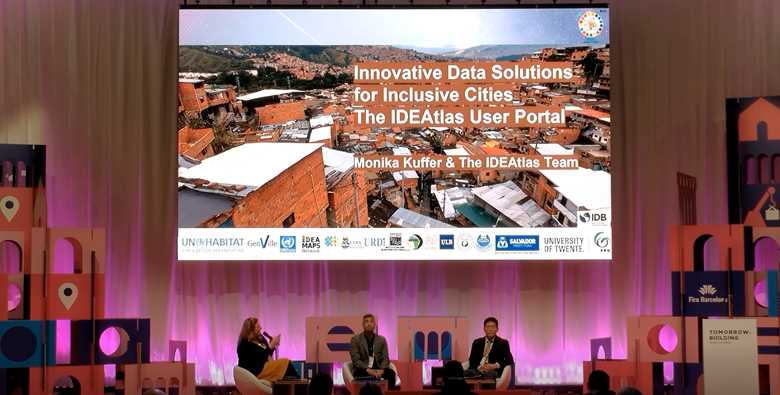
Participants also highlighted structural challenges many municipalities face in managing urban risk, including the lack of systematic inventories, outdated or fragmented data, and insufficient interoperability among governmental systems. These gaps hinder evidence-based planning and slow coordinated responses to threats such as flooding or extreme urban heat. Even when extensive data is available, it often remains descriptive rather than actionable.
Connecting social innovation with multi-stakeholder ecosystems
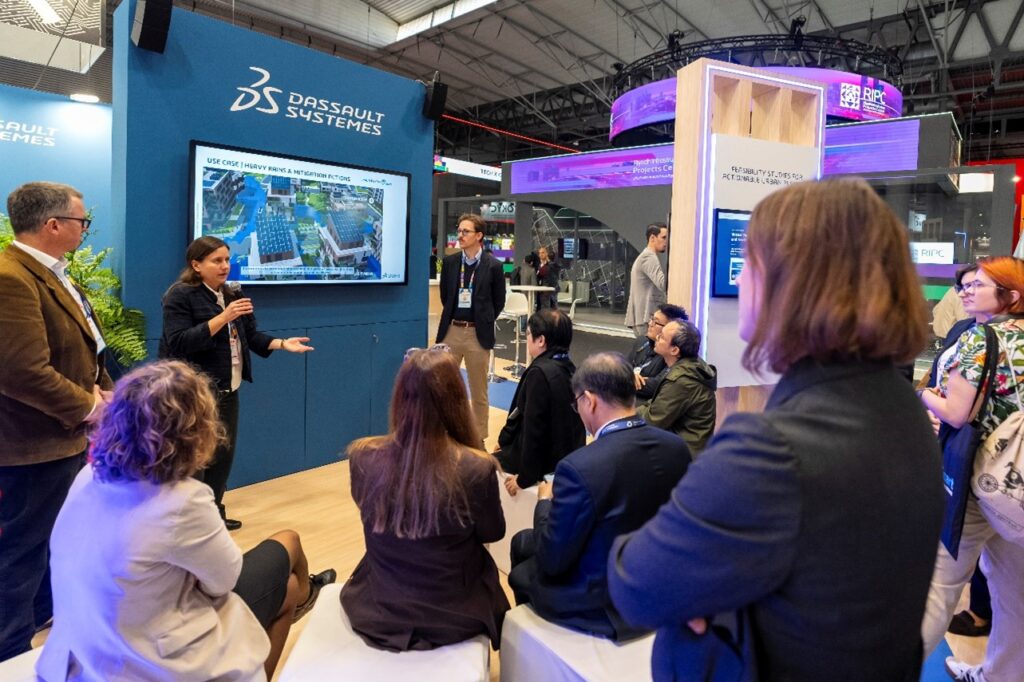
At Dassault Systèmes, social innovation capabilities are embedded within the Urban Virtual Twin. One strategy involves integrating public perception into Virtual Twin, either through co-designed surveys with territorial authorities or by leveraging natural language processing and machine learning to better understand citizens’ expectations and needs. The 3DEXPERIENCE platform enables key stakeholders — including citizen associations, universities, and public entities — to access and engage with the Virtual Twin to monitor and contribute to urban transformation projects. We support a wide ecosystem of urban stakeholders, composed of both public and private actors — by providing collaborative tools for projects related to ecological and energy transitions across different regions worldwide.
Two projects illustrate this approach:
- New Brunswick Southeast region (Canada):
In the Southeast region of New Brunswick, the project is carried out through a collaborative ecosystem involving local government, cities, universities, local companies, and Dassault Systèmes. The initiative uses Virtual Twin technology to map territorial capacity — land availability, housing, services, and mobility — while addressing pressures from:
- Rapid development along the Veterans Highway, which threatens wildlife migration. Its objective is to identify and design a biodiversity corridor that maintains habitat connectivity, supported by scenario analysis involving zoning adjustments and potential land acquisition.
- Rapid demographic growth on Moncton & Dieppe which may cause urban sprawl and increased traffic congestion. Its objective is to model, simulate and rank housing densification scenarios that will provide the additional housing units required while preserving or improving citizens’ quality of life
A Virtual Twin covering a 1,000 km² area, with detailed 5 km² zones for Dieppe and Moncton, integrates data on land use, housing supply, mobility, and planned developments. This shared reference enables partners to analyze risks and opportunities for corridor placement and to develop a strategy of housing densification to fulfill Moncton & Dieppe future housing needs, including affordable and student housing.
Hosted on the 3DEXPERIENCE platform, the Virtual Twin supports coordinated decision-making across the ecosystem, facilitates transparent communication with stakeholders, and helps develop solutions that balance ecological protection, territorial development, and long-term community needs
- Bécancour (Canada) — Energy Transition Valley:
The Energy Transition Valley in Bécancour brings together key actors involved in the energy transition to develop three integrated and sustainable hubs dedicated to strategic sectors such as battery innovation, transport electrification, hydrogen, and the decarbonization of industrial and heavy transport activities. Its mission is to create a complete ecosystem that supports innovation across these fields, while its vision is to establish itself as a leading Quebec ecosystem that contributes to the energy transition by accelerating innovation, strengthening training, and attracting talent and companies at both the national and international levels.
A central challenge addressed within this initiative concerns how to provide a dynamic environment that supports talent attraction, housing development, and mobility, enabling industrial and knowledge sectors to grow despite issues related to densification and traffic. The use of Virtual Twin technology supports this objective by improving the understanding of impacts generated by industrial projects — particularly in terms of housing, mobility, and land-use densification.
It also enables collaborative analysis and solution-building through the engagement of all relevant stakeholders. In addition, it strengthens communication with public authorities and citizens by clarifying key issues and illustrating the impacts and benefits associated with future developments.
Low-tech and nature-based solutions for mitigating environmental impacts
The event also highlighted environmental dimensions. Low-tech solutions and nature-based approaches have demonstrated strong effectiveness in reducing environmental impacts, particularly in vulnerable urban areas. These approaches are low-cost, easy to implement, and less dependent on large-scale infrastructure, making them accessible to public administrations with limited resources.
Examples include natural ponds for water retention, green corridors that enhance drainage and protect ecosystems, and temporary flood barriers. Beyond risk reduction, these solutions deliver co-benefits such as increased biodiversity, improved water quality, urban heat mitigation, and enhanced community well-being.
In collaboration with BMT TUFLOW and NOAQ, feasibility studies are being conducted to provide scientific assessments of flood-risk reduction delivered by simple measures such as natural ponds and temporary barriers. The use of digital twins further supports the implementation of these cost-effective solutions to help address climate-change impacts in cities. Combining advanced technologies with low-cost, nature-based approaches allows cities to mitigate environmental impacts while prioritizing environmental protection, community well-being, and public-sector financial efficiency.
What’s next?
Ultimately, the discussions at the Smart City Expo World Congress made clear that the future of urban development goes far beyond the deployment of advanced technologies. The well-being and resilience of cities depend on a complex model of collaboration in which diverse urban actors can collectively shape visions, share knowledge, and express their needs. Strategic implementation of simple, low-cost, and accessible tools — combined with inclusive governance and community-driven approaches — will be essential to mitigate the impacts of rapid urban growth and climate change. In this sense, the urban agenda of the coming decades must balance innovation with social participation, ensuring that technology serves as a catalyst for equitable, sustainable, and human-centered transformation.
Learn more
Further information about the combination of virtual twin technologies, AI tools, social innovation, multi-stakeholder ecosystems, and nature-based solutions for sustainability can be found on our Cities & Public Services pages