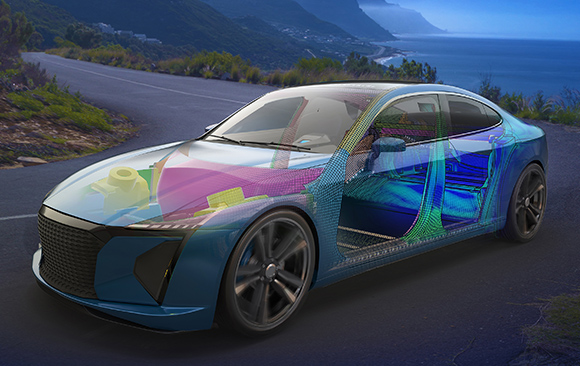
MODSIM unifies modeling and simulation on a common data model within a single user experience on the 3DEXPERIENCE platform, helping teams iterate faster, catch issues early and reduce the need for physical prototypes.
Product development teams face a hard truth: 70% to 80% of a product’s total cost gets locked in during the earliest design phases, yet those decisions are often made with only partial information. Concept engineers rush to a workable idea, design engineers overbuild to hit deadlines, and simulation analysts wait in line to validate what’s already been decided. The result? Late-stage failures, costly rework and missed market opportunities. MODSIM unifies modeling and simulation on a common data model within a single user experience on the 3DEXPERIENCE platform. The approach changes that story by connecting design and simulation from the very first sketch.
Why Siloed CAD and CAE Tools Slow Down Product Development
Walk into most engineering organizations, and you’ll find two teams speaking different languages. Designers work in CAD. Analysts work in CAE. Between them sits a wall of exported files, cleaned-up surfaces, and repeated preprocessing steps that eat up hours, if not days, that no one can afford.
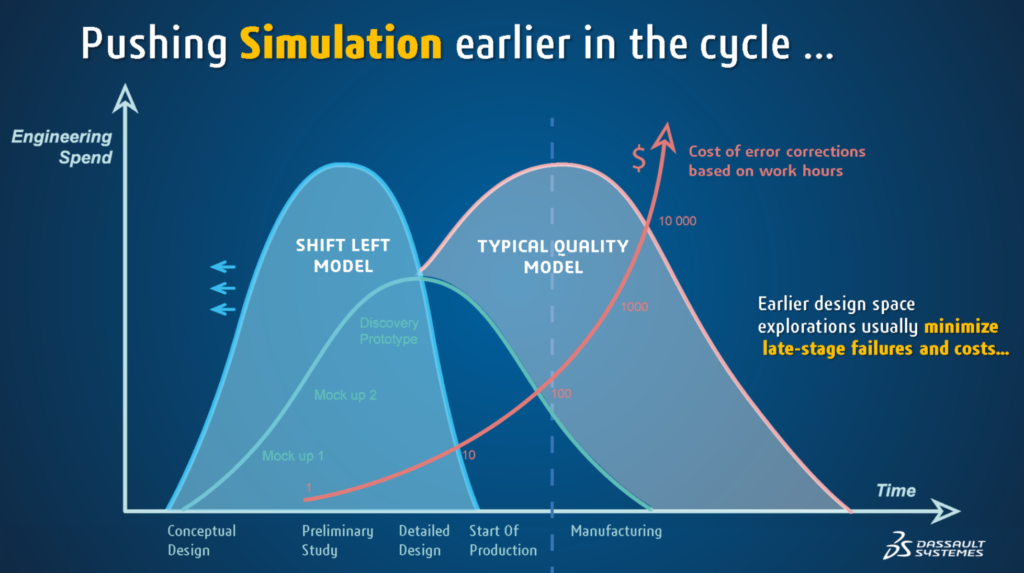
This separation carries a real cost. When product information stays siloed, it’s hard to get a consolidated view of requirements, design intent and simulation results across every discipline. Problems hide until late in the development cycle, when the design has solidified, and more stakeholders are involved. The later you catch an issue, the more it costs to fix—and research confirms that the cost of error corrections multiplies by a factor of 10 at each stage of development.
Concept engineers feel this pressure most acutely. Innovation starts with a strong concept, but early models evolve so fast, with so many unknowns, that running simulation-driven design on each idea feels impossible. So, teams settle. Once they have something that works, they move on, leaving better designs unexplored.
Traditionally, concept models evolve so rapidly, with so many changes and ever-changing inputs, that it’s simply too slow to convert a concept model into a simulation model, test it and repeat for every idea. Designers don’t have the time, so they miss the potential of unexplored designs.
Sometimes the simulation engineers work on outdated data and produce analysis results which are out of date and irrelevant because the design has moved faster than it could be analyzed.
That trade-off between speed and engineering confidence is exactly what needs to disappear.
MODSIM: Unified Modeling and Simulation on a Common Data Model
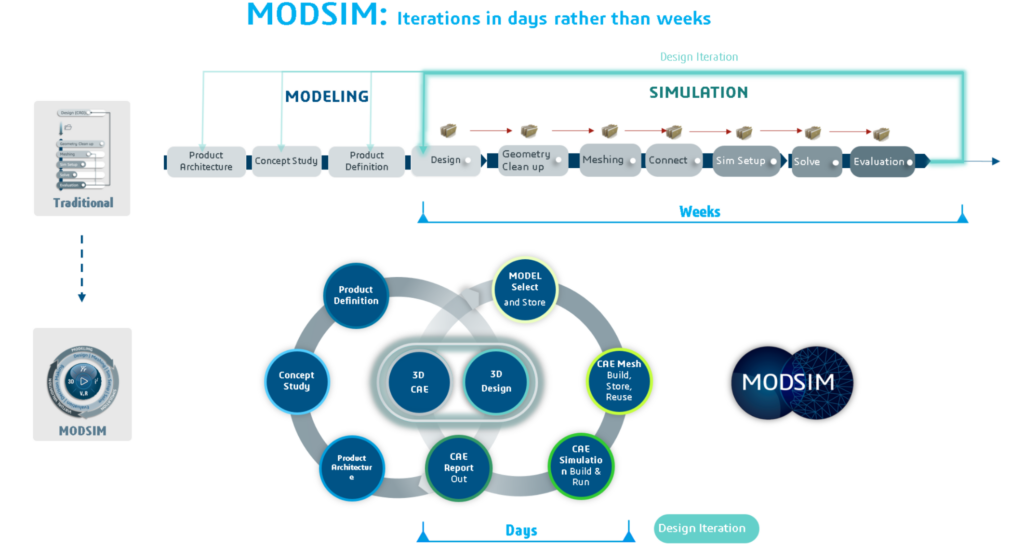
The MODSIM approach removes the wall between design and analysis. It combines CATIA modeling and SIMULIA simulation on a single associative data model within the 3DEXPERIENCE platform. The CAD model and the simulation model are totally in sync, nothing to export, convert or clean up before you run an analysis.
That single shift is what moves teams from design iterations measured in weeks to iterations measured in hours or even minutes. When you change the geometry, the simulation updates with it automatically. Simulation stops being a downstream bottleneck and starts driving design decisions from the concept phase forward. For concept engineers, this rests on a resilient, modular modeling approach: concept models are built from reusable, parametric modules whose relationships hold when inputs or architecture change, so each new idea can be re-simulated without rebuilding the model from scratch.
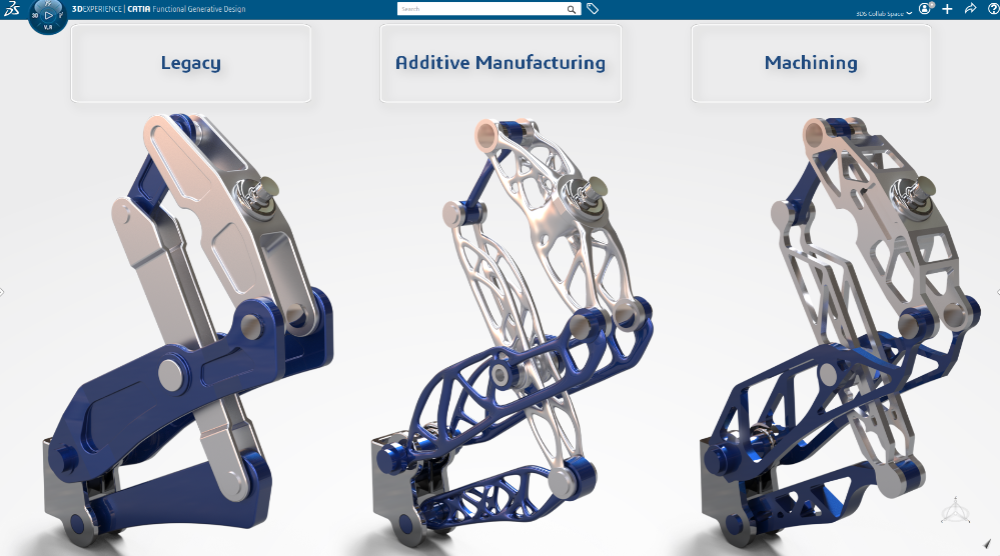
The unified model also opens the door to smarter, faster methods. With generative design driven by physics, engineers define performance criteria—such as weight, strength, pressure drop or vibration—and let the software automatically generate and evaluate design options. Design of Experiments (DOE) takes this further, enabling teams to explore the design space systematically to analyze large number of alternatives and identify optimal solutions without manually testing every variant.
MODSIM unifies the data model behind modeling and simulation, so there’s no distinction. This immediately eliminates the latency, because exporting or converting models for simulation is no longer needed.
For teams under pressure to reduce product cost and accelerate time to market, that latency was never a small thing.
Simulation-Driven Design from Concept to Manufacturability
A product that performs beautifully in isolation still has to survive the real world, and that means multiple physics at once. MODSIM enables multi-physics simulation, so analysts can study how heat build-up affects structural integrity, how electromagnetic fields interact with thermal loads or how airflow around a moving vehicle causes deformation. These are the problems that determine whether a product ships on time and at the right cost.
The same unified environment supports the product development lifecycle through three complementary engineering perspectives:
- Concept and design engineers can move rapidly from ideas to robust product definitions using CATIA’s advanced modeling technologies. Resilient and modular modeling helps architectures absorb changes without forcing teams to rebuild models from scratch; reusable modules accelerate the creation of variants; visual scripting enables engineers to automate geometry creation and explore complex design spaces; and Knowledgeware captures engineering know-how, rules and best practices directly in the model. Combined with simulation-driven design, these capabilities make it possible to evaluate more alternatives earlier while preserving design intent as the product evolves.
- Simulation analysts work on the same associative product definition and can access CATIA modeling capabilities directly. They can prepare or simplify geometry, evaluate multidisciplinary behavior and iterate on topology, shape or gauge changes without waiting for repeated CAD/CAE handoffs. Simulation templates, meshing rules and corporate standards can also be captured and reused, extending proven analysis methods across the engineering organization.
- Manufacturing engineers can validate manufacturability earlier in the process, using the virtual twin to identify issues such as over-tolerancing, tooling interference or geometry that cannot be manufactured as intended before those problems reach the shop floor.
Material complexity adds another challenge. Composites like carbon fiber deliver strong, lightweight designs, but they’re expensive and unforgiving. A slight change in fiber orientation can significantly alter structural strength. MODSIM helps engineers identify weak spots that need stiffening, automate ply placement and integrate manufacturing constraints into the design from the start. Stamping die design benefits in the same way: the die updates automatically when the part changes, and the software analyzes geometry, unfolds sheet metal and simulates the production process to catch problems before they reach production.
By capturing manufacturability rules, the virtual twin can detect where manufacturability issues are likely to occur. Identifying these issues during the design process is far less costly than fixing them on the shop floor. The virtual twin can also validate the production process well in advance, so production can start on schedule.
Catching problems in the virtual twin means fewer physical prototypes, lower development cost and a design that’s right the first time.
One Collaborative Environment: A Single Source of Truth With End-to-End Traceability
Unified modeling and simulation delivers its full value when the entire product development team works from the same data. As part of the cloud-based 3DEXPERIENCE platform, MODSIM connects concept and design engineers, simulation analysts, manufacturing engineers, project managers and stakeholders in one collaborative environment. Everyone references the same product definition, shares the same knowledge and communicates without the delays created by passing files across disconnected tools.
Project managers and stakeholders gain something they’ve long struggled to access: real-time visibility into product development status. Dashboards and analytics on the 3DEXPERIENCE platform show live requirements, design progress and simulation performance data. With MODSIM, managers can see which components don’t yet meet requirements, identify risks early and adjust schedules before delays cascade. Since the platform is cloud-based, project details are accessible on any device and can be presented in a format that executives and cross-functional leaders can act on.
With the virtual twin, all stakeholders, from engineers to project management to executives to sales, can see how the product will operate in the customer’s environment and provide input to make sure it brings the right capabilities to market.
Beyond providing a single source of truth, MODSIM strengthens traceability throughout product development. Requirements can be linked to the relevant product definition, simulation activities, input data and results, so teams can retrieve, for a specific product, what was done and why. This includes the model version, assumptions, parameters, scenarios and results, together with the requirement, engineering question or decision that motivated the activity. This continuity supports reproducibility, verification and validation (V&V), audit and certification, and impact analysis when a requirement or model changes.
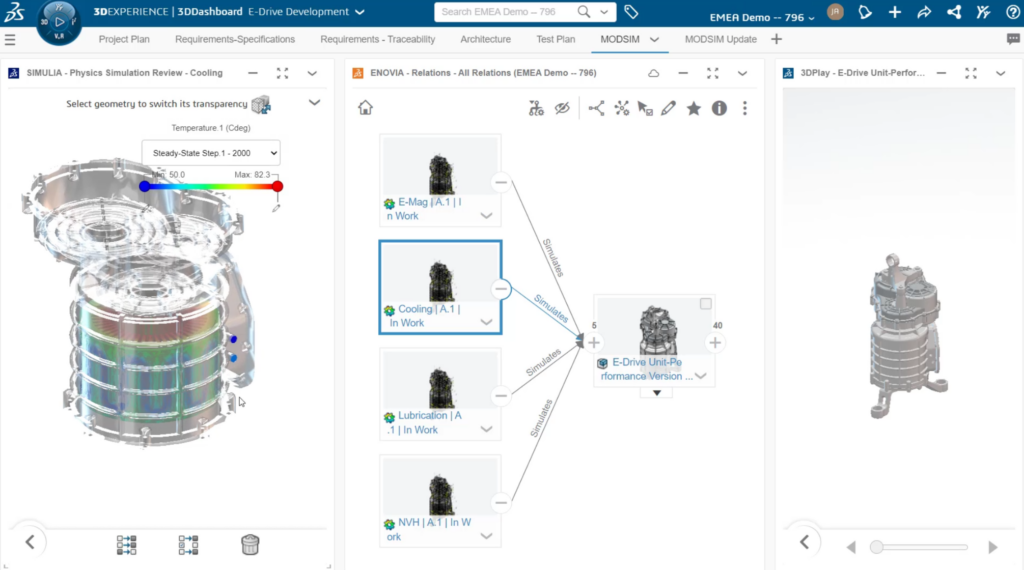
Design and simulation therefore stop being separate conversations. They become one continuous, data-driven flow grounded in a single source of truth, with the traceability needed to understand not only the current product definition, but also how and why key engineering decisions were made.
Accelerate Time to Market With Performance-Driven Design and MODSIM
MODSIM fundamentally reshapes how product development teams work. By left-shifting simulation to the concept phase, building a virtual twin experience early, combining advanced CATIA modeling technologies with SIMULIA simulation and driving optimization with physics-based generative design methods, teams can arrive at better products in less time and at lower cost. Modeling and simulation stop competing for schedule time and start reinforcing each other, enabling fewer physical prototypes, faster design iterations and more capacity for genuine product innovation.
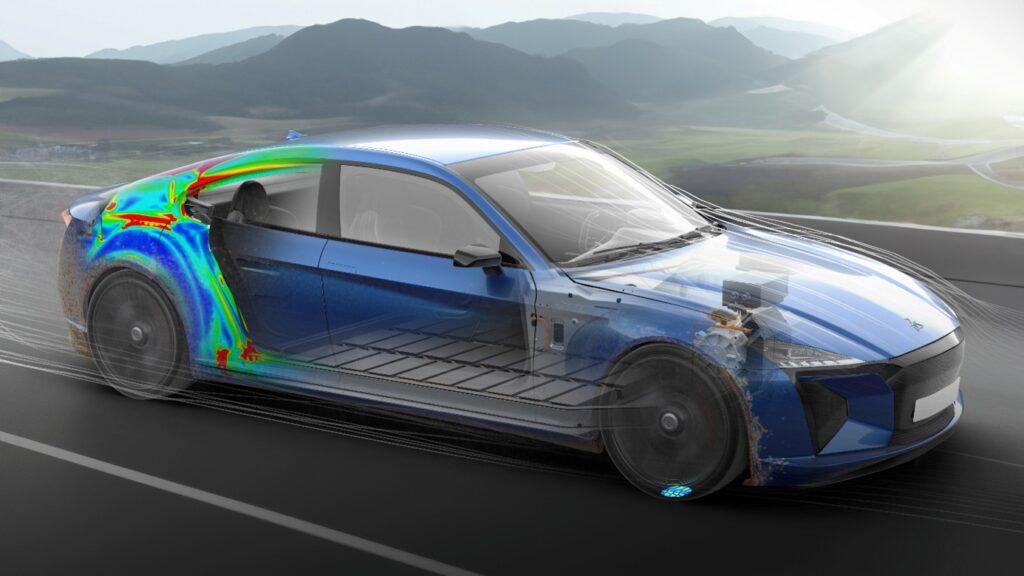
For aerospace, automotive, marine and industrial equipment teams working under real cost, compliance and time-to-market pressure, that combination is what separates market leaders from everyone else. With the MODSIM approach scaled through the engineering BOM and automated across departments, today’s investment becomes a foundation for future engineering capabilities, including AI and machine learning integration.
👉Download the brochure here
FAQ
MODSIM unifies CATIA modeling and SIMULIA simulation on a common data model within a single user experience on the 3DEXPERIENCE platform. It eliminates the traditional disconnect between CAD and CAE, enabling teams to make early design decisions with full simulation insight. This reduces late‑stage failures, rework and overall product cost.
MODSIM replaces file-based workflows with a single source of truth and traceable engineering data, allowing geometry and simulation to remain associative as designs evolve. Combined with resilient and modular modeling, visual scripting, Knowledgeware and reusable simulation methods, this shifts simulation to the concept phase, enables iterations in days instead of weeks, reduces physical prototypes and helps teams explore and converge on better designs faster.
The MODSIM approach removes the latency caused by siloed CAD/CAE tools—no more repeated exporting, cleaning or converting models. It prevents late discovery of design issues, reduces the cost of error correction, and enables concept and design engineers, simulation analysts and manufacturing engineers to collaborate seamlessly in one environment with traceability of what was done and why.
MODSIM enables multi‑physics simulation (thermal, structural, electromagnetic, fluid) within the same unified model. It also validates manufacturability early by detecting over‑tolerancing, tooling issues, composite fiber orientation problems and sheet‑metal stamping risks—long before reaching the shop floor.
Aerospace, automotive, marine and industrial equipment teams gain the most value—especially those facing strict cost, compliance and time-to-market pressures. MODSIM connects concept and design engineering, simulation, manufacturing and project stakeholders in one traceable environment, while creating a future-ready foundation for advanced automation, AI and machine learning integration.
 Sébastien Cêtre
 is a CATIA Engineering Consultant Industry Process Manager, within the CATIA Engineering Organization.
 Manohar Prabhu
 is the CATIA Engineering Consultant Industry Process Director, within the CATIA Engineering organization.