What Makes Industrial AI Trustworthy for Engineering?
Industrial AI is trustworthy when it is grounded in validated physics, not in language models alone. In engineering, speed means little without trust. An AI that drafts a fluent answer is not the same as an AI that is built on proven simulation technology and trained on validated simulation data, and the gap between the two is where product risk lives.
That is the idea at the center of SIMULIA R2027x, the next release of the simulation portfolio on the 3DEXPERIENCE platform. Two of the people leading it, Michelle Ash (CEO, SIMULIA) and Christian Whiting (vice president, R&D, SIMULIA), make the same argument from different angles: AI is fast becoming standard across industry, so having it is no longer an edge. The next advantage will go to the companies whose AI understands the physical world.
This post explains what that means, how it works in practice and what to expect when SIMULIA unveils R2027x at the live Release Keynote on Friday, November 20, 2026.
What is Physics-grounded Industrial AI?
Physics-grounded Industrial AI is artificial intelligence trained on, and anchored to, validated simulation of real-world physical behavior. It draws on Industry World Models built on proven simulation engines, trained on the data those engines produce.
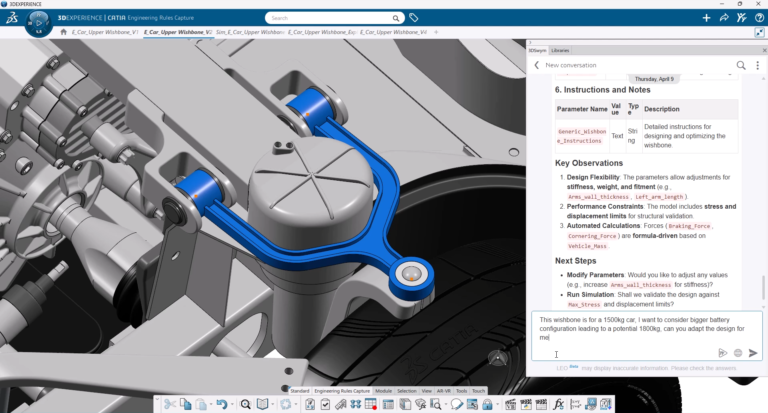
Whiting puts it plainly: many companies now offer physics AI, but not everyone has science-grounded tools. The difference, he says, is what sits underneath. SIMULIA builds its Industry World Models on its own simulation engines, and those models underpin the competencies of LEO, the agentic Virtual Companion on the 3DEXPERIENCE platform. LEO works through SIMULIA’s solvers, so the results it returns come from validated physics.
Ash adds two more qualities that matter to industrial buyers. AI on the 3DEXPERIENCE platform understands industrial applications and keeps customer data secure. Together, those three traits describe what “AI that understands the physical world” means in practice:
- Built on physics: validated, science-based simulation technology.
- Industry-aware: shaped by real industrial applications and workflows.
- Secure: designed to protect your data.
Why Aren’t Language Models Alone Enough for Engineering?
Language models can draw on validated data, but they cannot validate their own answers against the laws of physics. Engineering decisions depend on outcomes that obey those laws. Without a physics-based solver behind it, a model has no built-in way to check whether a bracket will hold, a field will behave or a flow will separate.
This is why Whiting stresses that SIMULIA’s AI models do not rely on language models alone. Language is how people talk to the system. Physics is what makes the answer worth acting on.
The result is AI that is fast, explainable and ready to act on, because its insights rest on simulation technology proven over decades of industrial use. For engineering organizations under pressure to shorten time to market while products grow more complex, that track record is what separates a useful insight from a risky guess.
What is LEO, the Agentic Virtual Companion for Engineering?
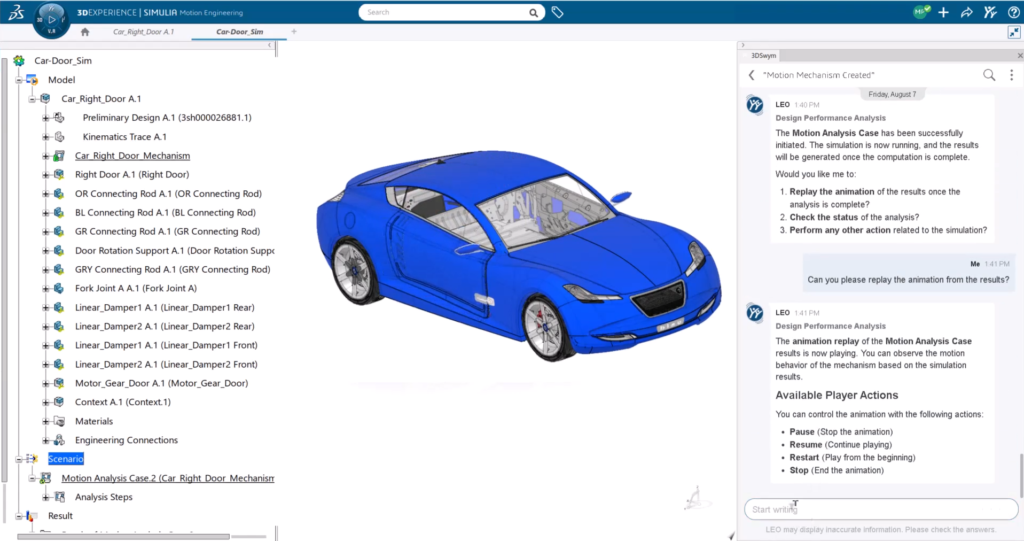
LEO is an agentic AI Virtual Companion on the 3DEXPERIENCE platform that sets up, runs and analyzes simulations for you. It goes beyond answering questions: within real industrial workflows, it takes on routine tasks and guides you in natural language at every step.
The practical payoff is a shift in where engineering time goes:
- Experts gain time for higher-value work instead of repetitive setup and post-processing.
- More people can use simulation with confidence, because LEO guides them through setting up a simulation and answers questions in plain language.
- Results rest on validated physics, because LEO runs simulations on SIMULIA’s solvers rather than relying on a language model.
As Whiting describes it, the goal is for engineers to spend their time on the work that matters most, while LEO handles the rest.
What is the Virtual Twin of Physics Behavior?
The Virtual Twin of Physics Behavior is a physics AI that predicts outcomes in near real time, based on high-fidelity data. It learns from industry-trusted SIMULIA solver data and delivers a high-fidelity 3D representation of your product in a fraction of the time a full simulation takes.
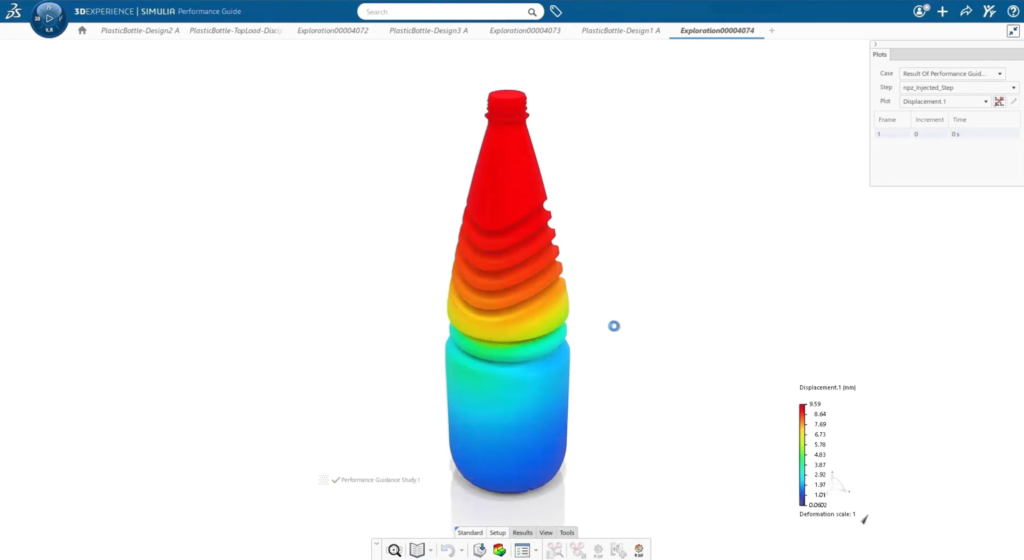
The real value goes beyond speed: near real-time predictions bring physics directly into the design process. You can see how a design will behave while you are still shaping it, without waiting for a specialist to run a full simulation, so simulation insight reaches more people across the team. It is the MODSIM idea, covered below, in practice. You can also explore far more design options earlier in development. Because it learns from trusted SIMULIA solvers, it helps you focus on the most promising designs, which you then confirm with full simulation.
Why Do Solver Technology and Performance Still Matter in the Age of AI?
AI is only as good as the physics behind it, so advances in solvers strengthen the AI capabilities built on them. The same trusted solvers that train the Virtual Twin of Physics Behavior and power LEO continue to advance in their own right.
R2027x brings the latest advances in structural, electromagnetic, fluid and multibody simulation across the 3DEXPERIENCE platform. It also shows how high-performance computing (HPC) reduces simulation time. Faster solvers, with the accuracy engineers already rely on, mean more training data for AI in less time and quicker results for the engineers using it.
That is why Ash describes the keynote agenda as covering LEO, the Virtual Twin of Physics Behavior and all of the solver updates together. They are one story, not three.
What is MODSIM, and Why is it Crucial for Industrial AI?
MODSIM is an approach that unifies modeling and simulation on a common data model on the 3DEXPERIENCE platform, so physics informs every design decision from the first concept. It is the bond between the design and simulation and thanks to this bond AI works seamlessly between CATIA, SIMULIA and other brands. It removes handoffs between design and simulation, keeps everyone working from the same data and puts simulation in the hands of more people across the engineering team.
Two days of keynotes showcase the approach:
- Thursday, November 19, 2026: the CATIA R2027x Release Keynote, covering connected Virtual Twins and Industrial AI, with live demonstrations of Virtual Companions and Generative Experiences.
- Friday, November 20, 2026: the SIMULIA R2027x Release Keynote, showing how trusted simulation and Physics AI come directly into the design process.
Together, the two events show how design and simulation become one.
Key Takeaways
- Trustworthy Industrial AI is built on validated physics and proven simulation technology.
- LEO is an agentic Virtual Companion that sets up, runs and analyzes simulations in real industrial workflows.
- The Virtual Twin of Physics Behavior brings near real-time, solver-trained predictions into the design process.
- Solver and HPC advances speed up both the AI capabilities built on them and the simulations engineers run directly.
- MODSIM unifies modeling and simulation on a common data model, removes handoffs and brings simulation to more people, so physics informs design from the first concept.
Join Us on November 20
Register now for the SIMULIA R2027x Release Keynote on Friday, November 20, 2026, or register for both keynotes to start with the CATIA R2027x Release Keynote on Thursday, November 19, 2026.
FAQ
SIMULIA R2027x is the next release of SIMULIA’s simulation portfolio on the 3DEXPERIENCE platform. It brings together Physics AI, agentic AI and solver performance.
The keynote takes place on Friday, November 20, 2026. It follows the CATIA R2027x Release Keynote on Thursday, November 19, 2026. According to Michelle Ash, the keynote is online and free.
Michelle Ash, CEO, SIMULIA; Christian Whiting, vice president, R&D, SIMULIA; and Delphine Genouvrier, senior director, R&D Role Portfolio, SIMULIA.
Industrial AI with LEO and the Virtual Twin of Physics Behavior, the latest solver technology and HPC performance, and unified modeling and simulation with MODSIM.
LEO sets up, runs and analyzes simulations. It also takes on routine tasks, guides less experienced users through simulation setup and answers questions in plain language.

Interested in the latest in simulation? Looking for advice and best practices? Want to discuss simulation with fellow users and Dassault Systèmes experts? The SIMULIA Community is the place to find the latest resources for SIMULIA software and to collaborate with other users. The key that unlocks the door of innovative thinking and knowledge building, the SIMULIA Community provides you with the tools you need to expand your knowledge, whenever and wherever.

Martin is the CATIA SIMULIA Offer Marketing Director