Executive Summary
Let us explore the transformative capabilities of Manatee, a critical tool that enables the management of magnetic noise & vibrations of electric machines and drives. By adhering to acoustic standards, engineers can optimize their approaches to enhance noise management and overall system efficiency in electric machine design.
Key Takeaways
- Manatee: A vital tool for tackling noise and vibration in electric machines, enhancing engineering outcomes.
- Magnetic Noise & Vibrations of Electric Machines and Drives Understanding: It is necessary to have awareness about e-NVH to bridge gaps between testing and simulation results.
- Consistent Measurements: Always use the same units (SPL vs. SWL) and accurately input parameters for valid comparisons.
- Noise Sources: Exclude mechanical and aerodynamic noises to ensure precise assessments of electromagnetic noise.
- Damping Importance: Consider actual modal damping in simulations as it significantly impacts acoustic behavior.
- Standards Compliance: Following acoustic measurement standards boosts accuracy and reliability in noise evaluations.
Introduction
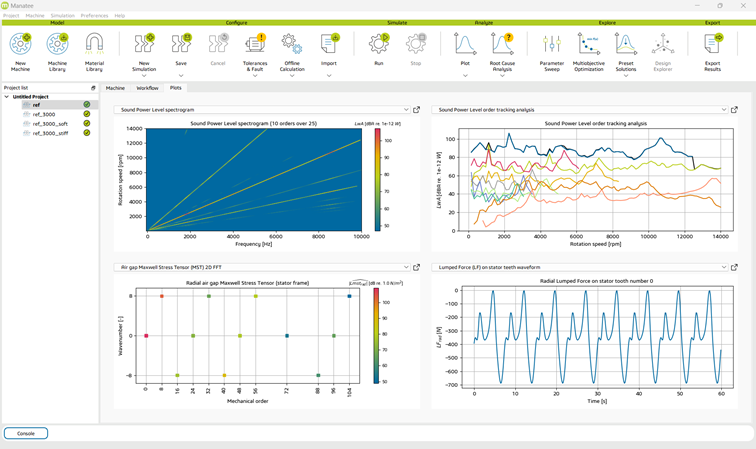
Originally designed to enhance consulting activities, this advanced tool has proven effective in troubleshooting and mitigating the noise associated with magnetic forces. With successful applications across more than 200 electrified systems, Manatee is a vital resource for predicting and managing electric machine noise, helping engineers refine their designs and improve overall system performance.
If you’re new to Manatee, our introductory blog on getting started with Manatee provides helpful background for this discussion.
Manatee can be used at the preliminary design stage to understand the physical phenomena responsible for noise and vibration and to design reduction techniques. An absolute correlation between tests and simulation is neither required nor accessible at those design stages. However, at a later design stage, when more input data are available, a good test of simulation correlation can be reached. In this blog, we will explore key considerations to prevent discrepancies between testing and simulation.
Sound Pressure versus Sound Power Level
When comparing tests and simulations, it’s essential to use consistent units. The manatee acoustic noise level can be expressed either as a sound power level (SWL) or a sound pressure level (SPL).
While SPL measurements are straightforward to obtain, they can come with considerable uncertainties, such as background noise, reverberation, and directivity. Therefore, careful attention is necessary when using SPL for comparisons. When employing an analytical SPL model in Manatee, it’s important to specify the actual room constant for the noise, vibration, and harshness tests to properly account for reverberation.
When comparing measured and simulated SPL results, be sure to enter in Manatee:
- the correct distance from the center of the e-machine to the microphone
- the correct directivity coefficient
- the correct room constant for the reverberant field
Electrical machines are typically tested in factories where the directivity coefficient may not be ideal, and the reverberation field can be uncertain. As a result, SPL simulation results may differ from experimental outcomes by up to ±10 dB.
It is advisable to perform sound power level measurements in accordance with acoustic standards (e.g., ISO 3745, ISO 3744, ISO 3746) for valid comparisons.
In loaded cases, the sound power level of the tested machine should exclude background noise and loading machine noise. Therefore, the intensimetry technique is recommended (in accordance with ISO 9614 standards).
Mechanical and Aerodynamic Parasitic Sources
When comparing measured and simulated SWL due to electromagnetic forces, ensure that non-magnetic acoustic noise sources, such as aerodynamic and mechanical noise, are excluded from your experiments. Be aware that aerodynamic noise may occur at the same frequencies as electromagnetic noise in specific applications.
Additionally, Manatee allows for the import of non-magnetic noise, including gear noise.
Noise Radiation Paths
Manatee offers various modeling levels suitable for the concept to the preliminary design phase. During the early design phase, semi-analytical vibroacoustic models primarily account for airborne noise radiated by the outer structure.
However, experiments typically reveal a portion of inner-borne noise, which can help explain discrepancies between test results and simulations. Inner-borne noise, caused by rotor excitation through magnetic forces, can be incorporated by using Manatee with a 3D FEA mechanical model, such as through the Electromagnetic Vibration Synthesis algorithm.
It’s essential to align the rotor FEA model, particularly the rotor bending modes and Rotor Housing Coupling mode, with experimental data for accurate SBN estimation. Additionally, the presence of the rotor can influence some stator modes (for example, the bending mode of a clamped-free stator), potentially causing differences between calculated and measured airborne noise if the rotor is excluded from the analysis.
When an electric motor is housed in a casing and sound power level calculations are performed using the outer envelope nodes of the casing in Manatee, the results will only consider structure-borne noise (caused by the vibrations transmitted from the motor to the casing), overlooking motor air-borne acoustic radiation through leakages. These leakages can contribute to the overall noise radiation, leading to higher noise levels.
Damping
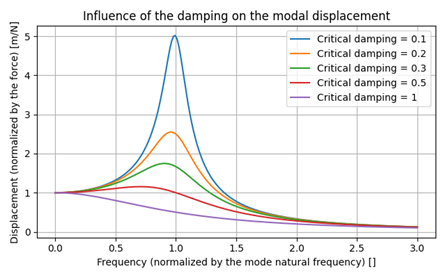
An important simulation parameter for achieving accurate absolute sound and vibration power levels due to magnetic excitations is modal damping, which typically ranges from 0.5% to 4% in electrical machines. Since damping cannot be calculated numerically, it depends on various factors such as temperature, resin type, winding technology, and mode/frequency.
Manatee default simulation workflows use a default average damping value of 2%. Simulations may then lead to = -12 dB to ) = +6 dB gaps compared to the test for the SWL at resonance peaks.
A step-by-step Experimental Modal Analysis is highly recommended to quantify the modal damping of your application. When measured damping is used in your simulation, the accuracy of vibration and sound levels can be brought down to +/-3 dB.
Additionally, discrepancies between simulations and tests may arise if the simulated modal basis is not representative.
Structural Modes
Discrepancies between simulation and tests can be obtained if the simulated modal basis is not representative of reality. This can be due to the following issues:
- Missing rotor in 3D FEA mechanical model
- The 3D FEA mechanical model has not been fitted with experiments
- 3D FEA mechanical model fitting has been carried out in different boundary conditions than operational ones (e.g., free-free)
- Stiffening effect of magnetic pre-stress on structural modes in some specific geometries
- Effect of coolant (e.g., oil film or water jacket) on structural modes and damping.
Magnetic and Geometrical Asymmetries
Eccentricities and geometrical or magnetic asymmetries can introduce new resonances due to additional magnetic force harmonics, significantly affecting vibration and noise levels.
Eccentricities, in particular, modulate all pulsating forces with Unbalanced Magnetic Pull (UMP) harmonics, which can easily excite different structural modes. If you have simulated a symmetrical machine in Manatee, you might find that some resonances are missing in comparison to experimental results.
It is recommended to take the following measurements:
- Phase current, resistance, and inductance (to evaluate current unbalance)
- Assess uneven turn distribution due to manufacturing constraints
- Measure stator bore radius (to identify non-uniform airgap)
- Balance the rotor and measure static and dynamic eccentricity (both direct mechanical and indirect electrical), including conical eccentricity
- Check IPMSM rotor magnetization along axial and circumferential directions (to detect non-uniform magnetization).
Current Waveforms
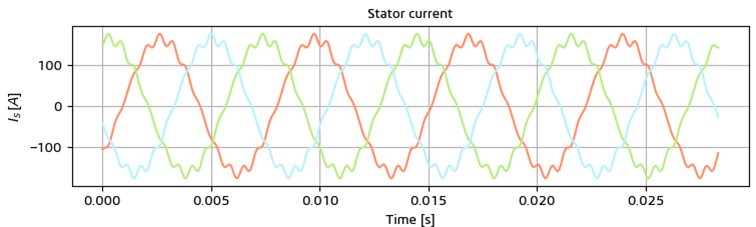
The current waveform influences magnetic excitation harmonics, which can vary between tests and experiments, particularly when using Manatee with a sine supply. Variations may arise from factors such as:
- Unbalanced phase currents
- Back EMF phase belt harmonics or Rotor Slot Harmonics (RSH or PSH) in induction machines
- Converter-induced low-frequency components, including 5f/7f voltage harmonics
- Parasitic harmonics resulting from faults
To address these issues, it’s advisable to measure the three-phase currents and incorporate them into Manatee simulations to assess their impact on e-NVH.
Data Acquisition Post-processing
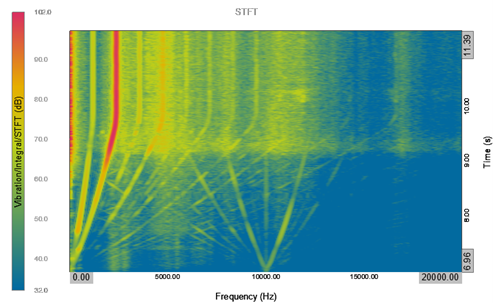
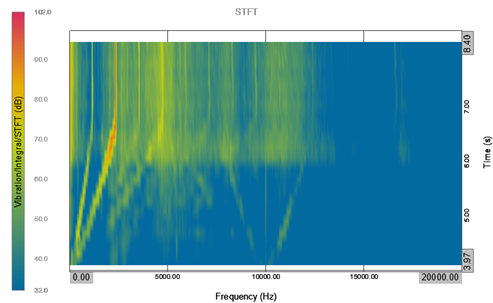
The signals obtained from a Data Acquisition System are typically post-processed using specific algorithms, such as the Short-Time Fourier Transform (STFT), RPM extraction, and order-tracking analysis. The parameters used in these post-processing techniques can significantly affect the results.
In addition to ensuring the accuracy of the test setup, it is important to consider the accuracy of post-processing. For instance, the STFT used to generate spectrograms involves a trade-off between time and frequency resolution. When comparing order levels, synchronous sampling (rather than fixed sampling) is recommended.
Order extraction should be performed by integrating energy over a specified bandwidth. It is advisable to conduct a sensitivity study on these parameters before comparing dB levels from tests and simulations.
Fluid-Structure Interaction in Electrical Machines
The following phenomena may impact the noise and vibration performance of the electric system:
- Temperature: Magnet temperature affects remanent flux and the amplitude of magnetic force harmonics.
- B(H) curve: If there is a high dependency on the fundamental frequency, ensure it is included in magnetic calculations.
- Axial magnetic forces: These may result from skewing or axial misalignment.
- Speed ripple or load fluctuations: These might not be included in numerical simulations.
- Strong electromechanical coupling: This includes the combined effects of centrifugal forces and eccentricities due to Unbalanced Magnetic Pull.
- Gyroscopic effects: Relevant for high-speed machines or when the magnetic circuit deforms under centrifugal forces.
- Strong rotor vibrations: These can modulate magnetic flux and may not be related to magnetic forces.
- Strong fluid/structure interaction: This applies to cases such as underwater electric motors or water-cooled electrical machines.
Modeling Accuracy
Manatee offers various modeling levels; when comparing Manatee results with experimental data, it’s important to progressively increase the modeling detail as discrepancies arise. Specifically:
- Electromagnetic loads should be calculated using electromagnetic Finite Element Analysis (FEA).
- Structural responses should be assessed with a 3D mechanical FEA model that includes both the rotor and stator, tuned to match experimental results.
- Acoustic responses should be evaluated with 3D acoustic FEA or Boundary Element Method (BEM) in free-field conditions under the following circumstances:
- If there are noise issues at low frequencies, the Equivalent Radiated Power model may overestimate sound levels.
- If significant acoustic leakage occurs, such as through the casing enclosing the electric motor.
Conclusion
In conclusion, Manatee serves as a critical tool for addressing noise and vibration challenges in electric machines. Its integration into the design process enables engineers to systematically analyze the noise and vibration performance of the electric system. When used for validation, discrepancies between simulation and experimental results must be avoided. By adhering to recognized acoustic standards and implementing consistent measurement protocols, practitioners can enhance the validity of noise evaluations. Essential considerations, such as excluding non-electromagnetic noise sources and incorporating damping effects, significantly contribute to accurate modeling. This methodological approach not only optimizes the design of electric machines, but also enhances their performance metrics, positioning Manatee at the forefront of noise and vibration engineering in electrified systems.
Read More

Interested in the latest in simulation? Looking for advice and best practices? Want to discuss simulation with fellow users and Dassault Systèmes experts? The SIMULIA Community is the place to find the latest resources for SIMULIA software and to collaborate with other users. The key that unlocks the door of innovative thinking and knowledge building, the SIMULIA Community provides you with the tools you need to expand your knowledge, whenever and wherever.

Katie is the Editor of the SIMULIA blog, an expert in engineering and scientific communication, and a strategic digital marketer. Katie has a BA in English and Writing from the University of Rhode Island and a MS in Technical Communication from Northeastern University. She is also a proud SIMULIA advocate, passionate about democratizing simulation for all audiences. Katie is a native Rhode Islander who lives just outside of her favorite city, Providence. She is a true New Englander and loves sharing all the cool things NE has to offer. She enjoys a variety of hobbies including history, astronomy, science/technology, science fiction, true crime, fashion and anything associated with nature and the outdoors. She is also mom to a 6-year old budding engineer and two crazy rescue pups.