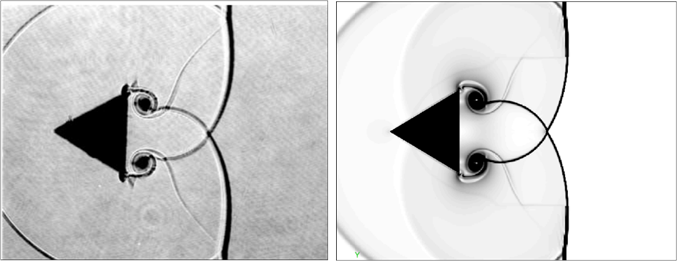
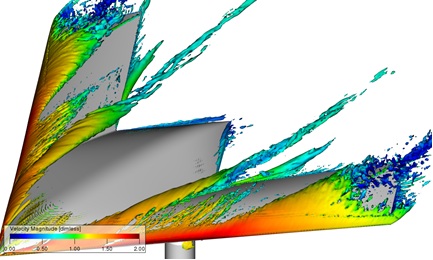
The Lattice-Boltzmann method (LBM) — well established over the past 20 years as the leading CFD tool for automotive aerodynamics — is now becoming the engine behind cutting-edge simulations of aircraft aerodynamics and acoustics with particular benefits for applications in the defense industry. Here is how we got here – from a theoretical curiosity in the 1980s to the wind tunnel’s digital rival today.
A Brief History: From Lattice Gas to Boltzmann
In the 1980s, researchers studying so-called lattice gas automata (LGA) showed that fluid-like behavior could emerge from simple rules governing how fictitious particles move and collide on a discrete lattice [1]. The approach was elegant but impractical: because particles were represented as simple on/off values, simulations were noisy and needed to be averaged over many runs to extract useful results. The breakthrough came when the crude particle counts were replaced with smooth probability distributions, connecting the method to the classical Boltzmann equation from kinetic theory. The noise vanished, the physics improved, and the lattice-Boltzmann method was born [2]. Subsequent refinements in the early 1990s made it fast and stable enough to consider for real engineering problems — though it remained limited, for now, to low-speed flows.
Exa Corporation and the Automotive Proving Ground
Founded in Burlington, Massachusetts in the early 1990s, Exa Corporation made a bold bet: that LBM could be turned into a practical industrial tool, starting with automotive aerodynamics. Their product, PowerFLOW, offered something traditional CFD solvers struggled to do —simulating complex, turbulent, unsteady flows around realistic vehicle geometries without spending weeks building computational meshes. Because LBM works on regular Cartesian grids that are generated automatically, engineers could import a full vehicle model and begin a simulation in hours rather than weeks.
The automotive industry took notice. Predicting aerodynamic drag, wind noise, and cooling airflow around a production car model involves extremely detailed geometry — door mirrors, underbody components, wheel arches, engine bay openings — and highly turbulent, separated flow that conventional steady-state solvers handle poorly. PowerFLOW’s inherently unsteady simulation approach, based on a Very Large Eddy Simulation (VLES) turbulence treatment [3], resolved most turbulent flow structures directly rather than modeling them away, producing results that correlated well with wind tunnel measurements. Major automakers adopted it as part of their development process, and PowerFLOW established itself as one of the leading commercial CFD tool through the late 1990s and 2000s.
Early Aerospace Inroads: Landing Gear and High-lift Noise
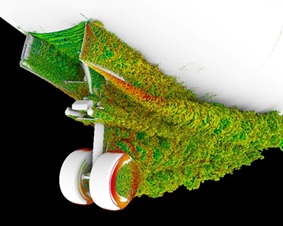
The same strengths translated naturally to aerospace applications where low Mach numbers prevail — in particular, the flow environment during approach and landing. Landing gear assemblies and multi-element high-lift wings generate intense broadband and tonal noise through unsteady turbulent interactions that PowerFLOW proved to be uniquely able to predict. Early validation campaigns on these configurations showed strong agreement with wind tunnel acoustic measurements [4], establishing PowerFLOW’s credibility in the aerospace community and laying the foundation for the far more ambitious NASA airframe noise partnership that would follow.
The Speed Ceiling — and the Decision to Break It
Automotive success, however, only took Exa so far. Cars travel at low Mach numbers where the standard LBM formulation is perfectly valid. Commercial transports cruise at around Mach 0.85; military aircraft operate well into supersonic territory. At these speeds, compressibility effects become dominant: the air’s density, temperature, and pressure change significantly as it flows over the aircraft, shock waves form where the flow locally exceeds the speed of sound, and the equations governing momentum and energy become tightly coupled. The standard LBM formulation, built on assumptions of small velocity perturbations and uniform temperature, breaks down under these conditions.
Exa’s leadership recognized that cracking the aerospace market meant solving this problem. The technical challenge was extending the speed range while preserving LBM’s core advantages: automatic meshing, inherent parallelism, and direct resolution of unsteady turbulent flow. A hybrid approach was developed in which the standard low-speed LBM kinetic solver was coupled to a high-order scheme capable of accurately representing the steep pressure and density gradients that appear across shock waves [5]. Stability at high Mach numbers — a persistent nemesis of compressible LBM formulations — required careful numerical design that took years of iteration to get right.
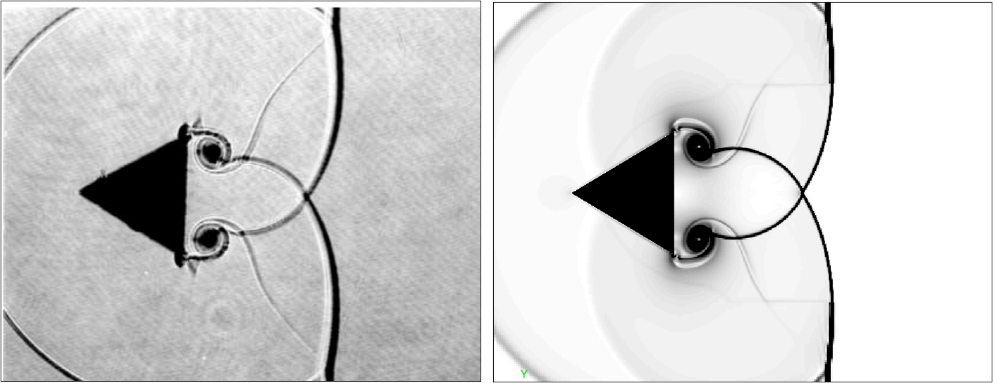
The payoff was a version of PowerFLOW that could simulate flows from low Mach numbers all the way to approximately Mach 2, covering the full subsonic, transonic, and low-supersonic flight envelope [6]. The same technology that had proven itself on car aerodynamics could now be pointed at an airliner wing at cruise, a fighter inlet at supersonic conditions, or a weapons bay generating intense acoustic loads.
In our next post in this series, we will describe the decade-long process of gaining credibility for this breakthrough in the aerospace and defense community through participation in AIAA workshops, countless validations against industry standard test cases, and an ongoing partnership with NASA.
To learn how these advances are being applied in practice, join Swen Noelting’s live webinar, “Optimizing Performance, Stability & Robustness in Defense Aviation with Advanced CFD Simulation,” on June 2, 2026. The session will explore how Lattice-Boltzmann-based CFD supports high-speed, unsteady flow and vibration analysis across defense aircraft, drones, missiles and launch vehicles. Register here: https://events.3ds.com/advanced-cfd-defense-aviation-optimization
References
[1] Frisch, U., Hasslacher, B. & Pomeau, Y. (1986). Lattice-gas automata for the Navier-Stokes equation. Physical Review Letters, 56(14), 1505–1508.
[2] Chen, H., Chen, S. & Matthaeus, W.H. (1992). Recovery of the Navier-Stokes equations using a lattice-gas Boltzmann method. Physical Review A, 45(8), R5339–R5342.
[3] Teixeira, C.M. (1998). Incorporating turbulence models into the lattice-Boltzmann method. International Journal of Modern Physics C, 9(8), 1159–1175.
[4] Casalino, D., Noelting, S., Fares, E., Van de Ven, T., Perot, F., Bres, G. Towards numerical aircraft noise certification: analysis of a full-scale landing gear in fly-over configuration, AIAA paper 2012-2235
[5] Lattice-Boltzmann/ Finite-Difference Hybrid Simulation of Transonic Flow, Nie, Shan, Chen, RIRR 2009-139.
[6] Noelting, S., Fares, E. et al. (2016). Validation of PowerFLOW for transonic and supersonic flow regimes. AIAA Paper 2016-0585.

Interested in the latest in simulation? Looking for advice and best practices? Want to discuss simulation with fellow users and Dassault Systèmes experts? The SIMULIA Community is the place to find the latest resources for SIMULIA software and to collaborate with other users. The key that unlocks the door of innovative thinking and knowledge building, the SIMULIA Community provides you with the tools you need to expand your knowledge, whenever and wherever.

Swen Noelting is a SIMULIA Aerospace & Defense Industry Process Director. He has a M.Sc. Mechanical & Aerospace Engineering from the University of Arizona and a Ph.D. Aerospace Engineering from Universität Stuttgart, Germany. From 1998 – 2017 he was the VP Aerospace for Exa Corporation. 2017 – present: Aerospace&Defense Industry Process Director, Dassault Systèmes