Introduction
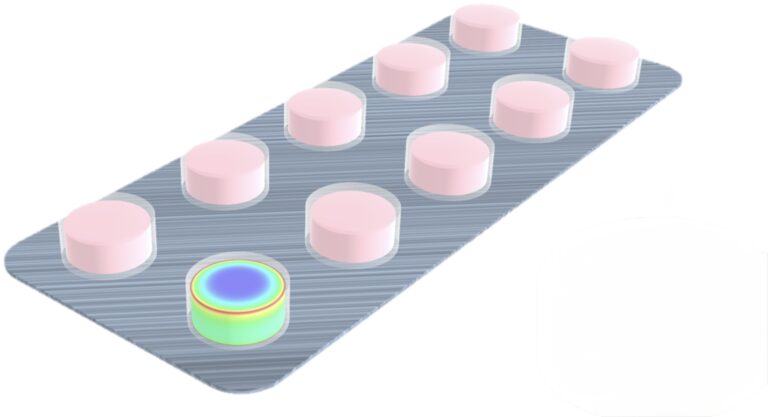
Ever wondered why there are so many tablet types on the market? The diversity of tablets isn’t cosmetic—it’s functional. A tiny variation in the tablet’s shape could alter its therapeutic effect. With the increasing complexity of diseases and the transition toward personalized therapy, pharmaceutical companies face a significant challenge in formulating efficient tablets not only from a medical efficacy standpoint, but also from a manufacturing standpoint. The traditional tablet development process involves an iterative cycle of lab-based powder compaction testing for a specific drug formulation across multiple tool designs, which is often time-consuming, resource-intensive and costly.
Tablet Manufacturing in Essence
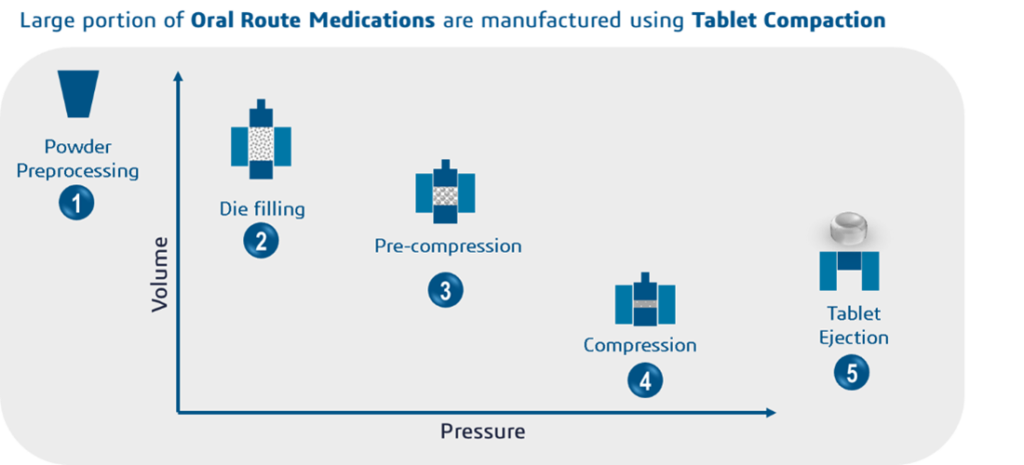
A typical tableting cycle begins with pharmaceutical powder blending to ensure compositional uniformity. After die filling, the powder is pre-compressed to achieve light compaction, followed by the main compression, which applies high pressure to form the final tablet. The ejected tablets are prone to developing defects, such as chipping, sticking, picking, capping and lamination. Every defective tablet signals lost value, highlighting the need for a tableting process designed to eliminate imperfections.
Tablet Prototyping: The Traditional Approach
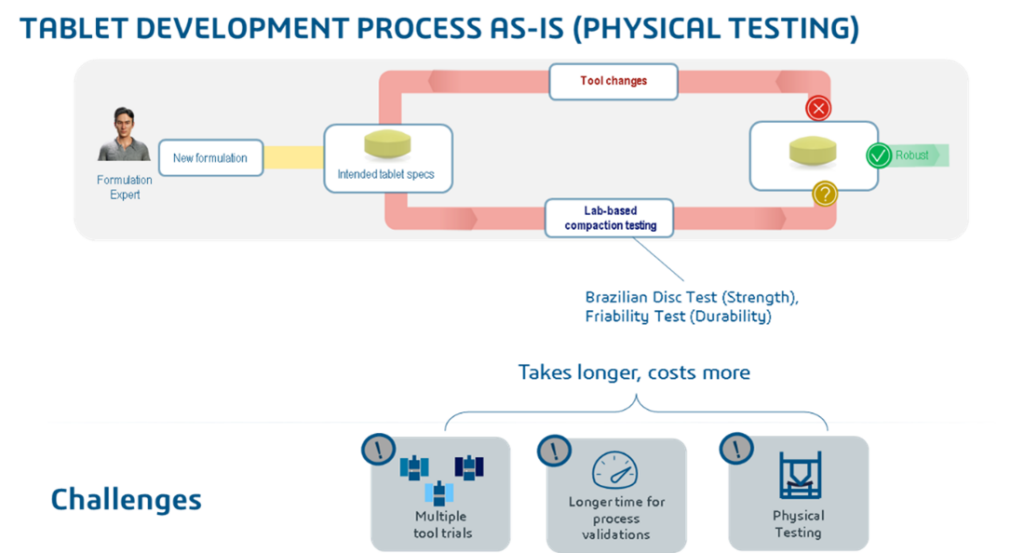
Minimizing the tablet defects during manufacturing is crucial. Traditionally, based on the required dosage, patient needs, formulation type and the drug’s physicochemical properties, the formulation expert chooses an appropriate tablet shape and size from standard tooling libraries and performs lab-based compaction tests. These tablet prototypes undergo a series of physical tests to evaluate their performance, including key performance indicators (KPIs) such as hardness, friability, disintegration and dissolution. If the prototypes fail to meet the required specifications, new tooling designs are developed and tested, leading to multiple design iterations. This as-is process, which relies heavily on physical testing and trial-and-error adjustments, is often time-consuming, resource-intensive and costly.
Modeling and Simulation in Tablet Compaction
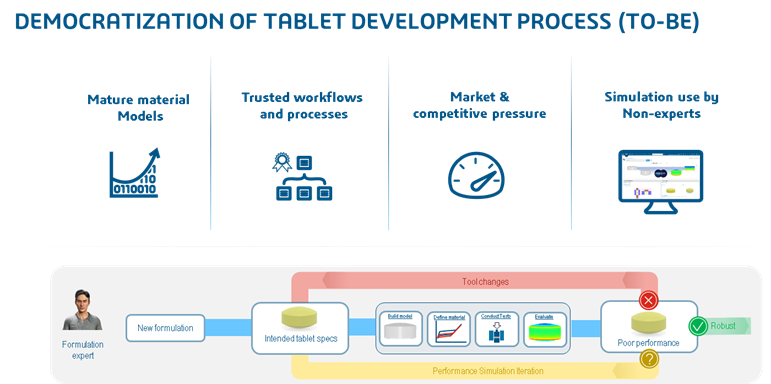
Simulating tablet compaction and analyzing the causes of defects through detailed stress analysis can help optimize process parameters to minimize defects. Virtual prototyping of lab-based tablet compaction using modeling and simulation technologies, such as Abaqus, has already been adopted by several pharma companies. However, they still face challenges during process validation, as simulation expertise is often limited to a small group. Additionally, when CAD models are created on separate software platforms, transferring and managing them for simulation and design modifications becomes cumbersome. At the same time, development teams are under growing pressure to accelerate time-to-market. Consequently, the MODSIM collaboration and the democratization of simulation, which make these capabilities accessible to a broader range of users, including formulation experts, are essential approaches to overcoming these limitations.
MODSIM Enables Efficient Tablet Compaction
To enable faster evaluation of tablet shapes and sizes, identify potential defects, and make the simulation more accessible to tooling designers and formulation experts, a four-step workflow can be implemented.
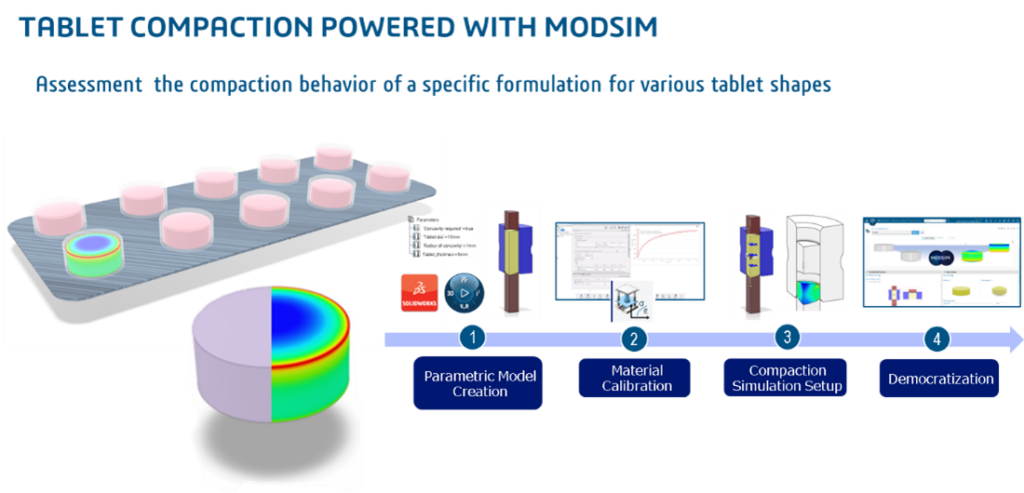
Parametric Model Creation
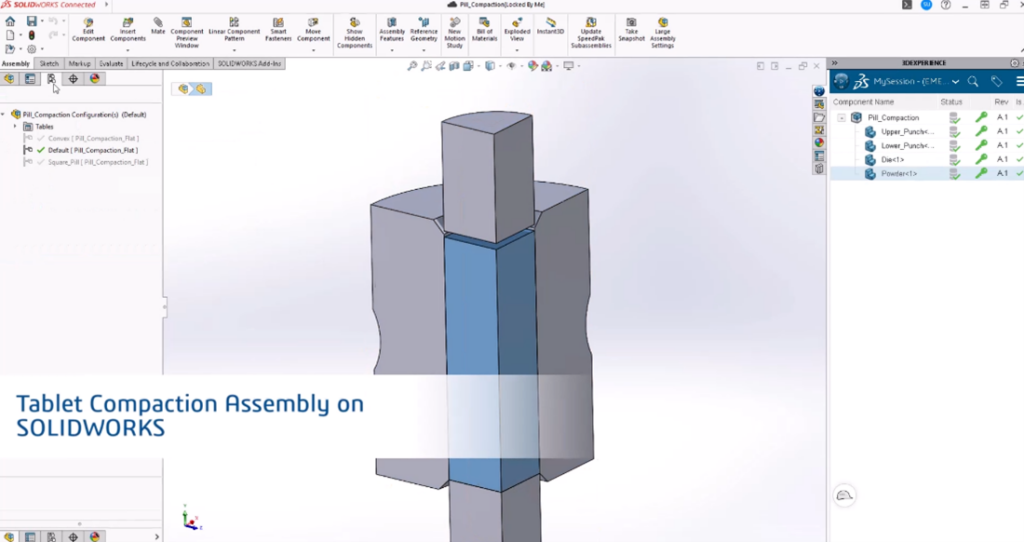
A virtual twin of tablet compaction can be developed to overcome challenges, such as the need to test multiple tools to achieve the desired tablet performance. This parametric tool assembly on the 3DEXPERIENCE platform enables the efficient creation and simulation of multiple tablet designs and shapes. Alternatively, SOLIDWORKS users can leverage MODSIM capabilities via two approaches. The first approach involves a concurrent design change and simulation update, in which a designer runs a simulation on a baseline SOLIDWORKS design on the 3DEXPERIENCE platform. Based on the simulation insights, the designer returns to SOLIDWORKS, modifies the design accordingly, updates the simulation model without repeating steps from the baseline simulation, and compares the results between the baseline and modified designs.
In the second approach, SOLIDWORKS users can perform parametric design studies leveraging the SOLIDWORKS Design app, along with simulation parameters (for example, material property, load cases, boundary conditions, etc.) for early design exploration.
These approaches not only enable designers to run initial analyses to guide their decisions but also eliminate the need for multiple file exchanges across different CAD software, making it easier to simulate and evaluate various tablet configurations seamlessly.
Material Calibration
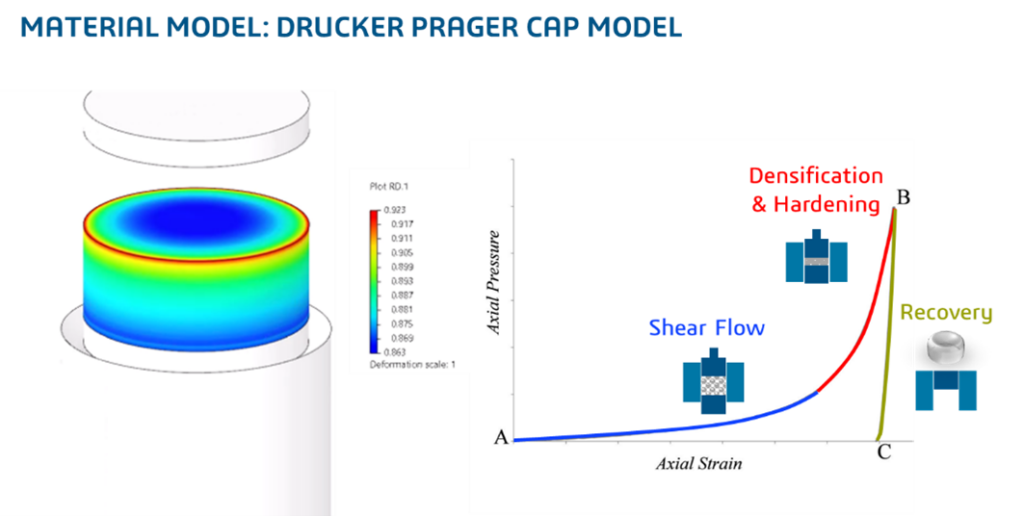
Tablet compaction is a complex physical process that begins with the initial rearrangement of pharmaceutical powders, resulting in shear flow. This is followed by Elastic-Plastic deformation of the particles, leading to tablet densification. Once the compaction force is released, the tablet undergoes nonlinear elastic recovery due to the powder’s dilation behavior. The inbuilt Drucker-Prager model with Cap Plasticity accurately captures this complex behavior.
The material calibration app on the 3DEXPERIENCE Platform simplifies calibrating advanced material models to enable high-fidelity simulations. The app supports a wide range of material models, built-in optimization algorithms, and sophisticated calibration methods to streamline and efficiently calibrate materials.
Compaction Simulation Setup
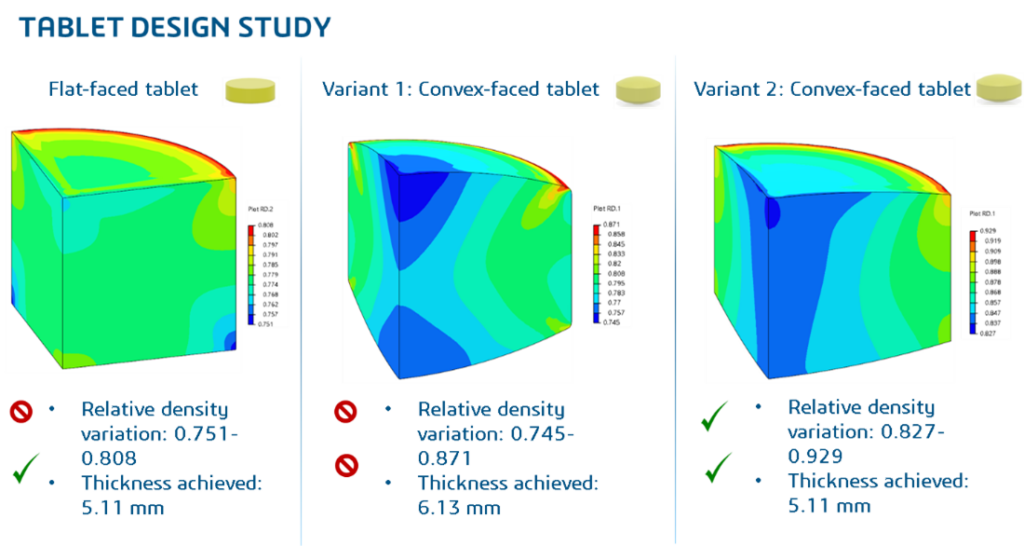
Let us dive into an example case, where the formulation expert needs to assess the compaction behavior of a tablet formulation to arrive at the tablet design, which is dictated by the requirements: tablet thickness and relative density range. The relative density range determines the tablet’s susceptibility to defects such as capping and chipping.
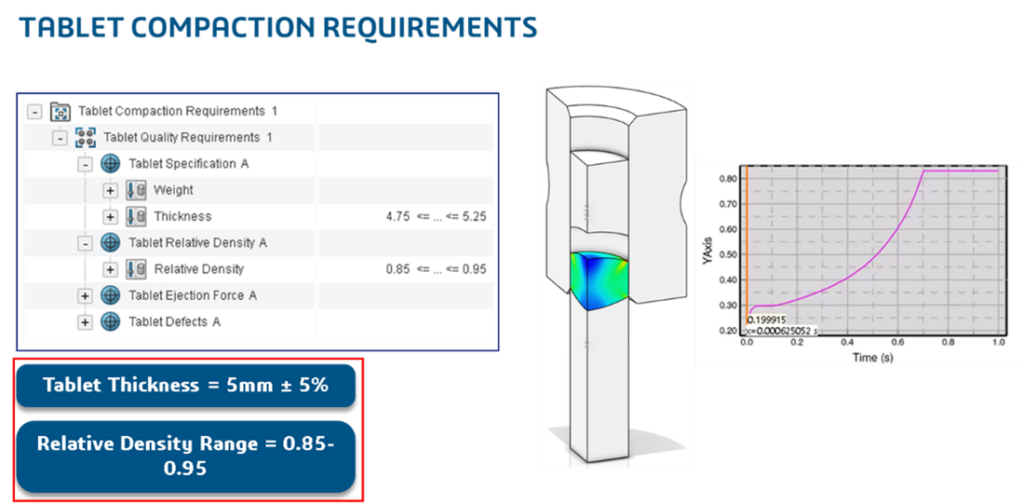
The simulation results of three typical tablet shapes (one flat-faced and two convex-faced variants—each with unique geometry) are shown below. The flat-faced tablet meets the thickness requirement, but has a relative density of 0.751, which is low enough to risk edge chipping during ejection, making this design less viable for production. Variant 1 of the convex tablet, which has higher convexity than variant 2, did not meet either requirement. Variant 1 has a non-uniform density distribution in the central region, indicating the likelihood of the tablet sticking during manufacturing, which is undesirable. Variant 2 achieves both requirements. The reduced convexity enables improved compaction in the central region, resulting in a more uniform density profile and enhanced manufacturability.
Formulation experts can leverage MODSIM technology to predict a tablet’s mechanical properties for a given formulation without conducting multiple lab-based physical tests with different tooling configurations.
Democratization of Tablet Compaction for Formulation Experts
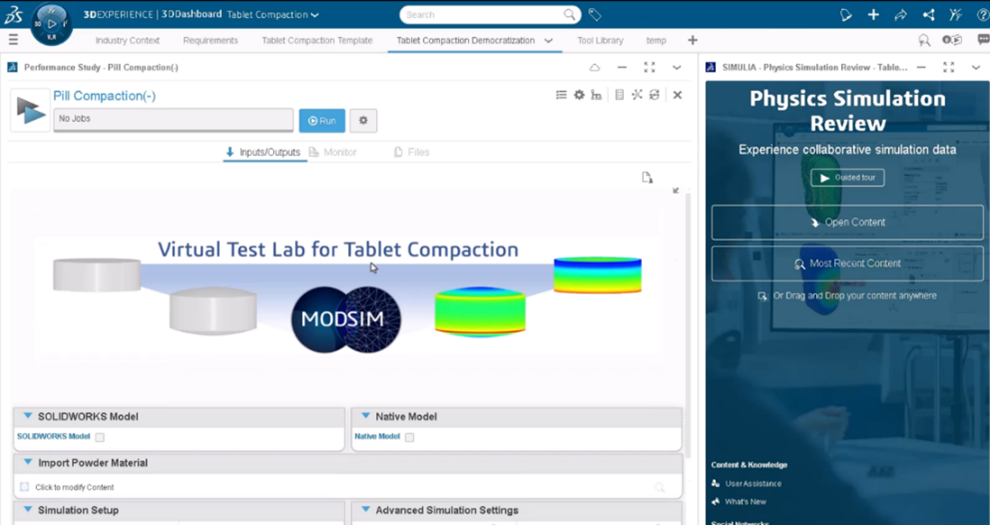
By leveraging the multidisciplinary optimization engineer role on the 3DEXPERIENCE platform, tablet compaction simulation can be easily democratized. Formulation experts can leverage advanced simulation capabilities early in the development phase, while incorporating best practices from simulation specialists for upfront validation. The process template offers easy import of parametric CAD designs from the SOLIDWORKS library, or CAD models already created on the 3DEXPERIENCE Platform can be used. The material calibration app can capture tablet material behavior, making it easier for formulation and simulation experts to incorporate complex material models into simulations. In addition, simulation parameters can be either customized or applied using predefined default settings. Once the simulation is executed, formulation experts can review the results and assess whether all KPIs (such as density distribution, stress concentration zones and compaction and ejection forces) meet the required specifications. This standardized template makes advanced simulation capabilities accessible to a wider range of users, significantly accelerating process validation and reducing time-to-market.
Conclusion
The methodology described above speeds up the tablet design process and significantly reduces the costs associated with multiple design iterations. Democratizing the simulation process further reduces reliance on specialized simulation experts, enabling formulation scientists to assess and optimize designs more efficiently. By adopting 3DEXPERIENCE Virtual Twin Technology to evaluate and validate tablet shapes, sizes and formulations, traditional physical testing can be largely replaced by virtual testing, thereby enabling pharmaceutical companies to significantly reduce development time and cost.

Interested in the latest in simulation? Looking for advice and best practices? Want to discuss simulation with fellow users and Dassault Systèmes experts? The SIMULIA Community is the place to find the latest resources for SIMULIA software and to collaborate with other users. The key that unlocks the door of innovative thinking and knowledge building, the SIMULIA Community provides you with the tools you need to expand your knowledge, whenever and wherever.

Himanshu is a SIMULIA Life Sciences & Healthcare Industry Process Specialist.