

For engineering and product lifecycle management (PLM) teams, ENOVIA remains a key platform for driving collaboration, efficiency and innovation. With each release, it evolves to meet the changing needs of engineering organizations, introducing a rich collection of capabilities that improve how global teams work together and bring new ideas to life.
In this post, we’ll focus on our new AI-powered Gen 7 improvements while also highlighting a few of the more than 175 new role-based features and enhancements across the ENOVIA portfolio. Visit the ENOVIA User Community for the complete overview of what’s new.
Gen 7 AI-Based Enhancements
Document Management introduces an AI-driven Generate Summary command that quickly summarizes a selected document and its related files, highlighting key information at a glance.
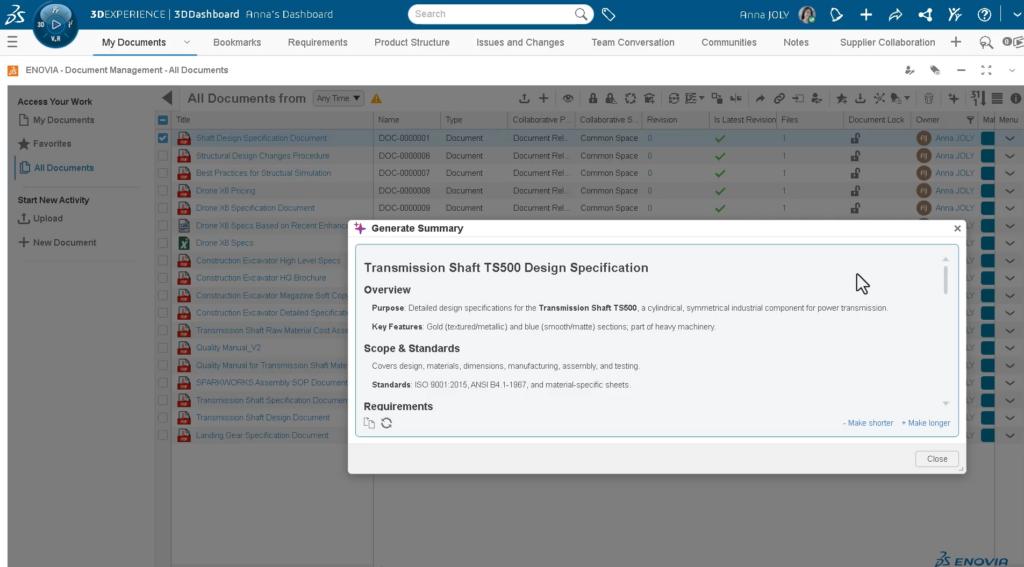
This feature accelerates information discovery and simplifies knowledge sharing. Engineers get key points surfaced instantly, rather than having to read through lengthy documents. For engineering leaders, it means faster decisions and less time spent reviewing and relaying details.
Alongside this, several new AURA competencies extend the same AI-first approach across the product lifecycle.
- AURA Change Management supports confident change decisions with AI-powered change control that surfaces impacts, dependencies and potential conflicts upfront.
- AURA Engineering Product Management helps teams converge on product definitions faster through generative EBOM, greater engineering definition completeness and release-readiness validation.
- AURA Product Portfolio Management turns market demand into revenue-focused product offerings by accelerating the definition of variability and streamlining configuration rule management.
Read the full “What’s New | ENOVIA Virtual Companions R2026x FD04 community post here.
Highlighted Role-Based Features & Enhancements
Improve Scheduling in ‘Project Planner.’
In FD04, the Project Planner role has been enhanced to make resource scheduling much more realistic:
- Percent Allocation for Task Assignments
Task assignments now reflect work effort through percent allocation. In earlier releases, the system assumed a person was 100% occupied for the full duration of a task, which was rarely the case. With percent allocation, you can assign a portion of someone’s capacity to a task, producing schedules that more closely reflect real workloads and helping you allocate talent more accurately.
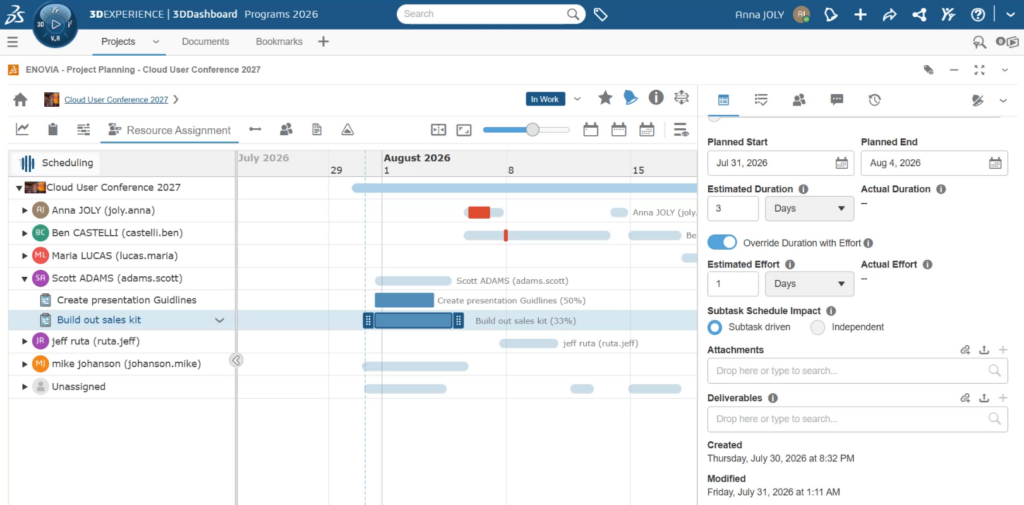
- Concurrent Task Scheduling Without Conflicts
The scheduler now allows a person to work on two or more tasks during the same time period, as long as the total capacity doesn’t exceed 100%. Previously, any overlapping effort was flagged as a conflict, even when spare capacity existed. This eliminates false conflicts from your project plans, helping engineering leaders schedule concurrent work with confidence.
Create a Supply Definition in ‘Supplier Item Manager’
The Supplier Item Manager lets users create a Supply Definition that consolidates all approved manufacturer list (AML) selections for every buy-intent component in a product’s structure into a single document. Rather than tracking AML decisions component by component, you capture the full sourcing intent at the product level – giving sourcing and engineering teams a single, clear reference for better supplier collaboration and more consistent procurement decisions.
Discover What the FD04 Release Has to Offer
Every release reflects ENOVIA’s commitment to solving industry challenges and driving innovation. 2026 FD04 is no exception. To explore the full scope of the FD04 release, visit the ENOVIA User Community, where you’ll find detailed enhancement overviews and role-specific videos.