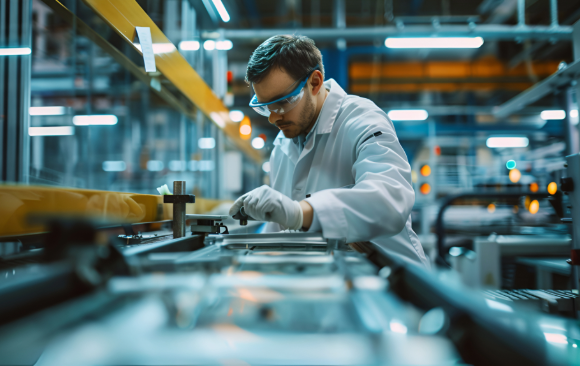
A circuit breaker cannot ship without proof of how it was built. The torque on every terminal, the lot number of the molded housing, the calibration record for the trip mechanism, and the operator who signed off on the final test. Lose any of that traceability, and the breaker is just a part nobody can certify. Now multiply that across thousands of wiring devices, switches, and power distribution units moving through dozens of plants on any given shift, and you have a picture of what modern electrical manufacturing actually demands from its systems.
That demand falls on the shop floor, not the general ledger. Which is why the sequencing question matters so much when a manufacturer commits to a multi-year ERP migration. An SAP S/4HANA project modernizes finance, procurement, and planning. It does not modernize how a product gets made. And with SAP’s 2027 end-of-support deadline pushing thousands of manufacturers into migration mode at the same time, betting your production traceability on an enterprise finance timeline is a risk most operations leaders should refuse to take.
The Shop Floor Can’t Wait for an ERP Rollout
A large-scale ERP migration rewires finance, procurement, HR, and planning. That scope is exactly why these projects stretch 18 to 36 months for large enterprises and routinely blow past both timelines and budgets. A 2025 benchmark analysis of SAPinsider migration data found that more than 60 percent of S/4HANA migrations exceeded budget, schedule, or both. Roughly 65 percent of surveyed organizations identified severe quality deficiencies after go-live.
Production never pauses for any of that. A wiring-device line still has to changeover between SKUs dozens of times a shift. Operators still need real-time work instructions for the variant in front of them. Quality teams still need genealogy down to the lot and serial number for every breaker and connector. Maintenance crews still need alerts before a press goes down, not after the scrap shows up in a cost report three weeks later.
You also get one real chance to modernize the shop floor during a transition this big. An ERP rollout typically hands the floor to paper travelers and finance-centric reporting, and once that lands, leadership rarely circles back to fund a second round of shop floor change. Operators who sat through a disappointing rollout aren’t eager to volunteer for another. Put MES/MOM first, and the order reverses. The floor gets the modern execution layer it actually needs, and the later ERP go-live arrives as a back-office event the plant barely feels.
Deploying MES first insulates the shop floor from that disruption. Production keeps running on modern execution infrastructure while the financial migration proceeds on its own timeline. When S/4HANA eventually goes live, the MES layer is already feeding it clean, granular production data instead of the spreadsheet estimates and manual entries that plague most ERP go-lives.
Start with MES/MOM, and the ERP implementation becomes nearly invisible from the shop floor. Operators aren’t disrupted. Production data stays clean. The risk on the ERP side drops because the financial system isn’t forced to absorb manufacturing’s complex, fast-changing execution logic. The ERP team focuses on finance, procurement, and planning, while the plant floor runs on purpose-built execution infrastructure.
Manufacturers Who Got the Sequence Right
One advanced materials manufacturer used MES as a partition layer between the shop floor and its enterprise systems during an ERP transition. The team pushed released work orders into MES weeks before the cutover, so operators had work queued and ready while transactions accumulated for posting once the new ERP went live. Production never stopped. The MES layer absorbed the disruption that would’ve otherwise halted the floor during the most chaotic phase of the migration.
A global equipment manufacturer faced a different version of the same problem. Its North American operations ran highly customized processes that standard SAP couldn’t support out of the box, on a patchwork of ERP and homegrown MES and WMS systems. Leadership saw that a typical “Big Bang” deployment would create unacceptable downtime. They deployed MES first to support Kaizen and manufacturing-led continuous improvement, then tackled the ERP transition with execution visibility already in place across the plant floor.
Half the Time to Value
MES/MOM implementations move at a different pace than ERP. A manufacturer can go from kickoff to production use in six to twelve months for a full-facility MES rollout, versus the 18-to-36-month runway that S/4HANA demands for large enterprises. That puts a modern execution layer on the floor in a fraction of the time.
That gap isn’t academic. Every month you wait for real-time visibility is a month of decisions made on outdated data: scrap buried in aggregate numbers, cycle-time bottlenecks undiagnosed, labor allocation running on tribal knowledge instead of actual throughput.
MES delivers measurable wins fast. Documented industry results compiled by MESA International include production cycle-time reductions of 20 to 45 percent and first-pass quality improvements of 10 to 30 percent. Downtime drops because operators see machine performance in real time. Scrap drops because quality checkpoints catch defects at the source instead of at final inspection. Compare that to ERP, where 55 to 75 percent of projects fail to meet their objectives. The financial system needs clean data to produce accurate results, and MES generates that clean data.
Your Manufacturing IP Lives on the Shop Floor, Not in the General Ledger
One argument lands harder than any timeline or budget number at the executive level.
The product definition, the process plan, the work instructions, the quality constraints, and the manufacturing rules that govern how your product gets built represent your organization’s intellectual property. A competitor can read your financial statements. It cannot replicate how your plants actually make a code-compliant device at volume, shift after shift. Finance is relatively static. Manufacturing changes constantly, driven by new products, new materials, tightening safety codes, and shifting customer requirements. That is the value stream that separates one manufacturer from another. The same logic holds well beyond electrical products. Aerospace and defense suppliers carry serialized as-built records on every flight-critical part, transportation and mobility makers manage thousands of variants and supplier changes across a single platform, and industrial equipment builders absorb engineering changes mid-run on machines configured to order. None of that production knowledge lives in a financial system, and none of it can wait for a financial migration to finish.
ERP modernizes the financial value stream. MES/MOM modernizes the intellectual property value stream.
As Mike Bradford, Director of Strategic Business Development for DELMIA at Dassault Systèmes, has written, “MES systems tend to comprise plant-based applications; MOM is more of an enterprise solution to manage the larger footprint of manufacturing, whether for one plant or across an enterprise.” That distinction matters for any company running multi-local manufacturing across many sites. MES gives you control of a single plant floor. MOM connects quality, logistics, materials management, and production into one execution model on a shared database, so a process improvement proven at one site propagates to every site instead of staying trapped where it started.
Why DELMIA Apriso Accelerates Your S/4HANA Timeline
DELMIA Apriso runs on a unified platform where production, quality, logistics, materials management, and maintenance share a single, contiguous data store. That isn’t a bolt-on integration. It’s an architectural foundation built on low-code configurability rather than custom code, so your team adapts execution workflows as products and codes change without rewriting the platform. That same configurability protects the upgrade path as the operation evolves.
When you pair DELMIA Apriso with an S/4HANA migration, the ERP system delivers faster value because production execution is already synchronized to its data structures. Integration happens faster. Reconciliation latency shrinks. The post-go-live scramble to retrofit outdated shop floor systems disappears because those systems were modernized first. Pairing Apriso with the Dassault Systèmes virtual twin extends the advantage, letting you validate a line rebalance or a new device introduction in simulation before committing capital or disrupting a running line.
Add DELMIA Ortems Planning and Scheduling, and the picture sharpens. Local pull signals align with enterprise demand signals. Production constraints surface alternatives instead of creating bottlenecks. Decision support runs on actual inventory and work-in-process data rather than planning estimates.
The Data Foundation Your ERP Needs
There’s a practical reason beyond speed and risk reduction for deploying MES first. ERP depends on accurate production data for demand forecasting, inventory optimization, and cost accounting tied to actual performance. Without MES, that data either doesn’t exist or arrives through error-riddled manual entry. Deploy MES first and cycle times, scrap rates, material consumption, machine utilization, and labor hours flow straight from the floor into enterprise planning, so the ERP system starts its life on real numbers instead of theoretical ones.
Regulated and code-driven industries feel this even more acutely. Electrical manufacturers need product genealogy and compliance evidence before they scale enterprise-wide planning. Pharmaceutical and aerospace manufacturers need closed-loop quality and traceability that only MES/MOM provides. Deploying ERP first in those environments means bolting compliance onto a financial system that wasn’t designed for shop floor governance.
When ERP Does Come First
ERP-first deployments happen. Organizations going through mergers that need immediate financial consolidation require a unified general ledger before they standardize manufacturing execution. Companies with no shop floor automation and urgent enterprise resource planning needs may start there out of necessity. But even then, the smartest teams build MES/MOM into the second phase rather than treating it as an afterthought.
Those cases exist. They’re the exception.
For the vast majority of manufacturers running production today, MES/MOM delivers faster returns, lower implementation risk, and a stronger data foundation for every enterprise system that follows. It protects the shop floor during the transition, generates the clean operational data ERP needs to be accurate, and puts the intellectual property value stream on a modern platform before the financial value stream demands it. A manufacturer earns its competitive edge on the plant floor. The technology sequence should start there, too.
DELMIA, from Dassault Systèmes, enables manufacturers to keep factory operations running smoothly. Powered by the 3DEXPERIENCE platform, our Manufacturing Operations Management (MOM) and Manufacturing Execution Systems (MES) solutions establish a unified digital environment that provides real-time visibility and AI-enhanced control. By connecting the virtual and real worlds, we enable you to streamline complex processes, minimize waste and guarantee quality. Harnessing data-driven insights and intelligent automation allows for optimized production, enhanced adaptability to disruptions and the delivery of sustainable, customer-focused manufacturing performance at scale.

Louis Columbus is currently serving as a member of the DELMIA Marketing team, where he assists with DELMIAWorks and robotics solutions. Previous positions include product management at Ingram Cloud, product marketing at iBASEt, Plex Systems, senior analyst at AMR Research (now Gartner), marketing and business development at Cincom Systems, Ingram Micro, a SaaS start-up and at hardware companies. Professional experience includes marketing, product management, sales and industry analyst roles in the enterprise software and IT industries. Columbus' academic background includes an MBA from Pepperdine University and completion of the Strategic Marketing Management and Digital Marketing Programs at the Stanford University Graduate School of Business. He teaches MBA courses in international business, global competitive strategies, international market research, and capstone courses in strategic planning and market research. Columbus has taught at California State University, Fullerton: University of California, Irvine; Marymount University, and Webster University.