What Is the Difference Between IT and OT in Manufacturing?
Two acronyms show up constantly in manufacturing conversations: IT and OT. They get tossed around in boardrooms, on plant floors, and in vendor pitches. Ask ten people in a manufacturing organization to explain the difference and you’ll get ten different answers. That confusion isn’t harmless. It’s the root cause of some of the most expensive blind spots in modern manufacturing.
So what do IT and OT actually mean? Why have they operated as separate worlds for decades? And what happens when you finally connect them? The gap between IT and OT is where production data goes to die. Closing it is where some of the biggest operational gains in manufacturing are hiding.
What are the Primary Functions of Information Technology (IT) in Factories?
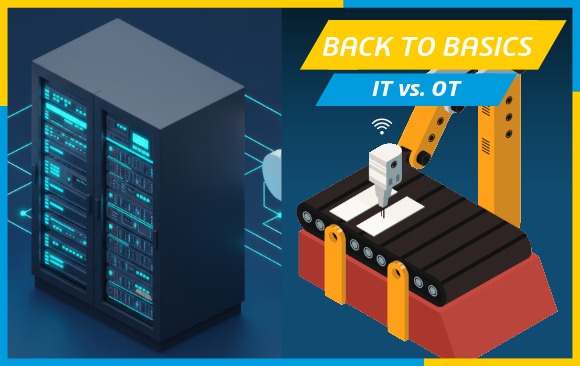
Information Technology, or IT, covers the digital systems that manage business data and decision-making across an organization. In a manufacturing context, that means Enterprise Resource Planning (ERP) software, product lifecycle management (PLM), financial systems, analytics platforms, and the networks and servers that run them.
IT answers the strategic questions. What should the plant produce? How much raw material should be ordered? Which customers need priority? Are margins tracking to plan? When the CFO reviews quarterly performance or the VP of Operations checks capacity utilization across plants, they’re working inside IT systems. These platforms handle data at the enterprise level, processing it through batch cycles or scheduled reports, managed by IT departments that prioritize data security, system uptime, and cross-functional integration.
What Is OT in Manufacturing?
Operational Technology, or OT, is everything that runs the physical production process. PLCs (programmable logic controllers), SCADA (Supervisory Control and Data Acquisition) systems, sensors, HMIs (human-machine interfaces), robotics controllers, and IoT devices on the shop floor. If a system controls a machine, monitors a process variable, or triggers an action on a production line, it’s OT.
OT answers the operational questions. Is the furnace at the right temperature? Did that weld pass inspection? How many units came off Line 3 this shift? What’s the vibration reading on spindle 7? OT generates data constantly and in real time, but that data traditionally stays on the plant floor. Controls engineers and maintenance teams manage it, and their priorities are machine availability, process safety, and throughput. If you’re running the business from the IT side, you rarely see any of it until someone pulls a report.
Why IT and OT Have Traditionally Been Separate
The separation wasn’t a mistake. It was intentional. A PLC running a stamping press in 1995 didn’t need access to the ERP. The ERP didn’t need millisecond data from the press. Different teams built these systems, maintained them, and optimized them for completely different goals.
IT teams prioritized confidentiality, data integrity, and standardization. OT teams prioritized availability, safety, and uptime. The two sides ran on different protocols, bought from different vendors, and operated under different security models. Often, they couldn’t even agree on vocabulary. An IT professional talks about “data latency.” A controls engineer calls it “scan cycle time.” Same concept, no shared platform to translate between them.
That division worked fine when product runs lasted months, customer orders followed predictable patterns, and a plant manager could walk the floor to know intuitively whether things were on track. Manufacturing in 2026 doesn’t offer those luxuries. A single facility now produces hundreds of SKUs. Supply chains shift weekly. A quality escape on Line 4 cascades into a customer delivery failure that shows up in the ERP three days too late.
What Are the Business Benefits of Integrating Manufacturing IT and OT Data?
The manufacturing environment of 2026 punishes information silos. Customers expect shorter lead times and smaller batch sizes. Supply chains shift without warning. Competitors who’ve connected their IT and OT systems are making faster decisions with better data. McKinsey research puts the stakes in sharp relief: manufacturers that successfully scale digital transformation achieve 30 to 50% reductions in machine downtime and 15 to 30% improvements in labor productivity. Those gains don’t come from IT alone or OT alone. They come from connecting both.
Here is where convergence gets practical. When IT and OT share the same data layer, real-time production data flows into business systems automatically. A MOM platform knows what’s happening on every line, at every plant, right now. Your ERP gets accurate yield data without waiting for someone to pull a report. Quality catches a defect trend early. Plant managers and the executive team finally look at the same version of reality instead of reconciling spreadsheets three days after the fact.
Predictive maintenance makes the point concrete. In a disconnected environment, a sensor on a CNC machine detects abnormal vibration, and that data sits in the OT historian until someone reviews it manually. Maybe Thursday. In a converged environment, DELMIA Apriso picks up the anomaly in real time, cross-references it against the maintenance history and production schedule, and triggers a work order before the machine fails. The operator sees a notification on the workstation. Maintenance gets a priority alert. Planning recalculates capacity. No phone calls, no emails, no three-day lag between the problem and the response.
What are the Core Industrial Cybersecurity Risks of IT-OT Network Convergence?
Convergence creates value, but it introduces risk if security isn’t addressed from the start. Manufacturing has been the most ransomware-targeted sector globally for four consecutive years, with attacks surging 61% in 2025 alone. An IDC study found that legacy OT assets are 15 or more years old in roughly half of manufacturing organizations. Only 15% have robust cybersecurity practices in place.
That doesn’t mean you should avoid convergence. It means network segmentation between IT and OT zones, zero-trust architectures, and endpoint protection designed for industrial environments all need to be part of your plan from day one. The answer to cybersecurity risk isn’t isolation. It’s managed, intentional connectivity with the right safeguards built in.
How Panasonic Connect Made It Work
Panasonic Connect ran into exactly this problem. Analog data scattered across systems. Production processes dependent on individual expertise rather than connected platforms. The kind of environment where critical information lived in one person’s head instead of flowing through the operation.
By implementing DELMIA Apriso as a common platform across its factories, the company changed that. As Panasonic Connect reported:
DELMIA Apriso helped unify analog and fragmented data, enabling real-time progress tracking.
That result is IT-OT convergence in a single line. Data that was scattered and manual became connected and real-time. The whole organization could act on it, not just the team that happened to be standing next to the machine when the reading came in. If your operation still runs on tribal knowledge and clipboard audits, that’s the gap convergence closes.
Where to Start
A full infrastructure overhaul isn’t required. The most successful convergence programs begin with a specific pain point: a production line where visibility is poor, a quality issue that keeps recurring, or a scheduling disconnect between planning and execution. Connect the OT data from that process to a MES or MOM platform. Measure the improvement. Expand from there.
DELMIA’s manufacturing operations solutions are built for that kind of incremental deployment. Configuration instead of custom code means faster time-to-value. Modular architecture means starting with a single plant doesn’t lock out future expansion. And virtual twin technology lets production teams simulate changes using real OT data before committing to anything physical. That’s IT intelligence and OT reality working the way they should.
How to Implement a Scalable IT-OT Convergence Strategy in Your Plant
IT handles the business. OT runs the machines. Neither one tells the full story on its own. The manufacturers pulling ahead right now are the ones treating these two domains as halves of a single operating system, not as separate departments with competing budgets and disconnected reporting. Your shop floor data is too valuable to stay trapped on the plant floor. And your business decisions are too consequential to be made without it.
Learn more by downloading our guide, “Boost Production Yield, Efficiency & Quality with IT-OT Convergence.”
DELMIA, a Dassault Systèmes brand, connects the virtual and real worlds to drive innovation and sustainability. Powered by the 3DEXPERIENCE platform, DELMIA’s Back to Basics blog series is your go-to resource for foundational insights into manufacturing, operations, and supply chain management. Designed for both newcomers and those seeking a refresher, this series delves into core topics and addresses key industry questions. Explore the essentials with DELMIA today.

Louis Columbus is currently serving as a member of the DELMIA Marketing team, where he assists with DELMIAWorks and robotics solutions. Previous positions include product management at Ingram Cloud, product marketing at iBASEt, Plex Systems, senior analyst at AMR Research (now Gartner), marketing and business development at Cincom Systems, Ingram Micro, a SaaS start-up and at hardware companies. Professional experience includes marketing, product management, sales and industry analyst roles in the enterprise software and IT industries. Columbus' academic background includes an MBA from Pepperdine University and completion of the Strategic Marketing Management and Digital Marketing Programs at the Stanford University Graduate School of Business. He teaches MBA courses in international business, global competitive strategies, international market research, and capstone courses in strategic planning and market research. Columbus has taught at California State University, Fullerton: University of California, Irvine; Marymount University, and Webster University.