Artificial intelligence is quickly becoming part of the industrial conversation, yet adoption in manufacturing remains cautious. Industry analysts consistently report that while manufacturers see significant potential in AI, many struggle to move beyond pilot projects because of concerns around trust, data quality, governance and the ability of AI to understand real operational constraints. Industry does not need AI that simply sounds intelligent. It needs AI that understands the world in which industrial decisions are made.
That is where virtual companions become strategically important. They are an essential element of Dassault Systèmes’ broader 3DUNIV+RSE vision and the development of industrial world models. Industrial companies operate in a world of products, production systems, supply chains, resources, constraints, standards, regulations and operational behavior. These relationships cannot be fully understood through documents or disconnected data alone. They need virtual representations of real industrial systems, connected knowledge and trusted context.
Virtual companions provide a natural way for users to interact with that context. They help people ask questions, explore alternatives, generate proposals, compare options and take action within the governed environment of the 3DEXPERIENCE platform. In doing so, they intelligently integrate into the daily work of engineering, manufacturing, planning, execution and operations.
This matters because industrial work is becoming more complex. Manufacturers are under pressure to accelerate innovation, shorten lead times, improve quality, reduce costs and respond faster to disruption. At the same time, products are becoming more configurable, production networks more distributed and supply chains more dynamic. Critical knowledge is often spread across experts, legacy systems, documents, spreadsheets, ERP exports, local practices and plant-specific rules.
The challenge is not simply that companies need more data. Most already have more data than their teams can easily interpret. The real challenge is helping people understand complexity and acting on it with confidence.
Why Does General Generative AI Fail in Critical Manufacturing Environments?
General-purpose chatbots have shown how useful AI can be for summarization, ideation, drafting and productivity. But manufacturing leaders are right to be cautious about applying general AI to critical industrial decisions.
In manufacturing, a “quick and rough” answer is not enough. An answer that sounds plausible, but is disconnected from governed data, validated processes, traceable logic or real operational constraints, can create risk. Decisions in industrial environments can affect safety, quality, compliance, machine utilization, material flow, delivery performance, cost and customer commitments.
This is why trust is central. Industrial users need to know where an answer comes from, what context it considered, whether it reflects company standards and how it relates to the actual product, process, resource or operational situation. They also need to remain in control of the decision. AI may assist, propose, compare, or generate, but the responsible expert must be able to validate and approve the result.
In critical manufacturing, trust is not created by a confident answer. Trust is created by context, governance, traceability and expert validation.
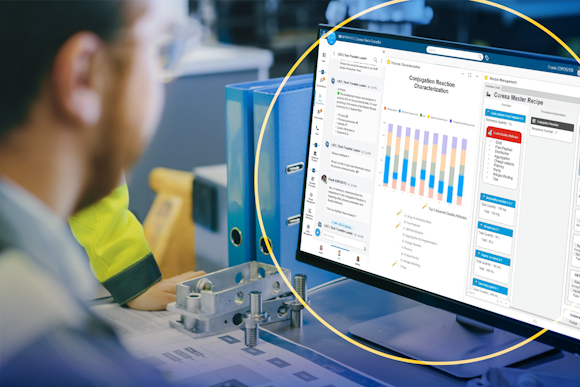
Virtual companions are designed for this industrial reality. They are not simply general chat interfaces placed on top of enterprise systems. They are AI-powered experiences connected to virtual twins, structured knowledge, enterprise standards, workflow context and the 3DEXPERIENCE platform.
What Is an Industrial Virtual Companion and How Does It Define Software Architecture?
A virtual companion changes how users engage with industrial knowledge and workflows. It gives people a more natural way to interact with complex systems while keeping the work grounded in trusted context.
At a broad level, virtual companions can help users interact, understand, guide, act, generate, optimize and capitalize knowledge.
They enable interaction by allowing users to ask questions and express intent in natural language. They help users understand context by interpreting requests against virtual twin data, enterprise rules, operational constraints, prior decisions and best practices. They provide guidance by helping users identify next steps, dependencies, risks, trade-offs and relevant knowledge.
Virtual companions can also help users act within governed workflows. Rather than forcing people to move outside the platform to ask questions or complete tasks, they support work in the same environment where product, process, resource, planning and execution data are managed. They can generate useful outputs such as scenarios, reports, recommendations, instructions, plans, programs, analyses or workflow content, depending on the user’s role and domain.
Just as importantly, they can support comparison and optimization. In industrial work, the question is rarely only “what is the answer?” More often, users need to know which option is better, what the trade-offs are, what constraints apply and what the likely operational impact will be.
Over time, virtual companions also help capitalize knowledge. They make prior experience, expert know-how, company standards and historical decisions easier to reuse across people, sites, programs and domains.
How Can Manufacturers Use AI Companions to Mitigate the Loss of Tribal Knowledge?
One of the most important challenges virtual companions address is workforce complexity. Many industrial processes still depend on experienced people who understand local constraints, past decisions, exceptions, standards and practical rules that are not always visible in formal systems.
Those experts are often overloaded, close to retirement or concentrated in a few locations. Newer workers need to become productive faster, but they may not have easy access to the reasoning behind past decisions or the accumulated knowledge of more experienced colleagues.
Virtual companions do not replace industrial expertise. They help make that expertise easier to find, reuse and scale.
By connecting users to enterprise knowledge and contextual guidance, Virtual companions can support faster onboarding, reduce dependency on a small number of specialists, improve consistency across teams and help preserve institutional knowledge. This is not only a productivity benefit. It is a resilience benefit for organizations that need to operate reliably as products, processes and workforces change.
Shifting from Disconnected Data to Integrated Industrial World Models
Traditional AI often works from documents, text, or isolated data sources. Industrial AI requires more. It needs to understand geometry, behavior, constraints, resources, processes, policies, historical knowledge and real-world operating conditions.
This is where the 3DUNIV+RSE and industrial world models become essential. They provide a richer model of industrial reality, allowing AI to operate with context rather than disconnected information. Virtual twins represent products, production systems, supply chains and operations in structured digital form. Virtual companions give users a practical way to interact with those representations.
Industrial world models give AI the context of the real industrial system. Virtual companions give users a way to engage with that context, question it, learn from it and act on it.
This is an important distinction. The future of industrial AI is not isolated prompting. It is trusted AI embedded in the flow of industrial work.
What Are the Key Performance Indicators (KPIs) and ROI of Industrial AI?
The value of virtual companions comes from helping industrial organizations reduce manual effort, accelerate decisions, improve consistency and increase reuse of enterprise knowledge.
The scale of potential impact is significant. In manufacturing engineering examples, potential benefits include up to 50% improvement in manufacturing engineering efficiency, up to 25% reduction in industrialization lead time, up to 50% reduction in cost of non-quality and the equivalent of up to one additional FTE of capacity per manufacturing engineer.
Other representative manufacturing metrics include 50% to 60% reduction in time to create assembly processes, 25% to 75% reduction in time to create work instructions, 90% to 95% reduction in MBOM creation and update effort and 50% to 90% reduction in learning curve.
In machining-oriented examples, potential impact includes up to 50% reduction in machine setup time and up to 25% machining time reduction.
These metrics point to a broader value message. When AI is grounded in industrial context, it can improve speed, quality, reuse and workforce productivity together. The value is not only doing individual tasks faster. It is improving the way knowledge flows through the organization.
How Virtual Companions Amplify DELMIA’s Core Mission and Operational Continuity
For DELMIA, virtual companions are a natural extension of the mission to help organizations plan, engineer, optimize and execute industrial operations.
DELMIA already operates at the point where industrial decisions become real-world execution. It connects manufacturing engineering, operations planning, production, logistics, scheduling, optimization and execution. Virtual companions enhance this foundation by making virtual twin context, operational intelligence and workflow knowledge more directly actionable.
They help users move faster within governed workflows, not around them. They reinforce DELMIA’s differentiation around connecting engineering, manufacturing planning, operations, and execution in a continuous loop. They also support a shift from digital continuity to AI-assisted operational continuity, where people can work with trusted AI experiences that understand the industrial context behind each decision.
For DELMIA, virtual companions are a way to make the virtual twin more actionable, helping users move from operational insight to governed execution with greater speed and confidence.
Shifting from Simple AI Assistance to Trusted Industrial Transformation
Industrial AI must be contextual, governed, trusted and embedded in the flow of work. Virtual companions help users move from search to understanding, and from understanding to action. They bring together people, virtual twins, enterprise knowledge and AI-assisted workflows in a way that can strengthen both productivity and confidence.
The strategic promise is not only faster work. It is a more intelligent industrial operating model.
Virtual companions mark an important step toward a future where industrial users do not simply access data. They collaborate with trusted AI experiences that understand their world, help them act on it and continuously strengthen the connection between virtual and real operations.
Read more about what Virtual Companions offer:
How the LEO Virtual Companion Redefines Digital Process Engineering
How the LEO Virtual Companion Accelerates NC Programming and CAM Workflows
How Do Virtual Companions Bring Industrial AI to Manufacturing Operations?
DELMIA, a Dassault Systèmes brand, connects the virtual and real worlds to drive innovation and sustainability. Powered by the 3DEXPERIENCE platform, our end-to-end solutions integrate virtual twins, industrial AI and augmented reality to optimize manufacturing, supply chains and workforces. We empower businesses to reduce waste and achieve sustainable, customer-focused operations, building a more resilient future.

Adrian Wood has been the Director of Strategic Business Development for the DELMIA brand at Dassault Systèmes since 2019. He is responsible for developing new and innovative business markets and reinforcing the company position as an innovative leader in key industries.