

Artificial intelligence is widely regarded as a catalyst for the next industrial revolution. Across manufacturing, supply chains and operations, AI is accelerating decision-making, optimizing planning processes and enabling new levels of resilience.
But as AI becomes more capable, an important distinction emerges: capability does not eliminate responsibility.
To understand why, it helps to take a broader view.
The Self-Driving Paradox
For more than a decade, autonomous driving technologies were deemed inevitable. Vehicles today can process sensor data in real time, detect lane markings, monitor surrounding traffic and react faster than any human driver. Under clearly defined conditions, they perform remarkably well.
And yet, the most advanced systems still require human supervision – particularly in environments that are unpredictable or ambiguous.
Why? Because AI models are trained on data. They recognize patterns based on examples they have seen before. When real-world conditions differ from what the system was trained to recognize, interpretation becomes uncertain. According to Janelle Shane, author of, You Look Like a Thing and I Love You there are instances in which image recognition-systems failed to identify objects when viewed from unfamiliar angles. In other cases, unusual movement patterns led to misclassification because the system had never encountered such behavior during training.
The limitation is not computational power. It is contextual understanding.
Even if an AI is given real data, or a simulation that’s accurate where it counts, it can still sometimes solve its problems in a technically correct but non-useful way. — Janelle Shane, Author of You Look Like a Thing and I Love You
A technically correct response is not always a practically sound decision. In autonomous driving, this distinction affects safety. In industrial operations, it shapes business outcomes.
Industrial Complexity Demands More
Supply chains today operate in environments defined by volatility and interdependence. Regulatory constraints, capacity limitations, fluctuating demand, geopolitical disruption and sustainability pressures intersect across global networks.
There are plenty of cases in which AI is preferable because it exceeds human performance… However, these successes are usually confined to very narrow, well-defined problems where the AI has been extensively trained, and it will often fail spectacularly the moment it is asked to operate outside of that specific context.
— Shane
AI brings undeniable advantages in this context. It can evaluate millions of variables simultaneously, simulate scenarios across planning horizons, and detect correlations invisible to manual processes. In nearly all use cases, AI exceeds human analytical performance.
Given sufficient flexibility, AI can even generate solutions beyond traditional planning logic:
Given a problem to solve, and enough freedom in how to solve it, AI can come up with solutions that their programmers never even dreamed existed. — Shane
This capacity is transformative. But AI alone does not define industrial success.
A production schedule may be mathematically optimal and operationally feasible, but might make an important customer unhappy. A sourcing decision may minimize cost yet introduce unacceptable risk. A logistics plan may meet efficiency targets while undermining service commitments.
These trade-offs require judgment. They require professionals who understand not only the data, but the broader business context in which that data operates.
Orchestrating Virtual Twins Across the Enterprise
Industrial decision-making does not occur within a single function. Supply chain challenges often originate outside the supply chain organization — in product design, production constraints or within the supply chain itself, such as network configuration. Optimizing one domain in isolation can unintentionally create inefficiencies in another.
This is why orchestration across multiple virtual twins is essential.
Combining the Virtual Twin of the Supply Chain, the Virtual Twin of the Product and the Virtual Twin of Production systems enable organizations to evaluate decisions holistically. When these domains are connected, planners can understand how a design change impacts sourcing, how production constraints affect fulfillment or how sustainability objectives influence network performance.
Breaking down silos is not simply a cultural objective — it is a structural requirement for resilient operations.
Through integrated virtual twin environments, organizations can simulate decisions across domains before execution, reducing risk and aligning operational performance with strategic intent.
Learn more about lean, adaptable operations enabled by virtual twin technologies here.
From Experimentation to Industrial-Grade AI
Across industries, organizations are investing heavily in AI-driven solutions. Yet research consistently shows that building and scaling internal AI capabilities is complex. Data fragmentation, inconsistent governance and insufficient domain expertise often limit the reliability of standalone systems.
AI cannot operate in isolation. It requires:
- Structured and harmonized data environments
- Embedded domain knowledge
- Transparent algorithms
- Continuous oversight
- Governance frameworks that ensure alignment with business objectives
This is where a human-centric philosophy becomes essential. AI must:
- be explainable.
- be trusted.
- operate within clear accountability structures.
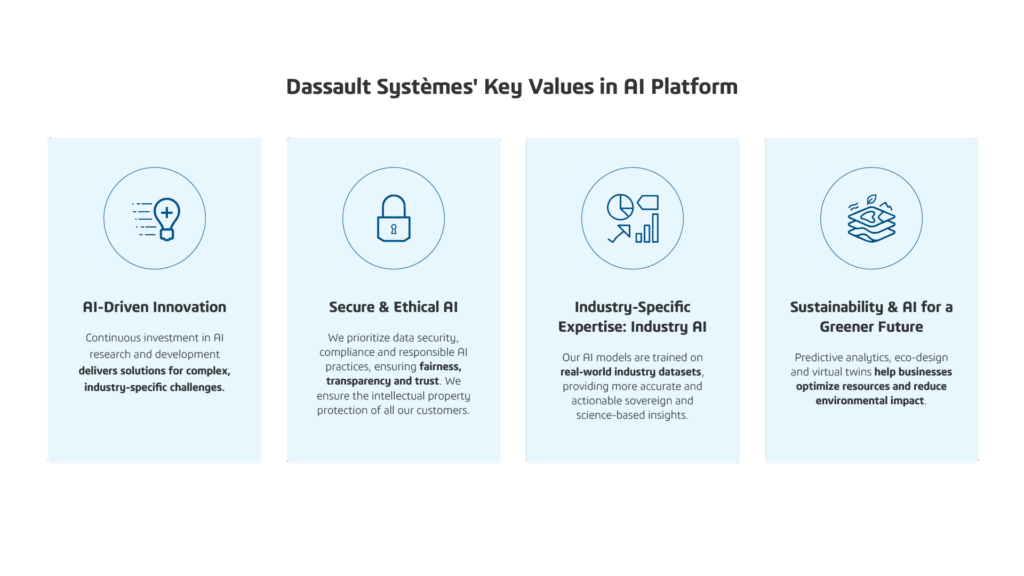
At Dassault Systèmes, these principles underpin the development of AI software technologies designed for industrial applications. The focus extends beyond performance to include transparency, data integrity, security and responsible governance – ensuring that AI systems support sustainable innovation rather than introduce uncontrolled risk. Learn more about this approach to AI here.
Virtual Companions: Augmenting Human Expertise
The evolution of AI in industry is not about removing humans from decision loops. It is about empowering them.
Within the DELMIA portfolio, AI operates inside a unified virtual twin environment that connects modeling, simulation, planning and execution across the value network. This integrated foundation enables organizations to evaluate decisions across strategic, tactical, and operational horizons with speed and clarity.
The introduction of AI-powered virtual companions marks a significant step forward. They analyze complex datasets, identify patterns, generate recommendations and accelerate scenario evaluation. They assist planners in understanding implications, support decision-making through advanced analytics and calculate at extraordinary speed.
But they remain companions, and not autonomous decision-makers. Because in high-stakes industrial environments, responsibility cannot be delegated to an algorithm.
Planning Intelligence for Resilient Supply Chains
As supply chains become more dynamic, organizations must move beyond isolated tools toward a hybrid planning system.
True resilience requires end-to-end visibility, cross-functional coordination and the ability to simulate the impact of decisions before they are executed. It requires connecting strategy with operations and embedding intelligence into daily workflows. These themes are further explored in the white paper The Right Supply Chain Planning Intelligence.
The future of supply chain performance will be defined by how effectively companies combine advanced optimization technologies with experienced professionals who understand nuance, risk and strategic intent.
The Virtual Twin of the Factory: From Visibility to Optimization
The ability to visualize the factory as a complete, dynamic system transforms how organizations improve performance.
A virtual twin of the factory enables manufacturers to evaluate production flows, resource allocation, layout configuration and sustainability objectives in a unified environment. Rather than optimizing isolated processes, decision-makers can assess the full operational impact of changes before implementation.
This capability supports:
- Identification of process bottlenecks
- Optimization of resource utilization
- Evaluation of alternative layouts
- Advancement of sustainability targets
By simulating factory operations in a virtual environment, organizations reduce risk, improve efficiency and align production systems with broader supply chain objectives.
Explore how lean, adaptable operations are enabled by virtual twin technologies here.
The Competitive Advantage Remains Human
AI is transforming the industry. It delivers speed, scale and analytical precision that redefine what is operationally possible. But capability does not replace accountability.
Just as autonomous driving systems still require human oversight when conditions become uncertain, industrial AI depends on experienced professionals to interpret recommendations and assume responsibility for outcomes.
AI is helping to drive industrial performance, but human expertise remains in the driver’s seat.
At DELMIA, we know that while AI accelerates execution, it is human creativity and vision that truly lead progress—because the only progress is human.
For more information on AI and supply chain intelligence and how it can benefit your organization, find out more here.
DELMIA, a Dassault Systèmes brand, connects the virtual and real worlds to drive innovation and sustainability. Powered by the 3DEXPERIENCE platform, our end-to-end solutions integrate virtual twins, industrial AI and augmented reality to optimize manufacturing, supply chains and workforces. We empower businesses to reduce waste and achieve sustainable, customer-focused operations, building a more resilient future.