Planning Fuel Logistics During Endless Disruptions
Fuel supply networks operate in a vastly more exposed environment than they did just a few years ago. Recent disruptions across critical maritime energy corridors demonstrate exactly how quickly routing, inventory positions, freight economics and supply continuity break down when a single point of instability ripples across the wider network.
Consider that roughly one-fifth of global crude, refined products and Liquefied Natural Gas (LNG) trade normally passes through one such critical corridor. Recent disruptions there have sharply raised oil price forecasts, freight costs and insurance premiums. While this is clearly a geopolitical story, it’s equally a logistics planning problem.
Fuel operators now face an almost unlimited range of interacting variables. Vessel delays, demand swings, inventory constraints, charter cost inflation, labor rules and weather bottlenecks don’t arrive one at a time. They arrive together. You can’t build resilience by creating a single efficient plan and hoping conditions hold. Resilience comes from testing many scenarios, understanding trade-offs quickly and reworking your plan while operations are still moving.
With global fuel supply networks fragile and constantly shifting, you need modern logistics planning. That means continuous replanning, realistic constraints, and thorough scenario evaluation. This article explores the evolving nature of these networks and provides actionable steps to help you transform a chaotic process into a production-ready Minimum Viable Product (MVP) in just four weeks.
A Highly Volatile Operating Model
The traditional planning model assumed a manageable amount of uncertainty. Transport plans were created in batches, dispatch windows remained relatively stable and dispatchers handled exceptions manually. That model is now breaking under immense strain.
Recent events in key energy shipping lanes have forced insurers, charterers and traders to reprice risk rapidly. Hull war-risk premiums recently rose from about 0.25% to around 3%, translating into millions of dollars in additional costs per vessel. Freight rates for LNG tankers also jumped sharply as supply and routing patterns fractured.
For planners, the core issue goes beyond cost inflation. The real danger is how disruption propagates. A delay at sea shifts berth timing. That delay affects terminal throughput, which changes inventory availability. Planners must then make entirely different routing decisions inland, often under tighter service windows and with fewer usable resources. A localized disruption becomes a massive network problem in a matter of hours.
The Multiplier Effect of Possible Disruptions
Planners spend most of their time maintaining data rather than making decisions. When a disruption hits, the response is manual and slow. Scenarios are not evaluated, they are guessed. And because the plan lives in a file rather than a system, every handoff between teams introduces another opportunity for something to go wrong.
Take fuel distribution. It always involves complexity. However, the current challenge lies in the sheer volume of variable combinations you must consider before making a decision. You’re rarely dealing with a single isolated event.
A logistics planner might need to account for all the following factors simultaneously:
- Reduced flow through a major transit corridor
- Sudden jumps in freight or insurance costs
- Inventory dropping toward a minimum threshold at one depot while another holds excess
- Changes in customer priority or allocation rules
- Shortages in compatible trailers or certified drivers
- Strict labor and rest-hour compliance constraints
- Low-emission or access restrictions in final-mile delivery zones
- Weather or port congestion altering arrival times
- Geopolitical turmoil changing route viability overnight
I explore these disruption patterns and their operational impact in more detail in our latest e-Book on fuel logistics resilience.
No single static model can capture all of this in advance. Success depends on your ability to generate, compare and refine many possible scenarios rapidly. Organizations that respond quickly to disruptions are not faster because they have better reflexes. They are faster because they have already modeled the disruption before it happened. When the event occurs, they are selecting from a set of pre-evaluated options, not starting an analysis from scratch.
Resilience Begins with Constraint Realism
In fuel logistics, planning quality directly depends on execution realism. A plan that ignores contamination rules, compartment constraints, driver-hour regulations or equipment compatibility isn’t resilient. It’s simply an incomplete plan.
Why Real-World Constraints Matter
Plans must account for real-world constraints like driver certifications, cross-docking, multi-stop routing and regulatory compliance. This matters even more during disrupted conditions. When product flows tighten, you have far less room to absorb planning errors.
If a tanker delay forces a different delivery sequence inland, that new sequence still must respect labor rules, asset compatibility, customer windows and available stock. Your system can’t treat these factors as secondary checks added after the fact. They must function as part of the core optimization engine. Resilience shows up in your operation as a plan that remains fully executable after the disruption has already started.
Buying Decision Speed with Scenario Planning
The most useful question a planner can ask is rarely, “What’s the best plan?” Instead, the better question is, “What happens if our primary assumption no longer holds?”
What if a major corridor stays constrained for another week? What if charter costs rise further? What if a terminal misses its unloading slot? What if you must source product from a completely different origin?
Organizations that model these possibilities in advance hold a distinct advantage when market conditions change. They don’t start from zero. They simply move from one pre-tested decision path to another. DELMIA emphasizes this heavily in our logistics and workforce planning solutions. By prioritizing what-if scenarios, tactical route creation and resource balancing, you shorten the critical time between a supply chain signal and your operational response.
From Chaos to Operational in One Month
One of the most common objections fuel organizations raise when evaluating planning platforms is the implementation timeline. Enterprise software projects with 12 to 18 month go-live windows are not attractive when the planning problem is urgent today.
The DELMIA Fuel Supply Optimizer (FSO) delivery model is structured around a different premise. The goal is not perfection at go-live. The goal is capability in four weeks.
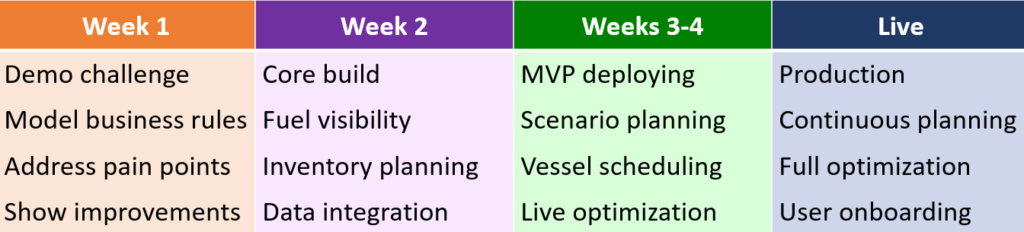
Week 1: Demo Challenge
The first week is not a sales demonstration. It is a working session. The client’s actual business rules, network structure and a representative sample of planning data are loaded into the platform. By the end of the week, the team has seen the system handle their specific constraints, not a generic example. Key pain points are identified and concrete evidence of how the system addresses them is documented. The 1-week challenge exists because the best way to evaluate a planning tool is to watch it plan a real network.
Weeks 2 to 4: MVP Build and Deploy
Weeks 2 through 4 focus on moving from validated concept to production deployment. This covers ingestion of existing planning data from Excel-based workflows into a structured, integrated planning and scheduling environment, configuration of the full constraint set, user training, and parallel running against the current process. By the end of week 4, a production-ready system is in place and planners are using it to generate real plans.
This is not a pilot. It is not a sandbox. It is a live operational capability. Further optimization, additional scenario models and expanded capability can be layered on after go-live, but the core planning function is running from day one.
Week 4 (end of week): Delivery
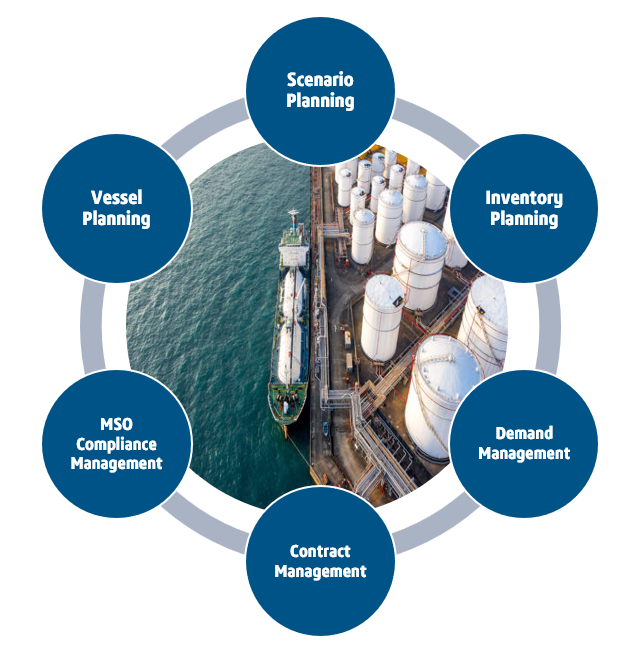
Full fuel inventory visibility across the network. Vessel planning and scheduling connected to inventory. Distribution planning with live constraint validation. Scenario planning capability the team can use without specialist support. Compliance monitoring for minimum stock obligations.
Turning Visibility into Action
Many fuel organizations now possess more supply chain data than ever before. But data alone doesn’t create resilience. True resilience depends on visibility tied directly to planning logic.
When new information enters your network, your plan must adapt instantly. DELMIA’s logistics execution solutions emphasize continuous, real-time monitoring, track-and-trace capabilities and immediate feedback loops from the field. Disruption rarely announces itself as a single catastrophic event. It reveals itself slowly through updated ETAs, missed connections, delayed loading and shifting inventory positions.
A connected planning environment allows these weak signals to trigger automatic recalculations instead of manual firefighting. This empowers your organization to move away from reactive recovery and step into controlled, strategic adjustment.
Take Control of Your Fuel Supply Network
The ongoing pressure on global energy supply routes serves as a stark reminder: you must plan fuel logistics for instability, not around it. Disruptions will continue to emerge from operational, commercial, regulatory and geopolitical sources. All of them will threaten the shape of your plan.
This is where advanced planning platforms, such as DELMIA Quintiq, prove structurally essential. Our logistics planning approach centers on multiple demand scenarios, intelligent route creation by zone, resource balancing and dynamic what-if evaluations across complex transport networks. You can use this unified planning framework to test the impact of delayed arrivals, reduced capacity, changed sourcing points, emergency reallocations or the temporary loss of a major transport corridor.
DELMIA Quintiq helps organizations master this reality. By unifying scenario evaluation, constraint-based optimization, resource balancing and continuous replanning into one connected process, we help you build resilient routes and adjust quickly under real-world constraints.
Resilience means asking better questions earlier, testing more possibilities before committing resources and adjusting your plan while you still have time to protect your service, margins and supply continuity. This capability is no longer an optional upgrade. It’s the basic requirement for operating a successful fuel network in a volatile environment.
Ready to build a more resilient supply chain? Explore how DELMIA Quintiq can transform your logistics planning and help you navigate supply chain disruptions with confidence. Contact us to get started.
DELMIA, a Dassault Systèmes brand, transforms supply chain planning and operations by connecting the virtual and real worlds through the 3DEXPERIENCE platform. Our solutions enable businesses to model, simulate and optimize a virtual twin of the supply chain, delivering resilient and efficient planning across horizons. By combining virtual twins with trusted industrial AI and advanced optimization, DELMIA provides real-time, explainable insights for smarter decision-making, reducing waste and improving agility. From end-to-end planning through detailed scheduling and execution, we empower organizations to adapt to disruptions, enhance sustainability and deliver exceptional customer experiences across the entire value chain.

AI & Optimization Specialist | Supply Chain Decision Intelligence | Scenario Modelling & Mathematical Optimization | Senior Presales Leader @ Dassault Systèmes