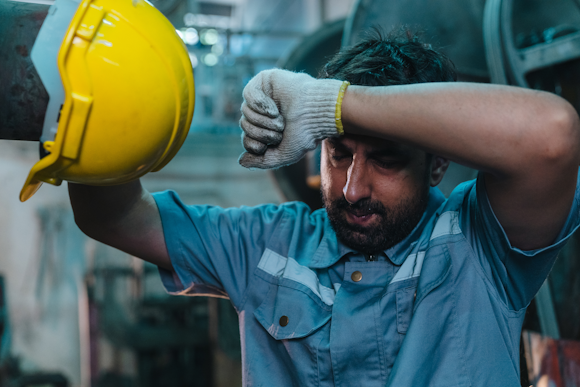
Managing heat on factory floors and in warehouses requires a combination of low-cost behavioral tactics, Personal Protective Equipment (PPE)-compliant cooling gear and facility-level planning. DELMIA’s Virtual Factory planning software and SIMULIA’s CFD and Thermal simulation capabilities help facility managers position industrial HVAC and ventilation units for maximum efficiency before a single unit is installed.
Working in a warehouse or manufacturing plant in summer isn’t just uncomfortable—it’s dangerous. When ambient temperatures climb past 100°F/38°C and radiant heat from machinery pushes the temperature even higher, workers face real risks: heat exhaustion, reduced cognitive performance and costly errors on the line.
The challenge is compounded by the sheer scale of industrial spaces. A 200,000-square-foot distribution center doesn’t cool the same way an office building does. Neither does a steel fabrication floor packed with furnaces, conveyors and PPE requirements that make it impossible to simply wear less. The solutions have to work within those constraints.
This blog breaks down what actually works—from low-cost behavioral tactics used by experienced warehouse crews, to the PPE-compliant cooling gear making rounds on warehouse workers, to the digital planning tools that facility managers can use to get ventilation and HVAC placement right the first time.
How Does Smart Door Management Pre-Cool Factories Without AC?
Some of the most effective heat mitigation strategies on factory floors don’t cost a cent. Workers and supervisors in high-heat environments often describe a simple but powerful tactic: open bay doors and dock doors at 5:00 a.m. to trap cool morning air, then shut them before 10:00 a.m. when outside temperatures begin to climb.
This approach creates a thermal buffer inside the facility. Once hot air from outside starts moving in, you lose the advantage. The goal is to pre-cool the thermal mass of the building, which includes the concrete floors, steel racking and equipment, before the day’s heat intensifies.
Paired with ceiling fans set to run in reverse. The counterclockwise motion pushes cool air down rather than lift warm air up, creating a wind-chill effect that makes workers feel cooler, according to Save on Energy. This strategy can reduce the peak interior temperature without any capital investment. It’s not a permanent fix, but it’s the kind of operational discipline that separates well-run facilities from struggling ones.
What PPE-Compliant Personal Cooling Gear Is Most Effective for Factory Workers?
Personal cooling is often overlooked in industrial settings because many off-the-shelf solutions don’t work with mandatory PPE. Hard hats, high-visibility vests and steel-toed boots don’t always leave much room for cooling down. To address this issue, safety professionals have flagged several compliant options that have gained traction on plant floors:
- Phase-change cooling vests contain materials that absorb heat as they melt, maintaining a surface temperature of around 58–65°F/ 14.4–18.3°C for two to four hours. They fit under or over high-visibility vests and don’t require electricity or refrigeration between uses. They only require cold water or an ice pack.
- Clip-on belt fans are small, rechargeable fans that clip to a tool belt or waistband which can be effective for sustained airflow during stationary tasks.
- Hard-hat sun brims are compliant brim attachments that reduce radiant heat exposure during outdoor or skylight-adjacent work. Simple, inexpensive and widely used in foundry and yard environments.
None of these replace proper facility cooling, but they give workers meaningful relief during peak heat hours, particularly during tasks that require standing near heat-generating machinery.
What Are the Most Cost-Effective Industrial Cooling Options for Facility Managers?
For managers, the heat conversation operates on a different level. Beyond compliance, facility managers weigh two main options for cost-effective warehouse cooling:
Industrial swamp coolers (evaporative coolers) work by pulling warm air through water-saturated pads, which drops the temperature through evaporation. They’re highly cost-effective in dry climates where operating costs can run 75% lower than refrigerated air conditioning for comparable square footage. The trade-off is that they lose effectiveness when relative humidity exceeds 50–60%, making them unsuitable for coastal or humid inland facilities.
High-Volume, Low-Speed (HVLS) fans move large volumes of air without the humidity sensitivity. A single HVLS fan can cover up to 22,000 square feet and creates a wind-chill effect that can reduce the felt temperature by another 11°F (about 6°C). They don’t lower air temperature, but they make conditions far more tolerable for workers.
The right choice depends on climate zone, facility layout, workflow patterns and budget. Many facilities run a hybrid approach using HVLS fans as the backbone, with targeted swamp coolers in loading zones or break rooms.
How Do DELMIA and SIMULIA Optimize Industrial HVAC Positioning and Ventilation?
Cooling a large facility is partly a physics problem—and physics problems benefit from simulation before implementation.
DELMIA’s Virtual Factory has what-if scenario capabilities that allow facility managers and industrial engineers to model their plant layouts digitally before committing to equipment placement. DELMIA Virtual Factory provides solutions to create and simulate a 3D virtual twin of entire factories, from the layout of machines to work cells and production lines. This matters enormously for ventilation and HVAC. Positioning a large industrial air handler on the wrong wall or spacing rooftop units without accounting for workflow obstructions, can leave entire zones without effective airflow while wasting energy elsewhere.
Through DELMIA’s Virtual Twin environment, teams can visualize equipment positioning, worker movement patterns and thermal zones in the context of the actual facility layout. Changes that would require physical repositioning of multi-ton equipment can be tested virtually in a fraction of the time.
SIMULIA, a brand of Dassault Systèmes, delivers realistic simulation software — powered by the 3DEXPERIENCE® platform — helps engineers and analysts reveal the world we live in. Engineers can simulate airflow dynamics across the factory floor, model how heat from machinery propagates through a space and test ventilation configurations before installation. The output isn’t just a cooler facility, but rather, it’s an energy-efficient one. Simulating and optimizing HVAC placement with SIMULIA allows teams to reduce overcooling in low-occupancy zones while improving conditions where workers actually spend their time.
For HVAC manufacturers designing industrial equipment, DELMIA’s manufacturing planning tools support the production side as well—from assembly process planning to line balancing—ensuring that the systems being designed for heat mitigation are themselves built with precision and efficiency.
How Do You Build a Layered Industrial Heat Mitigation Strategy?
Heat management on the factory floor isn’t one problem with one solution. It’s a layered challenge that spans individual worker comfort, operational practice, facility design and regulatory compliance.
The most effective facilities combine all three levels:
- Workers equipped with the right gear and clothing
- Managers running protocols like strategic door management and compliant rest-break schedules
- Engineering teams using tools like DELMIA and SIMULIA to design facilities where ventilation and HVAC systems are positioned for real-world performance, not just blueprint convenience.
Starting with the virtual twin means fewer expensive mistakes in the physical world. Starting with the right vest and the right shirt means fewer heat-related incidents on the floor today.
Both matter. Neither is optional.
FAQs about Beating the Heat on the Factory Floor
High-Volume, Low-Speed (HVLS) ceiling fans offer one of the best cost-to-coverage ratios for large facilities. For dry climates, industrial evaporative coolers (swamp coolers) can reduce cooling costs by up to 75% compared to refrigerated air conditioning. Many facilities combine both approaches, using HVLS fans for general coverage and targeted evaporative cooling in high-heat zones.
Heat exposure cost companies worldwide approximately 639 billion potential work hours in 2024, according to The 2025 Global Report of the Lancet Countdown.
No. Industrial swamp coolers work through evaporative cooling, which becomes ineffective when relative humidity exceeds 50–60%. In humid regions, refrigerated air conditioning or HVLS fans are more reliable options for warehouse heat mitigation.
DELMIA’s virtual factory planning tools allow engineering teams to model facility layouts digitally and test HVAC and ventilation unit placement before physical installation. Paired with SIMULIA’s computational fluid dynamics capabilities, teams can simulate airflow and thermal distribution across the factory floor to optimize equipment placement for both comfort and energy efficiency.
Phase-change cooling vests, clip-on belt fans and hard-hat sun brims are all designed to work alongside standard PPE requirements including hard hats, high-visibility vests and steel-toed boots. Phase-change vests are particularly effective, maintaining cooling for two to four hours without electricity.
Bamboo fiber base layers and long-sleeve performance fishing shirts rated UPF 50 outperform standard cotton and synthetic workwear in high-heat environments. Both materials wick moisture efficiently, dry quickly and allow better airflow—reducing perceived temperature across a full shift.
DELMIA, a Dassault Systèmes brand, connects the virtual and real worlds to drive innovation and sustainability. Powered by the 3DEXPERIENCE platform, our end-to-end solutions integrate virtual twins, industrial AI and augmented reality to optimize manufacturing, supply chains and workforces. We empower businesses to reduce waste and achieve sustainable, customer-focused operations, building a more resilient future.
 Prashanth Mysore
Senior Director for Strategic Business Development, DELMIA
 Martin Timm
Martin is the CATIA SIMULIA Offer Marketing Director