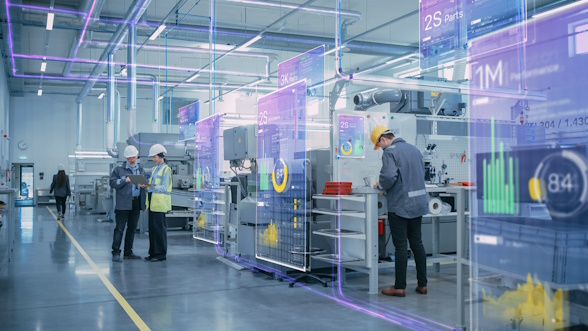
Energy costs are no longer a background variable in manufacturing economics. For many industrial operators, they have become the single largest swing factor in margin performance, investment decisions and competitive positioning. What has changed is not just the price level but the speed and unpredictability of the moves. Planning cycles built on stable energy assumptions are now liabilities.
The good news is that a generation of digital manufacturing tools, developed primarily to improve throughput and quality, turns out to be unusually well-suited to this challenge. DELMIA, the
Dassault Systèmes suite covering virtual factory design, process planning, robotics simulation and virtual commissioning, gives manufacturers something they have not traditionally had: The ability to model and stress-test their operations against energy scenarios before committing capital or locking in operational patterns.
This piece sets out how to use those tools across three time horizons: the immediate response window, the medium-term restructuring phase and the long-term transformation to a structurally lower-energy operation.
The manufacturers who come through this strongest will be the ones who used digital tools not just to cut costs, but to redesign how they operate.
Short-Term: The First 6 to 18 Months
The priority here is reducing energy waste without touching capital expenditure or disrupting production schedules. Most facilities have more room here than they think, and the digital factory tools reveal it.
Factory Flow Simulation: Finding the Hidden Load
DELMIA’s factory flow simulation was designed to optimize material movement and throughput. Its secondary benefit, which matters more right now, is that it surfaces idle machine time, queuing delays and suboptimal sequencing that all translate directly into unnecessary energy draw.
A simulation run against current production schedules will typically reveal two or three patterns worth acting on immediately. Machines sitting in ready-state between jobs. Conveyor systems running continuously when batch movement would suffice. Compressed-air systems cycling at full pressure during low-demand windows. None of these require new equipment. They require scheduling changes, and simulation lets you validate those changes before touching the live floor.
CNC Simulation: Cutting What Is Actually Cutting
CNC energy consumption is a function of spindle load, feed rates, tool path length and idle time between operations. Most CNC programs were written to optimize cycle time and surface finish. Energy was not in the cost function.
DELMIA’s CNC simulation environment lets process engineers run existing programs against energy models and identify where the tool is moving without cutting, where feed rates are higher than the operation requires and where tool changes are adding dwell time. In practice, reworking programs through this lens typically reduces machine energy consumption by 8 to 15 percent with no change to part quality. That is real money at current energy prices and the work can be done on a rolling basis as programs come up for their next revision cycle.
Robotics Simulation: Rewriting Motion Profiles
Industrial robots are energy-intensive relative to their productive output. The motion profiles written during commissioning prioritize speed and repeatability. They rarely consider power draw.
Running existing robot programs through DELMIA’s robotics simulation reveals where joints are accelerating harder than the task requires, where paths take unnecessarily wide arcs and where robots are holding position under load while waiting for upstream processes. Adjusting these profiles through simulation, then deploying validated changes to the live robot controller, typically produces 10 to 20 percent energy reductions per cell. For facilities with high robot density, this is a meaningful number.
Operations Engineering: Rescheduling Around the Tariff Clock
Time-of-use tariffs create a real arbitrage opportunity for manufacturers with any scheduling flexibility. DELMIA’s operations engineering and production planning tools allow planners to model energy cost explicitly as a scheduling constraint alongside the traditional parameters of capacity, tooling availability and delivery dates.
This is less complicated than it sounds. The goal is not to redesign production around energy alone, but to identify which operations have genuine scheduling latitude and move them off-peak. Simulation validates that the schedule change does not create downstream bottlenecks before anyone commits to it.
Mid-Term: 18 Months to 4 Years
By this horizon, the focus shifts from optimizing existing operations to redesigning them. Capital is now in play, but the discipline is to spend it on configurations that have been validated in a virtual environment before steel is moved or contracts are signed.
Virtual Twin: Modeling the Plant Against Energy Scenarios
The virtual twin capability in DELMIA creates a complete digital replica of the facility, including not just the physical layout but the process flows, machine interdependencies and utility connections. Once built, it becomes the primary tool for evaluating any significant operational change.
In the context of energy restructuring, the virtual twin allows you to model what happens to throughput, quality and total cost when you shift load between cells, retire high-consumption equipment, add buffer capacity to enable more flexible scheduling or change the energy source for specific processes. These are not spreadsheet calculations. They are full dynamic simulations that show second and third-order effects before anyone has spent a dollar.
The investment case for building the virtual twin, if it does not already exist, has shifted materially. Facilities that previously deferred it are finding that the cost of a single poorly-modeled energy investment exceeds the cost of the twin by a wide margin.
Virtual Commissioning: De-risking New Equipment Decisions
Equipment replacement is the most obvious lever for reducing energy consumption, but it is also the most capital-intensive and the hardest to reverse. Virtual commissioning addresses the risk directly.
Before ordering new equipment, DELMIA allows the full commissioning sequence to be executed in simulation, connecting the machine’s PLC logic to the virtual factory environment. This reveals integration issues, cycle time discrepancies and energy performance gaps before the equipment arrives on site. More importantly, it lets engineering teams validate that the energy savings expected from the new equipment are achievable within the specific context of their production system, not just in vendor benchmarks run under ideal conditions.
Facilities using virtual commissioning are reducing physical commissioning time by 30 to 50 percent. The more immediate benefit in the current environment is that they are avoiding purchases that look good on paper but disappoint in practice.
Process Planning: Restructuring the Bill of Process
Process planning is where engineering decisions about how to manufacture a part get translated into specific machine assignments, operation sequences, and tooling choices. These decisions, once embedded in production systems, tend to persist for years.
DELMIA’s process planning tools allow manufacturers to revisit existing bills of process with energy cost as an explicit parameter. Which operations are assigned to high-consumption machines that could be moved to lower-consumption alternatives? Which sequences create unnecessary heating and cooling cycles? Where are there consolidation opportunities that reduce total operation count?
This is painstaking work, but it compounds. Process changes made at the planning level propagate across every production run that follows. A 5 percent reduction in energy per part across a high-volume product family is a different number than a 5 percent reduction achieved through one-off scheduling adjustments.
Operations Engineering: Redesigning Shift Structures
The mid-term window is also where workforce scheduling and shift structures come under review. Operations engineering tools that model labor, equipment availability and energy cost together can identify configurations that the traditional approach, which treats these as separate optimization problems, would not find.
Four-day concentrated production runs with a three-day facility shutdown may outperform a five-day schedule in total energy cost, even if they reduce productive hours. Whether that trade-off works depends on inventory economics, customer flexibility and equipment warm-up costs. Simulation answers that question with numbers, not intuition.
Long-Term: 4 Years and Beyond
The long-term question is structural. Manufacturers who emerge from this period in the strongest position will have used digital tools not just to reduce energy consumption in their existing operations but to build operations that are intrinsically less exposed to energy price volatility.
Virtual Factory Design: Building for Energy Performance from the Start
For facilities planning greenfield investments or major brownfield reconfiguration, the virtual factory design capability in DELMIA changes what is possible in the design phase. Rather than optimizing a layout for throughput and then auditing its energy performance after the fact, energy flows become a design constraint from the beginning.
Waste heat recovery, compressed-air zoning, natural light integration and equipment grouping by thermal profile can all be modeled and optimized before a single foundation is poured. The energy performance of the facility becomes an engineered output, not a residual.
Robotics and Automation: Designing for Efficiency, Not Just Speed
The next generation of automation investment should be evaluated on energy performance alongside the traditional metrics of cycle time, flexibility and reliability. DELMIA’s robotics simulation environment allows design teams to compare robot models, end-effector configurations, and motion strategy options against both productivity and energy criteria simultaneously.
Collaborative robots, which typically draw significantly less power than industrial robots of comparable payload, are viable for a wider range of applications than they were five years ago. Simulation validates fit before purchase. For facilities running 20-hour production schedules, the cumulative energy difference between a collaborative robot and a conventional alternative is not a rounding error.
Virtual Twin as Ongoing Operating Infrastructure
The most forward-looking manufacturers are treating the virtual twin not as a project deliverable, but as operational infrastructure. The twin runs continuously, updated with live production data and is used by operations teams to evaluate scheduling decisions, maintenance intervention, and process changes in real time.
In an environment where energy prices can move 15 to 20 percent in a quarter, the ability to model the energy cost implications of a production schedule change before committing to it is genuinely valuable. Facilities that have built this capability report using it for decisions that previously relied entirely on planner experience and intuition. The combination tends to outperform either alone.
Energy performance does not come from individual initiatives. It comes from operations that were designed with energy in mind at every level.
Process Planning at Scale: Continuous Improvement Without the Risk
Long-term energy performance requires that process improvements compound over time rather than eroding as production pressures push operations back toward familiar patterns. Process planning tools that are integrated with the virtual twin create a closed loop: Simulated improvements are validated, implemented and then monitored against the twin to confirm the expected performance is being achieved in practice.
This matters because energy saving initiatives have a well-documented tendency to decay. The virtual infrastructure provides the accountability mechanism that sustains them.
Where to Start
The sequencing of these investments matters. CNC program optimization and factory flow simulation are the highest-return near-term moves. They require minimal capital, can be run against existing systems and deliver results within months. Virtual twin and virtual commissioning investments require more lead time, but pay back through avoided capital mistakes as much as through direct energy savings.
The common thread is that these tools were not designed for energy management. They were designed for quality, throughput and time-to-market. The fact that they are this useful for energy optimization is a byproduct of their underlying logic: they model operations in enough detail to make consequences visible before they become expensive.
Energy price volatility is not going away. The manufacturers who absorb this reality and build operations that can flex around it will be structurally advantaged over peers who are still treating energy as a fixed cost. The digital factory toolkit exists to help make that transition. The question is how fast each organization chooses to use it.
Discover more in our e-book, Design, Validate and Optimize Your Manufacturing Entirely in the Digital World.
About This Article
This perspective was prepared for manufacturing and operations leadership navigating near-term energy cost pressures and medium-to-long-term facility investment decisions. References to DELMIA reflect the Dassault Systèmes product suite including Virtual Factory, Operations Engineering, Virtual Twin Experience, Factory Flow Simulation, CNC Machining Simulation, Robotics and Virtual Commissioning and Process Planning capabilities.
DELMIA, a Dassault Systèmes brand, leads the industry with advanced virtual twin technology that leverages industrial AI and augmented reality—setting the standard for connecting the virtual and real worlds and achieving unrivaled operational excellence. Powered by the 3DEXPERIENCE platform, our solutions create a single digital environment where businesses can simulate scenarios, optimize processes and execute with precision. By mirroring complex systems in a risk-free virtual space, organizations gain the data-driven insights needed to enhance efficiency, predict outcomes and master their operations in reality.
 Prashanth Mysore
Senior Director for Strategic Business Development, DELMIA