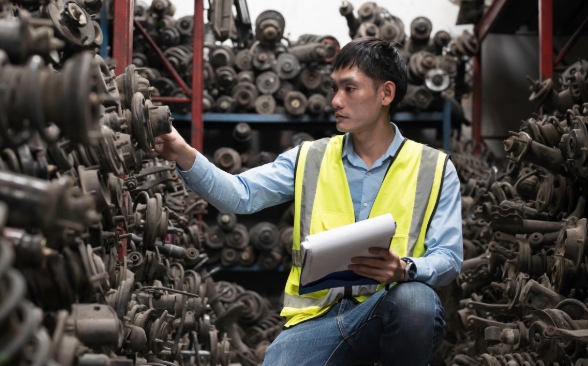
Let’s be honest about something the manufacturing industry has quietly accepted for decades: errors happen and we’ve built entire systems around managing them rather than eliminating them. Work instructions get misread. Torque specs get approximated. A weld is slightly off, a fastener is in the wrong position or a quality check misses a hairline crack because the inspector was on his 200th part of the shift. We call it the margin of error. We build it into our schedules, our budgets and our concession workflows. We’ve normalized it.
But normalized doesn’t mean acceptable. And in the industries where complexity is high and tolerance for failure is low – where a single misassembled component can ground a fleet, delay a rail delivery by months or trigger a safety investigation – that margin has always been a fiction. A convenient one, but a fiction.
The real cost of “good enough”
The numbers are harder to look at than most manufacturers realize. According to the American Society for Quality, poor quality costs the average manufacturer between 15% and 20% of annual sales revenue. World-class facilities keep that figure below 5%, meaning most manufacturers are running with a quality gap that could fund entire transformation programs. And most of what drives that number isn’t the scrap bin. It’s the invisible costs: rework hours, end-of-line discoveries that halt production, deviations and concessions that pull engineering teams away from new product development to investigate what went wrong on the shop floor. Engineering teams are regularly pulled away from new product development to investigate root causes and redesign flawed components, a tax on innovation that rarely appears on a quality dashboard.
Then there’s the downstream damage. A defect exported to a customer in aerospace or defense doesn’t just cost money; it costs certifications, contracts and the trust that’s years in the making. The rule of ten, that a defect caught in the field costs ten times more to fix than one caught at final inspection and a hundred times more than one caught at assembly, isn’t a theoretical construct. It’s an invoice.
And yet, the dominant approach to quality in complex discrete manufacturing has barely changed: paper-based or PDF work instructions, end-of-line inspection and human vigilance as the primary defense. In industries such as aeronautics, where a single aircraft assembly can involve thousands of individual operations, that’s an enormous amount of trust placed in memory, attention and the legibility of a 2D drawing.
Why Do Traditional Paper-Based Work Instructions Lead to Shop Floor Assembly Errors?
The problem isn’t the workforce. The problem is information, how it reaches the operator, and when. A technician assembling a complex structural sub-system doesn’t fail because they lack skill. They fail because the instruction they’re working from was designed for a screen or a printed page, not for a pair of hands holding a torque wrench six feet off the ground. They fail because the step they’re on looks almost identical to the step they just completed and the only difference is a bracket that should be placed a few inches lower. They fail because by the time an anomaly is flagged (two stations downstream or at final inspection or worse, at customer acceptance), the context is gone, and the investigation takes days.
Quality inspection faces its own version of the same problem. A checker working through a point-by-point control plan on a large assembly is doing pattern recognition under fatigue. A missed checkpoint, an incorrectly localized defect, an ambiguous finding that takes three people two hours to interpret: these aren’t failures of process design. They’re failures of information delivery.
How Does Industrial AR Improve Assembly Guidance and Quality Control?
Augmented reality doesn’t make workers smarter. It makes the right information impossible to miss, at the exact moment it’s needed, in the exact place it belongs.
In assembly guidance, AR overlays the precise instruction — the right component, the right orientation, the right torque value — directly onto the physical work environment. The operator isn’t cross-referencing a tablet or remembering step 47b. They see what needs to happen, where it needs to happen, before they act. Sequence is enforced. Deviations are caught before they become defects. The gap between the digital work instruction and the physical act of assembly collapses to near zero.
In quality control, the same principle applies. AR guides the inspector through the control plan point by point, in sequence, with the checkpoint physically located in their field of vision. A defect isn’t described in a report and later relocated by a quality engineer; it’s precisely mapped to the part geometry, with full context preserved. Investigation time drops. False closures drop. The quality loop tightens in ways that paper-based processes structurally cannot achieve.
How to Achieve 100% First-Time-Right Production Using AR-Guided Assembly
This isn’t theoretical. In aerospace, some manufacturers using AR-guided assembly from DELMIA Augmented Experience solution have reached 100% first-time-right on complex operations from the very first production cycle. Not after a learning curve or months of stabilization, but immediately. In structural steel fabrication for construction, operations that previously generated a steady stream of non-conformances now produce zero. Not fewer. Zero.
These results matter not just as performance benchmarks but as proof that the margin of error was never structurally necessary. It was the predictable output of a guidance model that asked humans to bridge the gap between digital engineering intent and physical execution using memory and approximation. Remove that gap, and the error rate follows.
For industries where the cost of a single non-conformance can trigger a regulatory notification, a customer penalty clause, or a production line stoppage, the business case for AR guidance doesn’t require a complex ROI model. It requires a single honest look at what “acceptable” has been costing.
The margin of error was never really acceptable. It was just something we stopped questioning.
See how manufacturers are achieving zero non-conformances with DELMIA Augmented Experience. Contact us directly or visit our website for additional information.
DELMIA, a Dassault Systèmes brand, leverages augmented reality (AR) to transform manufacturing operations and empower today’s industrial workforce. Powered by the 3DEXPERIENCE platform, our AR solutions deliver immersive, AI-assisted work instructions, real-time insights and advanced inspection capabilities that reduce ambiguity, enhance accuracy and improve product quality and worker safety. By connecting the virtual and real worlds, DELMIA enables manufacturers to optimize processes, boost workforce productivity and accelerate onboarding, while adopting smarter, more intuitive ways of working—driving efficiency, quality, resilience and sustainable performance.

DELMIA Senior Offer Marketing Manager