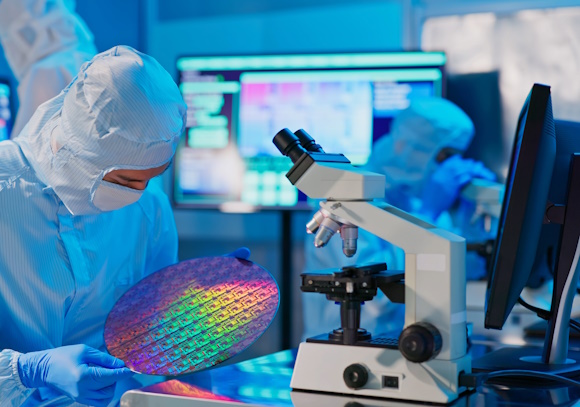
Walk into a new semiconductor fabrication plant (fab), an electronics assembly line or one of the plants now racing to build AI accelerator hardware and you will see two pressures sitting on top of each other. The people who knew the work by feel are retiring and the people replacing them are fewer, newer and often older than the hires of a decade ago. At the same time, the cost of getting a workstation wrong has not moved an inch. Musculoskeletal injuries remain among the most expensive and avoidable line items a manufacturer carries and almost every one of them traces back to a layout decision made long before anyone got hurt.
High tech feels like it should be immune to this. These are precision environments full of automation. But chips, boards and AI hardware are still built and inspected by human hands in large numbers and those hands are doing some of the most ergonomically punishing work in manufacturing: hours bent over a microscope, repetitive fine-motor assembly, awkward postures held inside a cleanroom suit that already limits movement and vision. The injuries are quiet and cumulative, which is exactly what makes them easy to design out early and expensive to ignore.
This is why ergonomics has stopped being a late-stage checklist item and started being a design discipline. The question is no longer whether you take human factors into account. It is how early, how precisely and how well the safety work connects to everything else you are trying to do on the floor. Done right, ergonomics and productivity are not a trade-off. They are the same outcome reached from different directions.
Key Drivers Pushing Ergonomics in Manufacturing
A few things are happening at once and they reinforce each other. In high tech they are sharper than almost anywhere else.
The talent gap is severe and specific. The semiconductor build-out is colliding with a workforce that cannot fill it. Several industry estimates, including reports by McKinsey & Company, point to tens of thousands of unfilled U.S. fab technician and engineering roles by 2030, with some projections of the broader skilled-worker shortfall running into the hundreds of thousands. Roughly a third of the semiconductor workforce is already 55 or older, attrition has climbed sharply and the industry struggles to look attractive next to other tech careers. AI hardware demand is pouring fuel on this: every new accelerator program and packaging line needs people who do not yet exist in sufficient numbers. New fabs are opening under capacity or sitting idle because the staff to run them is not there.
The work itself is hard on the body. Electronics and chip work concentrates exactly the risk factors that cause musculoskeletal disorders: high repetition, sustained awkward posture and fine force. Studies of electronics workers find shoulder symptoms in roughly a third of them, with older age, repetition and posture all independently raising the odds. Microscope and inspection work drives neck, back and eye strain and cleanroom garments restrict the field of view and range of motion for an entire shift. These are not freak accidents. They are predictable outcomes of workstations designed for a task and not for the person doing it.
The workforce is aging and shrinking. Older-worker employment has roughly doubled over the past two decades and global labor shortages are expected to run into the millions by 2030, according to Oxford Economics. Every retirement takes hand-built judgment with it: the technician who knew a tool’s quirks, the inspector whose eye caught defects before instruments did. The replacements are still developing that judgment and a meaningful share of them are 55 and up, working in bodies that need the job designed around their limits rather than against them.
Injury economics have not improved. Ergonomic redesign cuts injuries, absenteeism and compensation claims across every age band and the gains are largest for workers over 55. The flip side is that ignoring it gets more expensive as the workforce ages, not less. When you cannot easily replace a trained operator, keeping the one you have healthy stops being a wellness nicety and becomes capacity protection.
Ergonomics is shifting from reactive to predictive. For years, ergonomic assessment meant an expert standing on the floor with a clipboard after something already went wrong. That model was slow, costly and impossible to scale across plants. AI and automated data collection are turning it into a forward-looking, organization-wide capability. Companies are now generating risk profiles and flagging where injuries are likely before they happen, rather than analyzing them after the fact.
The tooling around the worker is getting smarter. AI-enabled wearables, posture sensors, fatigue trackers and powered exoskeletons now give workers real-time feedback and physical support during the task. Passive back-support exosuits can cut lower-back exertion by up to 30% on repetitive lifting. One reported deployment of AI-driven ergonomic tools cut sprains and strains by over 90% and wearables have been credited with reducing compensation claim costs by as much as half in high-risk settings.
Virtual Ergonomic Validation: Testing Workstations in 3D
All of that floor-level technology is valuable, but it is still downstream. By the time a worker is wearing a sensor that buzzes when their back angle gets dangerous, the workstation is already built. The cheapest injury to prevent is the one designed out before any steel is ordered.
That is what virtual ergonomic validation does and it is where digital human task simulation earns its place. Tools like DELMIA’s human task simulation let an engineer drop a lifelike, dimensionally accurate manikin into the 3D model of a product or a work cell and watch a representative worker actually perform the task. Reach, posture, lifting load, line of sight, clearance and the entire interaction are evaluated while the design is still soft and a change costs almost nothing. For high tech, that means checking whether an inspection station forces a neck angle that will wreck someone over a year of microscope work, whether a wafer-handling or board-assembly reach stays inside safe limits or whether a cleanroom-suited operator can actually see and access what the layout assumes they can.
The detail that matters most for an aging, varied workforce is the boundary manikin. You are not designing for a convenient average. You build manikins at the edges of your actual population, the very short and the very tall, the operators who get hurt when a layout only works for the median body and you score their postures against recognized standards before signing anything off. A cell that cannot pass that check is a design defect, not a training gap to paper over later. And once you have built a manikin that reflects your real workforce, you save it and reuse it, so the next project inherits the knowledge instead of rediscovering it.
- Validation lives in the same environment where the product and factory are authored, so a reach or posture problem surfaces while the geometry can still change cheaply.
- Boundary manikins built from your real population catch the operators most likely to be injured, not the comfortable middle.
- Posture scored against standards gives safety and compliance teams an audit trail, not an opinion, when they ask why a workstation was approved.
Immersive VR and AR Training for Industrial Workforce Readiness
Designing a safe workstation only solves half the problem. The other half is a worker who can perform the task correctly and confidently from day one and this is exactly where the retiring-veteran problem bites hardest. You cannot transfer thirty years of hands-on instinct through a slide deck. In semiconductors the squeeze is even tighter: only a handful of universities have real wafer-fab facilities, so most new hires have never touched the equipment before their first shift and fabs are onboarding people from adjacent backgrounds like HVAC, cleanroom and automotive work who need the specifics fast.
Passive training does not stick. Retention from lectures, videos and click-through modules sits around 10 to 20% after a few days. People complete the module, check the box and forget it. That is an expensive way to onboard into a job where a mistake damages a high-value part or hurts someone.
Immersive training changes the retention math because the worker does the task rather than watches it. In Virtual Reality (VR), a new operator rehearses a complex assembly, makes mistakes that cost nothing and builds muscle memory before touching real hardware. That matters enormously when the real hardware is a wafer, a populated board or an AI accelerator module worth more than the worker earns in a month and when a mishandling event can scrap it instantly. The research is consistent: VR learners pick up skills faster and remain more engaged than learners using classroom methods. By 2026 the large majority of enterprises are either running or planning AR and VR training programs, with manufacturers reporting productivity gains around 20%. A worker who has already worked through the hard scenario in simulation walks into the real one calmer and steadier.
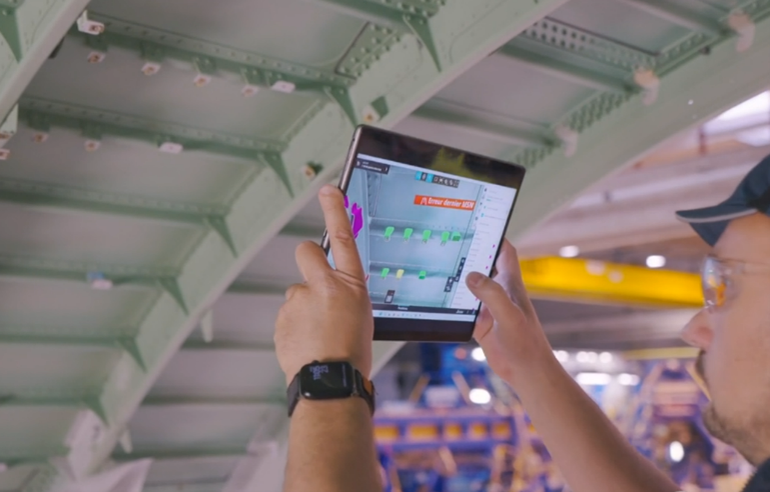
Augmented Reality (AR) handles the live side of the same problem. Instead of a paper work instruction, the operator sees 3D guidance overlaid directly on the physical components, stepped through the sequence, with errors caught as they happen. DELMIA’s Augmented Experience does precisely this, projecting validated work instructions onto the real assembly so what gets built matches what was designed, with no translation loss in between. In the high-tech industry, this applies specifically to the assembly and quality inspection of semiconductor manufacturing equipment where the scale and access complexity make AR guidance genuinely useful.
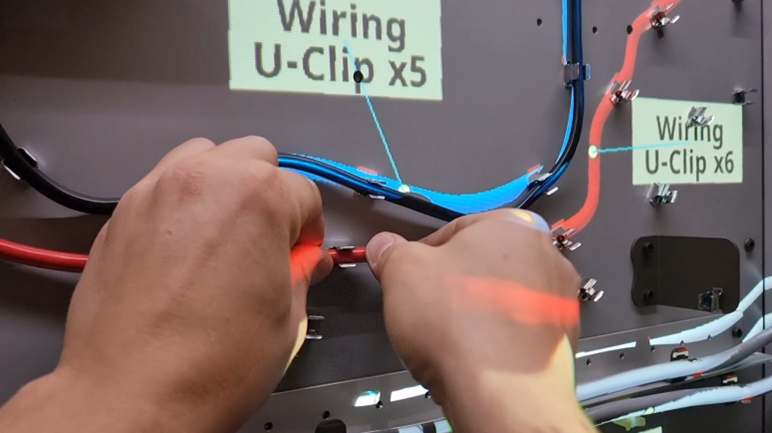
Agentic AI adds another layer to this: operating autonomously through continuous feedback loops, an AI agent can surface the right process knowledge at the right moment, capturing and reusing the expert know-how that typically walks out the door with a retiring technician and making it available to every operator, regardless of experience level.
Integrating Ergonomics, Training and Safety into One Digital Twin
It is easy to treat ergonomic validation, immersive training and workforce safety as separate initiatives owned by separate teams. In practice they are one loop and they tend to look underwhelming when funded in isolation.
You validate the workstation so the task is safe and within human limits. You train the worker in total immersion on that exact validated process so they perform it correctly from the start. The safety outcome falls out of both: a worker set up for an achievable task, who rehearses it until it is second nature, does not get hurt and does not wreck the expensive part. Floor-level wearables and exoskeletons then catch what slips through, closing the loop with real movement data you can feed back into the next design.
The connective tissue is the digital twin of the human. The manikin that proved the cell was ergonomic, the AR instructions the headset projects and the VR scenario the new hire trains in can all draw from one model of the work. That shared source is what turns three good ideas into a single system and it is what lets the knowledge of a retiring workforce be captured as something the organization keeps rather than something that walks out the door.
How to Implement Digital Ergonomics in Manufacturing Operations
If you run operations or manufacturing engineering, the move is not to buy three tools and hope they connect. It is to treat the human as a first-class object in the digital twin, the same way you already treat the machine and the part. A few practical starting points:
- Pull ergonomic scoring into design reviews, not into a separate late-stage study. Treat a cell that fails on a boundary manikin as a design defect to fix now.
- Build your manikin library from your real workforce demographics, including older and edge-case operators as well as adjacent-industry hires now filling fab and assembly roles. Reuse the library across projects.
- Drive both AR work instructions and VR training from the validated process, so what the worker rehearses and what guides their hands match what was designed.
- Use floor wearables and sensor data not just for live alerts but also as feedback into the next round of design validation.
- Measure the loop end to end: injury and near-miss rates, time to competency for new hires and scrap and rework on high-value parts. The three programs justify each other when you look at them together.
Conclusion: Linking Ergonomics Directly to Manufacturing Productivity
The labor math is not going to ease up, least of all in high tech. Fewer skilled people, an older workforce, fabs and AI hardware lines that need staff faster than the pipeline can supply them and injuries that cost the same as they always have. The manufacturers handling it well are the ones that have stopped treating ergonomics as a safety formality and started treating it as design. Validate the task against a real human before you build it. Train the worker through immersive simulation on that exact task. Support them on the floor with smart tooling and feed what you learn back into the model. Design for the human early enough and safety and productivity stop competing for the same budget. They start paying for each other.
DELMIA, a Dassault Systèmes brand, connects the virtual and real worlds to drive innovation and sustainability. Powered by the 3DEXPERIENCE platform, our end-to-end solutions integrate virtual twins, industrial AI and augmented reality to optimize manufacturing, supply chains and workforces. We empower businesses to reduce waste and achieve sustainable, customer-focused operations, building a more resilient future.
 Prashanth Mysore
Senior Director for Strategic Business Development, DELMIA