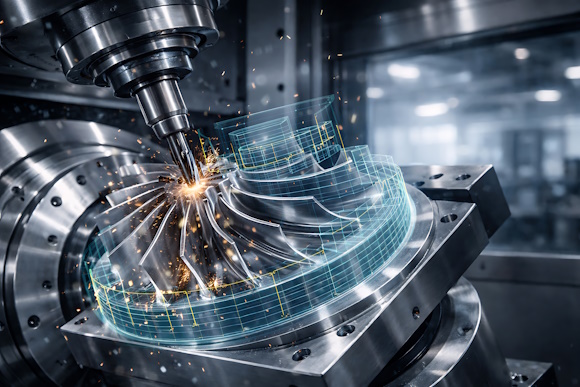
Modern manufacturers need faster throughput, fewer errors and smoother handling of engineering changes. A connected CAD to CAM workflow built on digital continuity helps close the gap between design and manufacturing by keeping product data, intent and revisions aligned from CAD through CAM programming and NC output.
What Is CAD to CAM Digital Continuity in Modern Manufacturing?
CAD to CAM digital continuity is the seamless transfer of design data from computer-aided design (CAD) into computer-aided manufacturing (CAM) without unnecessary file translation, manual rework or loss of engineering intent. In a connected environment, engineering and manufacturing teams work from the same product information, which improves consistency and reduces translation errors.
This approach is especially valuable for companies that manage:
- Complex parts and multi-axis machining
- Frequent design changes and revision updates
- Multi-CAD environments
- High-volume or high-mix production
Rather than treating CAD and CAM as separate stages, digital continuity connects them into one streamlined workflow.
Why Does CAD to CAM Connectivity Matter for Manufacturing Efficiency?
In traditional workflows, CAD data is often exported, imported and reinterpreted by CAM programmers. Each handoff introduces risk:
- Missing or outdated revisions
- Duplicate setup work
- Inconsistent geometry or product structure
- Delays in NC programming and machine setup
A connected CAD to CAM process addresses these issues by:
- Reducing manual data transfer and file conversions
- Preserving design intent from engineering to machining
- Improving revision control and traceability
- Shortening programming and setup time
- Supporting faster collaboration between design and manufacturing teams
For manufacturers focused on efficiency, this kind of digital continuity directly impacts productivity, quality and lead time.
What Are the Key Benefits of a Digital Continuity Workflow in Manufacturing?
A digital continuity strategy delivers practical benefits across the manufacturing lifecycle:
- Faster time to production: CAM programmers work with richer product context and fewer interruptions.
- Better data reuse: Design and manufacturing data are reused more effectively across programs.
- More consistent machining programs: Standardized workflows reduce variation.
- Faster response to engineering change orders: Updated revisions propagate more smoothly.
- Reduced translation errors: Fewer file conversions mean fewer opportunities for data loss.
- Improved standardization: Best practices can be scaled across teams and projects.
These benefits become more critical as product complexity increases and lead times shrink.
How Does Digital Continuity Improve CAM Programming and NC Output?
CAM programming is often a bottleneck when programmers must recreate intent from imported CAD files. A connected CAD to CAM workflow reduces this friction by letting teams access:
- Product structure
- Geometry
- Related manufacturing context
directly inside their CAM environment.
Programmers can then spend less time reconstructing information and more time:
- Optimizing toolpaths
- Refining setups
- Developing efficient machining strategies
The result is a more efficient, repeatable and scalable NC programming process.
How Do You Build a CAD to CAM Workflow for Smarter Manufacturing?
A smarter CAD to CAM workflow supports the full path from design to production. When product data stays connected, manufacturers can:
- Make better decisions faster
- Respond more quickly to late-stage design changes
- Reduce rework and manual corrections
- Maintain consistency across revisions
- Scale machining operations more effectively
In short, digital continuity helps manufacturing teams work with more confidence and less friction.
Why Is CAD to CAM Digital Continuity a Competitive Advantage for Manufacturers?
CAD to CAM digital continuity is more than a technical improvement. It’s a practical way to:
- Speed up manufacturing workflows
- Reduce errors and rework
- Handle engineering changes more efficiently
- Improve overall productivity
By connecting design and machining in one continuous process, manufacturers can achieve faster throughput, better quality and a more scalable operation.
If you’re evaluating CAM software, manufacturing platforms or digital continuity solutions, focus on how well your system connects CAD and CAM data end-to-end. The stronger that connection, the more your manufacturing workflow will benefit.
CAD to CAM digital continuity refers to the seamless transfer of design data from computer-aided design into computer-aided manufacturing without unnecessary file translation, manual rework or loss of context. In a connected environment, engineering and manufacturing teams work from the same product information.
Traditional workflows often rely on file exports, imports and manual interpretation, creating risks of missing updates, duplicate work and delays. A connected CAD to CAM process reduces manual data transfer, preserves design intent, improves revision control and shortens programming time.
Benefits include faster time to production, better data reuse, more consistent machining programs, faster response to engineering changes, reduced translation errors and improved standardization across teams and projects.
A smarter workflow supports the full path from design to production, enables faster decisions, responds quickly to late-stage changes, reduces rework, maintains consistency across revisions and scales machining operations more effectively.
A connected workflow reduces friction by letting teams access product structure, geometry and manufacturing context directly in the CAM environment. Programmers spend less time reconstructing information and more time optimizing toolpaths and setups.
DELMIA Machining is an advanced, CATIA/SOLIDWORKS-native CAM solution designed for complex multi-axis machining in aerospace & defense, automotive, industrial technology, combining AI-assisted programming with full process control to reduce NC programming time while maintaining production-grade reliability.

DELMIA Senior Offer Marketing and Business Development Manager