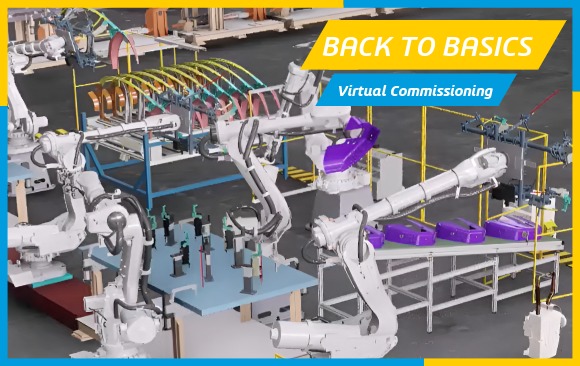

DELMIA’s Back to Basics blog series is your go-to resource for foundational insights into manufacturing, operations and supply chain management. Designed for both newcomers and those seeking a refresher, this series delves into core topics and addresses key industry questions.
Virtual Commissioning is the strategic process of testing, validating, and debugging control software against a high-fidelity digital model of a machine or entire production system—long before physical equipment ever touches the shop floor. At its core, DELMIA Virtual Commissioning breaks down traditional silos by front-loading the commissioning phase. Instead of waiting for physical hardware completion, engineering teams seamlessly connect real-world programmable logic controllers (PLCs) directly to a virtual machine model, executing exact real-world logic within a risk-free digital environment.
What are the Three Pillars of Virtual Commissioning?
To achieve a fully synchronized virtual commissioning ecosystem, three essential elements must converge:
- The Virtual Twin Experience: A dynamic, physics-based digital replica that accurately simulates the behavioral mechanics of the entire line or plant—including robots, conveyors, and electromechanical devices.
- The Control Logic: The operational intelligence embedded directly within the PLCs.
- The Communication Interface: A seamless, high-speed digital thread connecting the Virtual Twin with the physical or virtual PLC.
The objective is to empower all stakeholders—from design engineers to plant managers—to collaborate effortlessly within a unified digital environment, ensuring flawless execution from the very start of a line implementation project.
Why Manufacturers Need Virtual Commissioning
Modern production systems are growing faster in complexity than traditional commissioning methods can handle. Tighter delivery schedules, multi-vendor automation components, and increasingly sophisticated PLC logic mean that late-stage error discovery carries consequences that were simply unacceptable a decade ago.
The pressure is structural. Commissioning typically sits at the tail end of a project, meaning any problem found there collides directly with launch deadlines — and the cost of halting a nearly complete production line dwarfs what the same fix would have required weeks earlier.
Fixing a machine issue during physical commissioning can be more expensive than catching it at the design stage. That financial reality alone explains why manufacturers across automotive, aerospace and consumer goods are shifting validation work upstream.
Worker safety adds another layer of urgency. Testing hazardous motion sequences on live hardware exposes technicians to real risk — a problem that disappears entirely when the same scenarios are executed in a simulated setting.
How the Virtual Commissioning Process Works
The process follows a clear, structured sequence that engineering teams execute before a single component reaches the production floor. Each phase builds directly on the previous one, making the overall workflow both logical and traceable.
Here is how it typically unfolds:
- Digital model construction: A detailed 3D model of the machine or production cell is built, incorporating accurate geometry, kinematics, and sensor behavior to reflect real operating conditions.
- Control system connection: The actual PLC or robot controller is linked to the virtual model — the controller operates as though it were commanding physical hardware.
- Simulation and debugging: Engineers run production scenarios, observe system responses, and resolve logic conflicts or motion errors in a consequence-free setting.
- Performance benchmarking: Throughput, cycle time, and safety interlocks are measured against design targets before any physical build begins.
Fixing a software conflict at this stage costs a fraction of what the same correction demands once hardware is installed and production timelines are at risk.
Pre-Deployment Validation: Testing Systems Safely
Pre-deployment validation is where virtual commissioning delivers its most measurable impact. Running full production scenarios against a digital model exposes motion conflicts, safety interlock failures, and timing mismatches that would otherwise surface only once hardware is bolted down and schedules are already under pressure.
Beyond cost, there is a safety dimension that physical tryouts simply cannot match. Hazardous sequences — unexpected robot trajectories, pressure overloads, or collision paths — can be triggered deliberately in the virtual model and studied without any risk to personnel or equipment.
How Virtual Commissioning Reduces Costs and Mitigates Risk
By leveraging advanced simulation technology, manufacturers can proactively expose and rectify control software errors at an early stage—when modifications cost a fraction of traditional, on-site troubleshooting. This simulation-driven approach completely optimizes control systems and automation before physical deployment, drastically reducing real-world risks, overhead costs, and time-to-market.
How to Get Started with Virtual Commissioning
- Read Virtual Commissioning with DELMIA: Transforming Industrial Automation
- Download Transforming Manufacturing Assembly Lines with Virtual Commissioning and Transforming Robotic Manufacturing Success with DELMIA Robotics
- Request a demonstration
DELMIA, a brand of Dassault Systèmes’, provides a unified environment for designing, simulating, programming, and commissioning robotic systems using a physics-accurate virtual twin. Built on the 3DEXPERIENCE platform, it supports 2,000+ robot models, multiple PLCs and all major processes, generating validated trajectories and native robot code from a single data model. The virtual twin, combined with AI-assisted automation, cuts programming and commissioning time while enabling fast, reliable adaptation to product or production changes.