What is the benefit of ergonomic design?
Ergonomic design matches workstations, tools and tasks to the physical capabilities of workers rather than forcing workers to adapt to a fixed layout. The benefit is measurable: fewer musculoskeletal injuries, lower compensation costs, faster training and higher productivity. For manufacturers, ergonomic design turns worker safety into a competitive advantage rather than a compliance checkbox.
Why was ergonomics treated as an afterthought for so long?
Ergonomics was treated as an afterthought mainly because of the lack of ergonomics knowledge from engineers. Yet for engineers stepping into manufacturing roles, have to take layout design decision that impact the works task on the factory’s.
Digital human modeling dates back to the 1960s, when early aerospace engineers developed it to study how pilots performed tasks in cockpit design. Despite six decades of progress, cross-training between engineers and ergonomists remained rare.
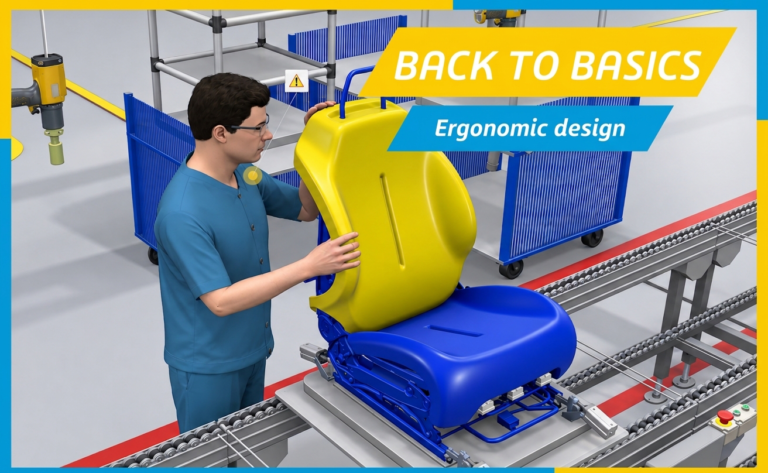
Without shared training, engineers and ergonomists rarely collaborated. Ergonomic assessment got pushed to the end of the design process, if it happened at all. Production lines got built first and workers had to adapt to them afterward. On a car assembly line, that can mean working overhead under the vehicle body, or bending into the cabin to fit a seat, cycle after cycle. That sequencing shows up in injury rates, turnover and lost production time.
The solution is to move ergonomic assessment upstream, into the virtual design of the line, before anything is built.
How does Smart Posturing technology change ergonomic assessment?
New three-dimensional modeling technologies have moved the field past manual manikin placement and into automated, data-driven assessment. DELMIA Ergonomic Workplace Designer can reuse the process planning data engineers already have, so nothing needs to be redefined. From that data and the 3D layout of the workstation, it works out where the manikin should stand and what it needs to grasp.
The Smart Posturing Engine (SPE) then predicts a realistic, probable posture without collisions, accounting for the weight of the object and the way the hand grasps it. Ergo4All™ analyzes that posture to flag potential ergonomic risks, then suggests ways to lower them. Both are patented, scientifically validated technologies, developed with two Montreal engineering schools: École de technologie supérieure (ÉTS) for the Smart Posturing Engine and Polytechnique Montréal for Ergo4All.
In one click, the Smart Posturing Engine postures the manikin and Ergo4All rates the ergonomic risk, so process engineers can screen many more worker tasks, early in the design. With traditional digital human modeling tools, engineers posture the manikin by hand. DELMIA’s internal measurements put that at about five minutes per posture, or 20 minutes for a task with four key postures, and a task often needs several assessments as the design changes. Speed matters because production line changes often happen with little advance notice, leaving engineers no time for lengthy manual review.
What are the measurable benefits of ergonomic design?
The return is direct: less time per assessment, more worker tasks assessed and ergonomists focused on the critical cases. Automating ergonomic assessment during production line changes saves hours compared to manual methods, which builds the business case leadership needs.
As James Brown, Digital Manufacturing Engineer at Prodtex, put it on DELMIA’s Global Operations on the Go Fit a Day’s Work in 30 Minutes with Ergonomic Workplace Designer podcast:
I was able to do probably a day’s work in 30 minutes.”
The benefits extend across the organization:
- Fewer musculoskeletal injuries and lower compensation costs
- Reduced worker turnover through safer working conditions
- Faster decision-making across engineering and operations teams
- Better allocation of certified ergonomists across multiple facilities or regions
- Stronger company culture, since investing in worker safety signals that management takes it seriously
The allocation of ergonomists is where automated screening changes the most. Process engineers assess every worker task with Ergonomic Workplace Designer, and only the tasks that screening flags as critical go on to in-depth analysis by ergonomics specialists in DELMIA Ergonomics at Work. Expert time goes to the few tasks that need it.
Why does ergonomic design matter for attracting new engineering talent?
Manufacturing faces a real skills gap. A 2024 study by Deloitte and The Manufacturing Institute projects that U.S. manufacturers could need as many as 3.8 million additional employees between 2024 and 2033. If applicant skills gaps are not addressed, 1.9 million of these jobs could go unfilled.
Ergonomic design gives new engineers a practical, resume-ready skill and a better reason to stay. With automated posturing and risk assessment, process engineers who are not ergonomists can assess ergonomics themselves, early in the design. Working in a visual 3D environment like the 3DEXPERIENCE platform also makes the assessment itself more engaging.
How does ergonomic design connect to the wider production system?
Ergonomic design does not stop at the workstation. Because DELMIA Ergonomic Workplace Designer runs on the 3DEXPERIENCE platform, ergonomics and process planning share the same data and the critical tasks move on to expert analysis on the same platform. Teams work from one shared virtual twin of the line.
See it in action: explore DELMIA Ergonomic Workplace Designer,
FAQs About Ergonomic Design
An ergonomist applies ergonomics theory, principles, data and methods to workplace design to optimize human well-being alongside overall system performance, according to the International Ergonomics Association. Ergonomics is never black or white. So the ergonomist uses his judgment and expertise to find the best solution for the worker and the manufacturing company.
Ergonomics is the scientific study of how people interact with the systems around them. Ergonomic design applies that science to workstations, tools and tasks so they fit workers’ physical capabilities.
Overexertion, such as lifting, pushing, pulling or carrying, is the costliest cause of serious, nonfatal workplace injuries in the United States: about 13 billion dollars a year in workers’ compensation costs, according to the Liberty Mutual Workplace Safety Index on 2023 data. It is also the leading cause of these costs in manufacturing. Indirect costs, such as lost productivity and replacement staff, come on top.
Ergonomic assessment should happen during the virtual design phase, before the line is built. Assessing early lets teams find and fix risks before workers are affected. Pushing assessment to the end, or skipping it, forces workers to adapt to a finished layout and raises injury, turnover and lost-time costs.
Digital human modeling uses virtual manikins in a 3D environment to simulate how people perform tasks, so engineers can evaluate posture, reach and strain before building anything. Manual manikin placement is slow, which is why automated approaches have emerged.
No. Ergo4All flags potential risks and suggests ways to lower them, but it doesn’t replace the judgment of a certified ergonomist. It helps process engineers screen worker tasks early. The critical tasks then go to ergonomics specialists for in-depth analysis in DELMIA Ergonomics at Work. This enables ergonomists to spend their time where it matters most.
Track metrics before and after a change: injury rates, workers’ compensation costs, turnover, absenteeism, assessment time and quality defects tied to physical strain. Compare the savings against the cost of tools and redesign. Exact returns vary by plant, so use your own baseline data rather than industry averages.
DELMIA, a Dassault Systèmes brand, connects the virtual and real worlds to drive innovation and sustainability. Powered by the 3DEXPERIENCE platform, our end-to-end solutions integrate virtual twins, industrial AI and augmented reality to optimize manufacturing, supply chains and workforces. We empower businesses to reduce waste and achieve sustainable, customer-focused operations, building a more resilient future.

DELMIA Ergonomics Roles Portfolio Engineering Specialist, Virtual Ergonomics