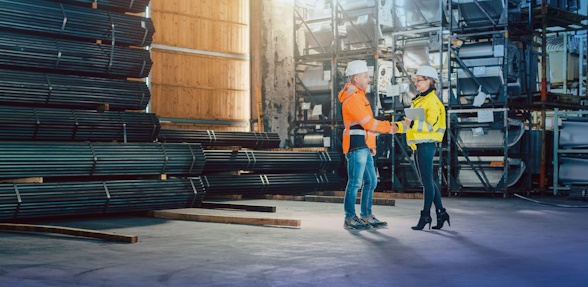
The metals market in 2026 looks nothing like it did five years ago. Copper shortfalls driven by AI data center buildouts. CBAM adding real carbon cost to anything exported into Europe. Chinese overcapacity suppressing global steel pricing while US tariffs on steel and Aluminium imports redraw domestic competitive dynamics. Reshoring scrambles rebuilding supplier networks that took decades to develop.
And yet, when I am at customer workshops or presenting at industry events, the question I hear most is still: “Where do we start with digitizing our supply chain?”
It is the second question. The first one, the one that actually determines whether the investment pays back, is: “Are we asking the right things before we commit?”
I have worked across various industries over 20 year and within that 5+ years with metals industry. The programs that fail do not fail because of the wrong software. They fail because the organization started digitizing before it understood what it actually needed to fix.
1. Identifying Root Causes vs. Pain Points in Metal Planning
Every metal company has a story about its biggest problem. Usually it is forecast accuracy, on-time delivery, or inventory costs. But when you work through the data, the root cause is rarely where the pain is felt.
In metals, AI and machine learning are increasingly applied to demand forecasting, predictive maintenance, and quality control, yet most manufacturers are only beginning to connect these capabilities to their actual planning and scheduling systems. The gap between what the market signals and what production schedules reflect can run weeks or months wide, and that gap costs margin every single day.
Before anything else, map the actual failure points. Not the polished version in the board presentation, but the ones your schedulers are dealing with at 6 a.m. Digitizing a broken process does not fix it. It just makes the chaos move faster.
2. Solving Data Fragmentation in Metals Manufacturing
The most common barrier we encounter in metals is not technology readiness. It is data quality. Multiple facilities running different ERPs. Systems inherited from acquisitions. Local IT decisions that made sense at the time but left behind a landscape nearly impossible to harmonize.
I have sat in rooms where a CFO insists the company has “one version of the truth” and the operations director quietly disagrees. They are both right. The financial system has clean aggregate numbers. The shop floor runs on tribal knowledge and whiteboards.
Real-time inventory tracking and digital twins are becoming more prevalent in metals manufacturing, but they depend entirely on clean, connected data to function. If your heat data doesn’t link to your order management system, your digital twin simulates fiction instead of your actual operation.
Your data does not need to be perfect. It never will be. It needs to be structured enough to be useful, and you need a realistic plan to close the gaps as you scale. Modern platforms including DELMIA’s are built to work with heterogeneous, multi-source data environments. But they cannot fix what you have not acknowledged is broken.
3. Preparing for 2028: Copper Deficits and Carbon Costs (CBAM)
The organizations making digital transformation work in 2026 have stopped treating it as a technology upgrade. They are treating digital capability as a core operating model, shifting from reactive execution to predictive orchestration.
For metals specifically, that means looking well beyond your own four walls. Bloomberg Nef’s Transition Metals Outlook flags structural copper deficits from 2025 onward, with China continuing to dominate midstream capacity in Aluminium, graphite, manganese, and rare earths, all critical inputs across the metals value chain. McKinsey’s Global Materials Perspective points to supply-demand imbalances across most commodities, with energy transition materials projected to grow at 4.5% CAGR through 2035.
Planning systems designed for a stable, globalized world will not handle this. The most valuable conversations we have with steel producers and Aluminium smelters during DELMIA implementations are not about automating what already exists. They are about what the supply chain needs to handle in 2028: reshored supply bases, carbon-linked procurement, multi-tier visibility across the value chain. Dassault Systemes 3DEXPERIENCE platform and DELMIA Quintiq apps were built for exactly this kind of constraint-heavy, grade-mix complexity, with scenario planning that can respond when the ground shifts, not just when it already has.

4. Ensuring Long-Term Adoption of Digital Transformation
This one ends more programs than any technology decision.
The people who have spent careers mastering physical processes: metallurgy, casting sequences, rolling schedules, heat treatment cycles run the metals operations. They are not wrong to be skeptical of software that promises to optimize what they have spent decades learning to feel.
Transformation in this industry does not work through mandates. It works when a shift supervisor notices that the system’s inventory recommendation was right three times in a row and starts to trust it. That takes time. It takes someone internally who understands both the tool and the production floor and has the standing to make adoption stick.
According to Gartner’s 2025 Tariff Volatility Survey, 54% of Chief Supply Chain Officers said it would take more than 12 months to shift even 25% of their supply to regional sources, which tells you exactly how much inertia sits inside these organizations. Technology does not move that. People do.
Who is accountable for adoption six months after go-live, not just deployment? Who checks whether planners are using the system, or have quietly reverted to spreadsheets? If the answer is unclear, the program will drift. It almost always does.
5. Defining Metrics: Reducing Lead Times and Operational Costs
“Better visibility” is not a metric. Neither is “improved decision-making.”
In metals distribution, the working capital pressure is structural. Mill lead times often run 8 to 16 weeks. Customer delivery expectations run days. Cash gets tied up in that gap and the inventory that sits in it while margins erode quietly. A real digitization target for a service center is not “improve planning.” It is: reduce excess inventory carrying costs by 15%, or cut the quote-to-order cycle from five days to one.
For a primary producer, meaningful KPIs look different: heat-to-ship cycle time, yield loss per heat, or the percentage of customer orders fulfilled without manual intervention. DELMIA implementations in metals have targeted reductions in lead times and operational costs of up to 20%, but that number only means something if you have measured the baseline before go-live.
CBAM hardwires carbon data into procurement decisions, and Digital Product Passports shift from optional to a regulatory requirement across sectors, including metals. If traceability and emissions reporting are not in your digitization roadmap now, you will be retrofitting them under deadline pressure in 24 months. That is an expensive way to learn.
Set the metrics before you start. Measure the baseline before you go live. Then you will actually know whether it worked.
Across the metals companies I have worked with, steel, aluminum, specialty metals, the ones that get this right tend to start narrower than planned, measure harder than expected, and scale faster than anyone predicted. The ones that struggle usually begin with vendor selection and work backwards to the problem.
Ask these five questions first. The technology decision gets a lot easier after that.
DELMIA, a Dassault Systèmes brand, transforms supply chain planning and operations by connecting the virtual and real worlds through the 3DEXPERIENCE platform. Our solutions enable businesses to model, simulate and optimize a virtual twin of the supply chain, delivering resilient and efficient planning across horizons. By combining virtual twins with trusted industrial AI and advanced optimization, DELMIA provides real-time, explainable insights for smarter decision-making, reducing waste and improving agility. From end-to-end planning through detailed scheduling and execution, we empower organizations to adapt to disruptions, enhance sustainability and deliver exceptional customer experiences across the entire value chain.
 Prashanth Mysore
Senior Director for Strategic Business Development, DELMIA