
As buildings, grids, and mobility electrify in parallel, energy design is no longer a single-discipline exercise. Decarbonization pushes systems toward heat pumps, photovoltaics, batteries, and flexible loads—while climate change increases cooling demand, shifts solar yield, and stresses components from batteries to chillers. Engineers need to understand both trends together: not only whether a design works today, but how it behaves under tomorrow’s weather and tomorrow’s operating patterns.The solution is not a larger spreadsheet—it is system simulation with equation-based models that capture dynamics, control, and cross-domain coupling in one environment. With CATIA Dymola and the Sustainable Supply Systems Library (SuSy), engineers can run year-long, hourly simulations in seconds—and compare adaptation measures, costs, and emissions before investing in hardware.
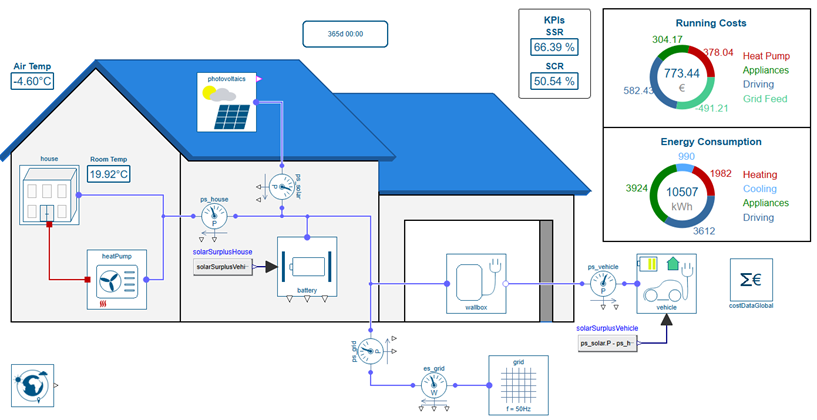
Smart home with SuSy in Dymola:
Why tomorrow’s energy question is a system question
The building sector accounts for a large share of global final energy consumption. Efficiency measures reduce heat demand, but electrification and hotter summers increase electrical cooling needs. Renewable generation adds another layer: more sunshine can improve PV yield, yet cell efficiency drops at high temperatures—so “more sun” does not automatically mean more usable power without system context. Storage and flexible operation complicate the picture further; scenarios also stress pumped-storage availability, battery aging, and cooling demand for storage assets. A higher solar harvest still does not automatically mean higher self-sufficiency if consumption timing and grid exchange dominate. These effects only appear when building thermal behavior, local climate, generation and storage, and tariffs or emissions factors are evaluated together over representative time horizons. That is the strength of Modelica-based system simulation in CATIA Dymola.
Climate data inside the simulation loop
Meaningful “future” studies start with credible weather. In Dymola, climate can be supplied through test reference years, historical records, or transformed datasets aligned with regional projections. This allows the user to account for urban heat island effects—critical when comparing a suburban residential building with a dense urban district.
SuSy: from smart homes to hospitals and industry
To model integrated energy systems quickly, CATIA Systems provides the Sustainable Supply Systems Library (SuSy). SuSy is intentionally lean: few parameters, short run times, and robust numerics so engineers can explore many scenarios instead of tuning one heavy model.
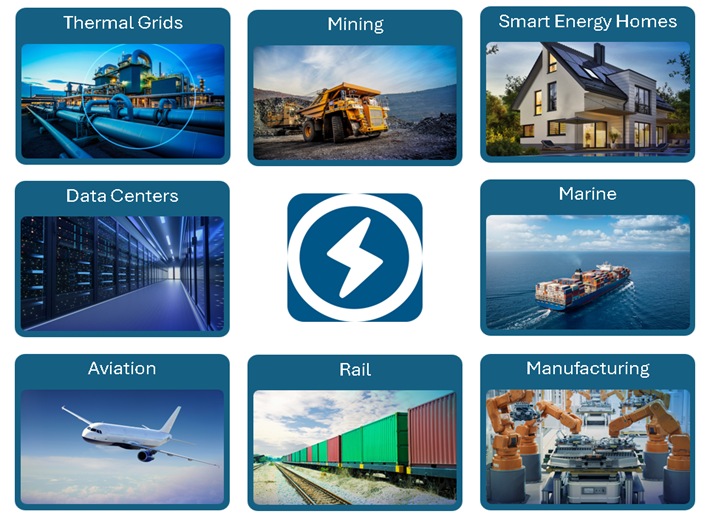
SuSy connects electricity, thermal networks, fuels, storage, and mobility through physical connectors. Ready-made examples span smart buildings, district energy, manufacturing, mining, marine, rail, and more.
Electricity, thermal, fuel, and mobility domains in one interconnected SuSy model:
A smart-energy home might combine PV, battery storage, a heat pump, and an EV charger. SuSy can simulate one year at hourly resolution in seconds – fast enough to compare control strategies and equipment sizing across seasons.
The same library scales to non-residential contexts: data centers with chiller sizing studies, or battery production halls where high process heat and hall cooling interact with on-site renewables and storage.
Quantifying adaptation: cooling, storage, cost, and carbon
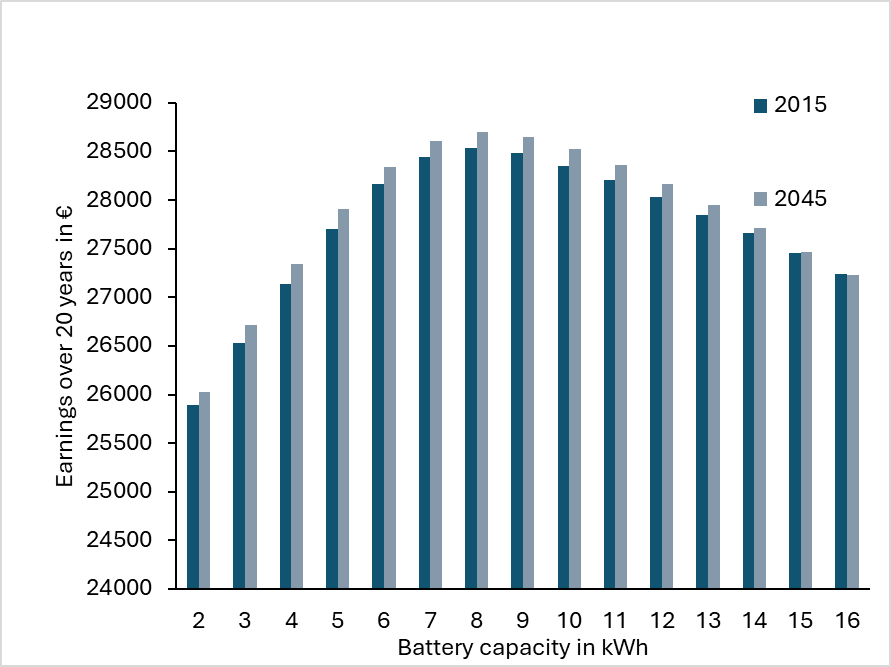
Climate adaptation is more than adding PV panels. Simulation lets engineers compare insulation and shading, cooling capacity, storage sizing, and user behavior under future weather. A sweep over battery capacity, for example, shows the optimal size shifting with weather, self-consumption, and tariffs. Because SuSy tracks CAPEX, OPEX, levelized cost of energy, and direct and indirect emissions alongside the physics, trade-offs such as the extra roof area and battery needed for near-zero grid emissions become visible before capital is committed.
Battery capacity vs. long-term earnings:
Conclusion
Climate change and the energy transition are not separate problems. Tomorrow’s buildings will need more cooling, more flexibility, and more renewable integration at once – often on the same site. System simulation with CATIA Dymola and the Sustainable Supply Systems Library lets you test those futures quantitatively: weather, equipment, behavior, cost, and emissions in one repeatable workflow.
For examples, release notes, and guidance on the Sustainable Supply Systems Library—and to connect with other practitioners—visit the CATIA System simulation community on 3DSwym.
FAQ
A static annual balance uses fixed weather and simplified assumptions. SuSy in Dymola runs simulations where control, storage, part-load efficiency, and weather time series interact. You can swap climate files (historical vs projected TRY years), compare operating strategies, and observe peak loads—not only yearly totals.
SuSy examples and building templates support residential smart-energy homes, offices, healthcare facilities, data centers, and industrial production (including high internal heat gains and hall conditioning). Internal gain profiles and ISO-oriented thermal models help match occupancy and usage patterns to each typology.
Domain experts build and validate models in Dymola; Systems Simulation Designer and Analyst roles let others run approved scenarios through web cockpits. The CATIA System simulation community is a good starting point for library documentation, tutorials, and best practices.

Imke Lisa KRUEGER is a Multi-Physics Modeling Software Engineering Senior Manager within the Multi-physics Libraries organization.