Challenge
Industries are entering a new era where products are no longer purely mechanical. From vehicles and aircraft to medical devices and consumer electronics, products are becoming smart, connected, and continuously evolving. This shift is often described as the transition towards software-defined experiences — where software plays a central role in delivering value to users.
In this new paradigm, hardware and software must work together seamlessly to create intelligent systems capable of interacting with the real world through sensors, data processing, and connectivity. Enabled by cloud computing, Big Data, and the Internet of Things (IoT), software increasingly determines how products behave, evolve, and deliver value throughout their lifecycle.
However, this transformation introduces significant complexity. Designing software-defined products requires tight collaboration between hardware engineers, software developers, and systems engineers. Traditional product development approaches—where disciplines operate in silos—are no longer sufficient.
Instead, organizations must adopt a systems engineering approach that manages complexity across the entire lifecycle, from requirements definition to verification and validation. Maintaining end-to-end traceability, coordinating development cycles between hardware and software, and ensuring architectural consistency have become critical challenges for industrial companies.
Solution
To address these challenges, CATIA, powered by the 3DEXPERIENCE Platform, provides an architecture-driven governance approach for the development of complex systems and software-defined products.
The platform enables organizations to manage system architecture, requirements, models, and validation processes within a single collaborative environment. By placing system architecture at the center of development, it ensures alignment between product definition, engineering processes, and lifecycle governance.
With the acquisition of ENALEAN, Dassault Systèmes further strengthens these capabilities. ENALEAN’s flagship solution, Tuleap, brings advanced Application Lifecycle Management (ALM) functionality to the ecosystem.
We’re delighted to join Dassault Systèmes. We share a common vision to provide our clients an efficient solution to engineer their software. Our team capitalized huge expertise that complement Dassault Systèmes 45 years industry knowledge & know-how to generate Virtual Twin of Software-Defined Product for our clients.
Laurent CHARLES, ENALEAN CEO & Co-Founder
Tuleap complements the 3DEXPERIENCE platform by managing software development workflows, including agile project management, requirements management, and traceability across the software lifecycle. By connecting software engineering processes with systems engineering models in CATIA and ENOVIA PLM, organizations can bridge the gap between hardware development and software delivery.
Tuleap competes with leaders such as Jira and CodeBeamer, Polarion, offering a comprehensive suite of features designed to streamline project management at scale (agile or hybrid) and foster effective team collaboration. With its integrated agile tools, task management, software development, issue tracker and collaborative workflows, Tuleap is an ideal alternative for teams looking to replace Jira or enhance their existing project management processes.
Together, CATIA and Tuleap enable a unified approach where system architecture, hardware design, and software development are coordinated and traceable within a continuous digital thread.
Benefits
The combination of CATIA’s Model-Based Systems Engineering (MBSE) capabilities with Tuleap’s ALM platform delivers several strategic advantages.
First, it breaks down silos between disciplines, allowing systems engineers, hardware designers, and software developers to collaborate around a shared architecture and set of requirements.
Second, it provides end-to-end traceability, ensuring that requirements, design decisions, and validation results remain connected throughout the entire lifecycle. This is particularly critical for industries operating in highly regulated environments.
Many industries such as Transportation & Mobility, Aerospace & Defense, High Tech, Industrial Equipment need to adopt a new approach to develop complex products in a highly regulated environment. Our clients will leverage our 3DEXPERIENCE platform to reduce lead time, improve collaboration across disciplines, and make better engineering decisions earlier in their development process.
Olivier Sappin, CATIA CEO
Third, the approach improves development agility by aligning hardware and software development cycles. Software teams can adopt agile practices while maintaining strong governance and integration with system engineering processes.
Finally, the combined solution accelerates innovation by allowing organizations to design scalable architectures, reduce lead times, and improve product quality and resilience.
Industries such as Aerospace & Defense, Transportation & Mobility, and High-Tech can therefore develop next-generation software-defined products while maintaining control over complexity and ensuring long-term system integrity.
Traceability is one of the keys to ensuring that our software respects safety regulations. Tuleap has become our critical friend for ASPICE audits and this acquisition enables the multidiscipline collaboration necessary for hardware-software compatibility. We see a strong value to be able to connect Systems Engineering, PLM and ALM to manage Software Defined Vehicles complexity.
Ghislain Poncet, SW Engineer, JTekt
FAQ
Tuleap is an Application Lifecycle Management (ALM) platform designed to support agile software development, requirements management, and end-to-end traceability across software engineering processes.
- What are the main capabilities?
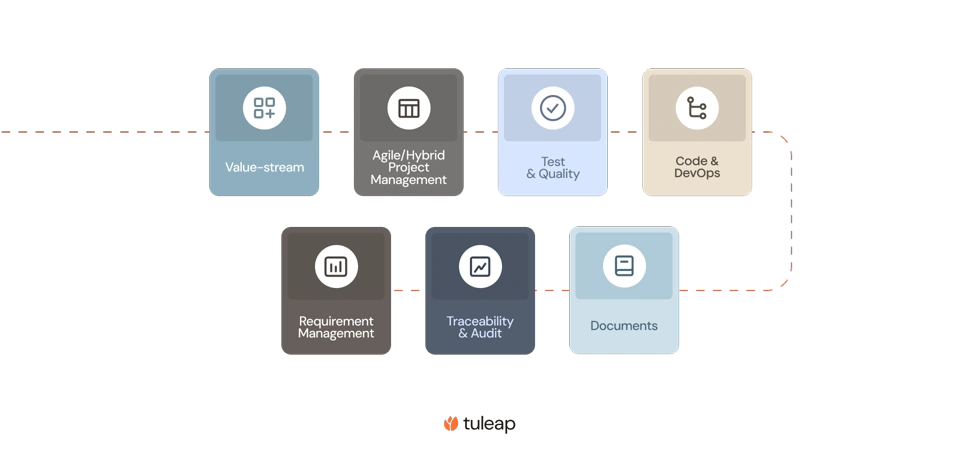
– Agile and DevOps project management (Scrum, Kanban, SAFe)
– Requirements and backlog management
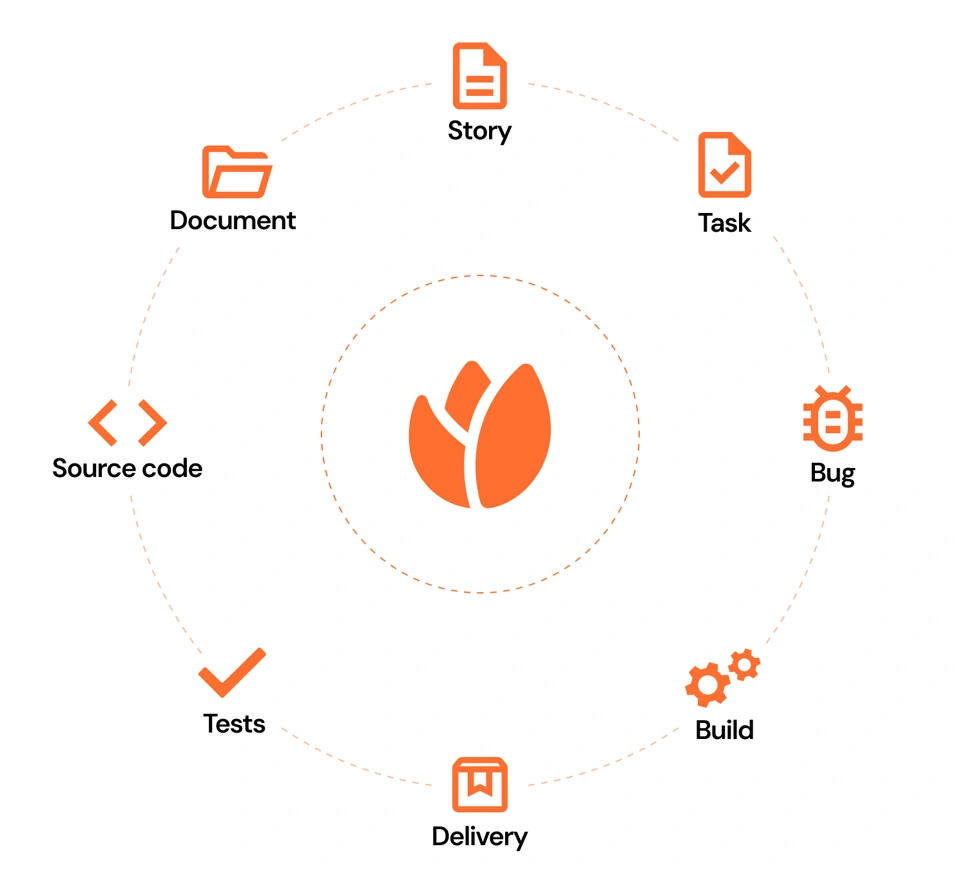
– Task, bug, and issue tracking
– Test management and quality tracking
– Code management and integration with Git/SVN
– Documentation and collaboration tools
– End-to-end traceability from requirements to tests and delivery
- What are the Key characteristics of Tuleap?
– Versatile & highly configurable, AI native platform
– Designed for regulated industries (aerospace, automotive, medical, defense) where traceability and compliance are critical
– Full control of code and data
– Single platform replacing multiple tools like Jira, Confluence, and other plugins
– Available on-premise or in the cloud
- How does Tuleap complement CATIA?
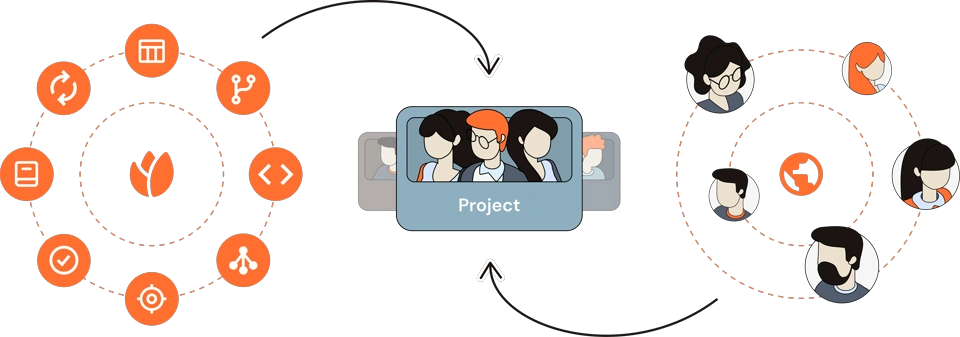
While CATIA focuses on Model-Based Systems Engineering and system architecture, Tuleap manages software development workflows. Together they connect systems engineering and software engineering within a unified environment.
- Why is this important for software-defined products?
Software-defined products require tight coordination between hardware, software, and system architecture. Integrating MBSE and ALM ensures consistent development processes and traceability across disciplines.
- Which industries benefit the most?
Industries developing complex, regulated, and connected systems—such as Aerospace & Defense, Transportation & Mobility, and High-Tech—benefit significantly from this integrated approach.

As VP of R&D for CATIA Systems, with over 15 years of experience in embedded systems and software, Frederic Bourcier defines the strategic evolution of the virtual twin of the systems accelerating the continuous development of the products while ensuring safety and cybersecurity until certification.