The CATIA Release Keynote R2027x taking place on Thursday, November 19, 2026, demonstrates how Industrial AI helps engineers tackle complexity, connect workflows and turn decades of industrial expertise into actionable outcomes.
Engineering teams need AI that solves specific technical challenges and delivers measurable business value.
Turning AI investment into measurable business outcomes remains a challenge. According to PwC’s 29th Global CEO Survey, only one in eight CEOs say AI delivers both higher revenues and lower costs.
For engineering, the opportunity goes beyond adding AI to existing tools. It lies in connecting industrial knowledge, engineering expertise and product data to help teams tackle complexity, make better decisions and get actionable results. Connecting industrial knowledge, engineering expertise and product data is the vision behind CATIA R2027x.
How does CATIA R2027x evolve Industrial AI for engineering?
CATIA R2027x brings together Virtual Companions and Generative Experiences in the context of Industrial AI and the Virtual Twin.
The keynote will show how Virtual Companions and Generative Experiences can support engineering work, from reasoning through industrial constraints to automating design workflows, while end-to-end digital continuity connects information across disciplines
Together, these themes frame a broader ambition: helping engineering teams work with more connected tools, industrial knowledge and AI capabilities.
How can Industrial AI create value for engineers?
Industrial AI needs to do more than generate plausible answers. Engineering teams need AI that can work with industrial context, understand constraints and support tasks within real engineering workflows.
In the CATIA R2027x interview, Olivier Sappin, CATIA CEO highlights the opportunity to translate decades of industrial experience and know-how into competencies that engineers can use across mechanical, electrical, electronics and software disciplines.
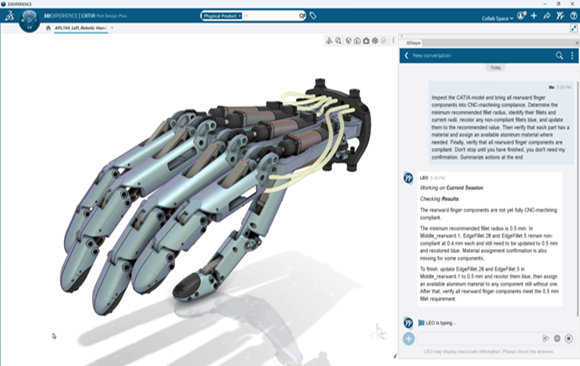
The goal of translating industrial experience into usable competencies is the thinking behind CATIA’s Virtual Companions. Rather than simply responding to questions, they reason through constraints, plan next steps and carry out tasks under the user’s control.
The keynote will demonstrate how this approach can support human-AI teamwork on complex industrial challenges.
How can Virtual Companions help engineers reason through industrial constraints?
Virtual Companions work alongside people as trusted industrial experts.
In CATIA R2027x, AURA and LEO illustrate two complementary experiences:
AURA: The Business Expert
LEO: The Engineer
Virtual Companions like AURA and LEO reason through constraints, plan next steps and carry out tasks under the user’s control, drawing on industrial knowledge, physics and materials science.
The keynote will show AURA and LEO tackling industrial challenges in live demonstrations.
How can Generative Experiences automate industrial design processes?
CATIA Generative Experiences are AI-powered capabilities that automate industrial processes.
They can turn inputs such as text, documents and other representations into actionable outputs, such as deliverables and completed tasks. They can also create or enrich Virtual Twins, helping teams explore and understand a product virtually before it physically exists.
CATIA Generative Experiences have the industrial context needed to maintain quality and comply with industry and enterprise standards.
During the keynote, attendees will see how Generative Experiences support industrial workflows, alongside demonstrations focused on faster design iterations, earlier risk identification and broader access to business data.
CATIA Generative Experiences focus on turning information into useful outcomes in an industrial context, not simply generating content.
How does CATIA R2027x support end-to-end digital continuity?
CATIA R2027x supports end-to-end digital continuity by connecting workflows so information flows across disciplines without manual rebuilding or recreation throughout the product lifecycle.
The release themes include connections between architectural design and detailed electrical wiring, as well as between schematic design and virtual commissioning.
The connections between architectural design, electrical wiring, schematic design and virtual commissioning illustrate the goal of a more continuous engineering process, in which information can move forward between activities rather than teams repeatedly reconstructing it.
See CATIA R2027x in action on November 19
The CATIA Release Keynote R2027x on Thursday, November 19, 2026, features live demonstrations of Virtual Companions and Generative Experiences in real engineering scenarios.
The keynote runs 90 minutes, starting at 9:00 AM, CET.
The speakers are:
- Olivier Sappin, CATIA CEO
- Romain Perron, CATIA Design & Engineering R&D Vice President
- Frédéric Bourcier, CATIA Cyber System R&D Vice President
See how Virtual Companions and Generative Experiences are changing engineering work on the 3DEXPERIENCE platform.
👉Register for the CATIA Release Keynote R2027x here
Frequently Asked Questions
CATIA R2027x is a release focused on Virtual Companions, Generative Experiences and end-to-end digital continuity in the context of Industrial AI on the 3DEXPERIENCE platform.
The CATIA Release Keynote R2027x takes place on Thursday, November 19, 2026, as a 90-minute session. You can join in person in Vélizy-Villacoublay or online from anywhere.
The keynote features live demonstrations of Virtual Companions and Generative Experiences, showing how Industrial AI can support engineering workflows, accelerate design iterations and help identify risks earlier.
Virtual Companions such as AURA and LEO reason through industrial constraints, plan next steps and carry out tasks under the user’s control, bringing industrial knowledge into engineering workflows.

Arnaud Casteran is a CATIA and SIMULIA Senior Offer Marketing Manager at Dassault Systèmes.