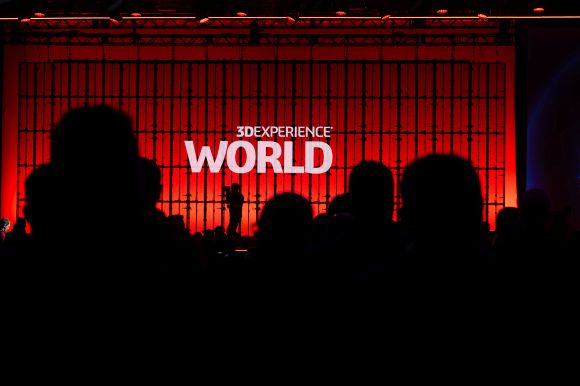
In the waning hours of 3DEXPERIENCE World 2026, Suchit Jain called the third and final general session his favorite. It’s not hard to see why.
“This is my favorite session because we get to do one thing: We celebrate you, our community,” said Jain, the VP of Strategy and Business Development for SOLIDWORKS. “Today, I want to talk about our innovation footprint, where innovation lives, who carries it forward and how we grow it together.”
Jain told the still substantial crowd of SOLIDWORKS and 3DEXPERIENCE platform users gathered in Houston that they’d see the SOLIDWORKS innovation footprint through four lenses:
- Innovation hubs reshaping regions
- Students and competitions building the workforce of the future
- User advocacy community keeping everyone connected
- Programs and tools SOLIDWORKS is putting in the hands of the next generation
Over the first half of the session, Jain and guests shared stories and examples of how SOLIDWORKS – and its communities – are solving real-world problems. For the second half, keynote speaker Jay “Engineezy” Vogler delivered a TED-style talk with a powerful message: “Just finish it.”
Let’s dive in.
Celebrating SOLIDWORKS’ innovation footprint
First up were three leaders from local innovation hubs in Connecticut and Brazil, who discussed their programs and how SOLIDWORKS contributes to their successes by providing access to technology, mentorship and more.
- CCAT, the Connecticut Center for Advanced Technology, helps small and medium-sized manufacturers adopt advanced technologies, providing training, technical services and grants to help businesses compete.
- CITAP, an innovation hub in Pompeia, Sao Paolo, Brazil, develops people’s potential through education and innovation.
- SENAI CIMATEC, in Bahia, Brazil, is a technical school, university and R&D center all in one that supports industry by providing skilled workers and new solutions.
“This is what we mean by innovation footprint,” said Jain. “Innovation lives in places like CITAP, CCTAP and SENAI CIMATEC, where public support, private industry and education agree to invest together in people, tools and purpose. Our role at SOLIDWORKS and Dassault Systèmes is to be a connector in the background and make sure our platform supports this kind of work.”
Next up was Matas Čiuželis, a Lithuanian student who had been part of the Lituanica X robotics team supported by SOLIDWORKS in the FIRST Global Challenge.
Since first meeting Jain in 2023, Čiuželis, who is studying at university now, said the team has grown from just a handful of students to more than 400 members. All of their robots were developed using SOLIDWORKS, and the teams learned the best skills and workflows straight from the experts.
“Don’t be afraid to follow your dreams,” Čiuželis told students in the crowd. “Because if you do what you truly love, you can be the best at it.”
Closing out the student and competition portion was the announcement of the winner of the 2025 AAKRUTI Innovation Competition.
AAKRUTI is a global design contest for students that began in India and has grown into a bona fide movement with more than 12,000 students from more than 500 colleges solving real-world problems with design. This year’s competition included 254 all-girl teams.
The top 12 pitched their projects to a panel earlier in the day in a “Shark Tank” style session that included presentations and Q-and-A before the winning team was announced in the general session.
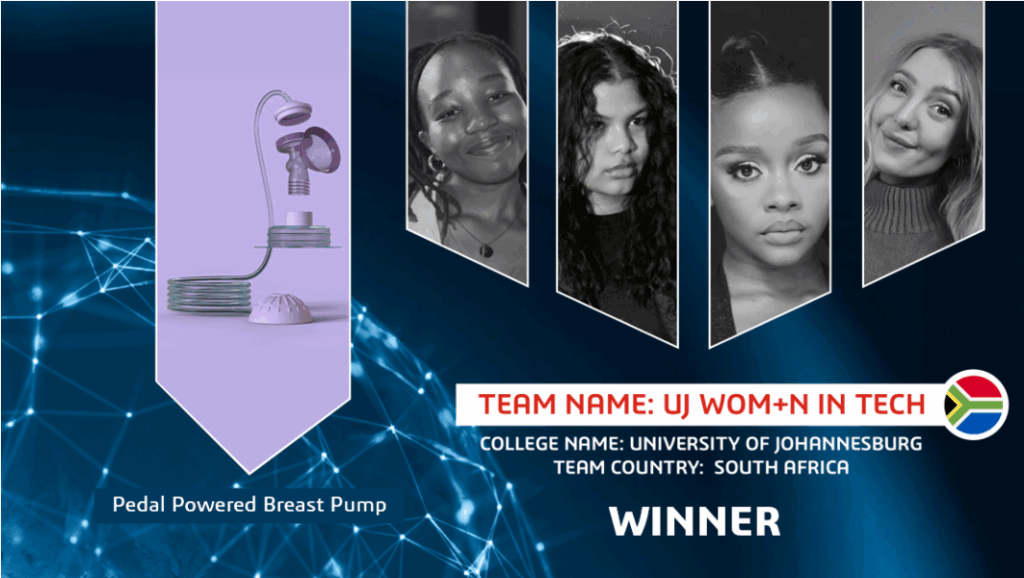
The winning team/project? Latch, a pedal-powered breast pump conceived and designed by team UJ WOM+N in TECH, an all-female team from the University of Johannesburg in South Africa.
The AARKUTI winner was followed up by awards for SOLIDWORKS Champions and the SOLIDWORKS User Group Networks (SWUG) members. These groups connect passionate users who teach and learn and help each other. The awards are well-deserved recognition for instrumental members of a second-to-none user community.
Learn more about the awards over on the SOLIDWORKS blog.
What empowers the journey?
When it comes to putting programs and tools in the hands of the next generation, Jain shared exciting updates and expansions on products to support students.
First, he announced that the SOLIDWORKS certification program, a strong signal for employers seeking qualified candidates, has reached 1 million certified users worldwide.
Next was the SKILLFORCE program. Launched just last year, the program provides students with commercial access and support. It has already impacted more than 350 internships and projects in dozens of countries, helping them turn their studies into real-world experience.
He then introduced the FutureForce program that will be available May 1 of this year. FutureForce will allow customers to nominate educational institutions to get a package that includes free SOLIDWORKS access for students, certification opportunities and training programs. “This ecosystem will continue to grow on every side,” Jain said.
Finally, Jain announced a free student edition of SOLIDWORKS will be available starting July 1 to “give students a simple way of learning SOLIDWORKS to explore, practice and build their first projects.”
“This is how we expand access, build skills and grow the innovation footprint together,” Jain said.
‘Just finish it’
For the closing keynote, Vogler, a mechanical engineer-turned-creator known to fans as Engineezy, spoke about the importance of completing projects.
When he walked away from his job and started making kinetic sculptures as personal projects, Vogler quickly had a realization: “Not just completing the project itself, but completing the project cycle matters far more than I expected,” he said.
He talked through the project cycle from starting to encountering problems to the “pit of despair” and out the other side.
“If you innately need to create things, what a time to be alive,” Vogler said. “The barrier to making things has never been easier. But that’s the irony. When making things has never been easier, finishing things becomes harder.”
There are distractions, like the couch. And that shiny new project you’ve started thinking about. So, when you’re in the pit of despair, you engineer small wins. You build momentum. And you eventually reach flow state. This is where the work is still hard, and you might run into problems, but the end is in sight and time starts to melt away.
But, he said, if flow state feels so good, why finish at all? Because the emptiness at the end of the project means the finished product was never the purpose. The value was in learning along the way and only in finishing does experience become learning.
“Finishing is what closes the loop. It’s what lets you put the project down,” Vogler said, adding that each finished project compacts your learning and builds confidence. “You stop seeing yourself as someone who has ideas and start seeing yourself as someone who brings ideas to life.”
And that’s a wrap on 3DEXPERIENCE World 2026. See you next year in Nashville.
READ MORE
 Patrick Ball
Patrick is a Senior Communications Manager on the Corporate Publishing team here at Dassault Systèmes. An experienced journalist, marketer, speechwriter and storyteller, Patrick's words have appeared on pages and stages around the world.