A new simulation method earns credibility in the aerospace and defense industry the hard way: by being tested publicly against experimental data, in front of the community’s most demanding critics, on the problems that are critical challenges for the industry.
The AIAA High-Lift Prediction Workshop
Of all the benchmark challenges in aerospace CFD, high-lift aerodynamics is among the most difficult. When an aircraft deploys its flaps and slats for takeoff and landing, the wing’s geometry becomes highly complex — multiple overlapping surfaces separated by narrow gaps, each generating its own turbulent wakes that interact with the others. The flow is massively separated, highly unsteady, and acutely sensitive to geometry details. Traditional RANS-based solvers have long struggled in these conditions, producing flow structures and maximum-lift predictions that typically match wind tunnel results poorly.
The AIAA High-Lift Prediction Workshop (HLPW) series was established precisely to expose these shortcomings and drive improvements across the CFD community. Workshops test solvers against high-quality experimental data for standard publicly available high-lift configurations — such as the Common Research Model in landing configuration — at angles of attack up to and beyond stall that define aircraft certification margins.
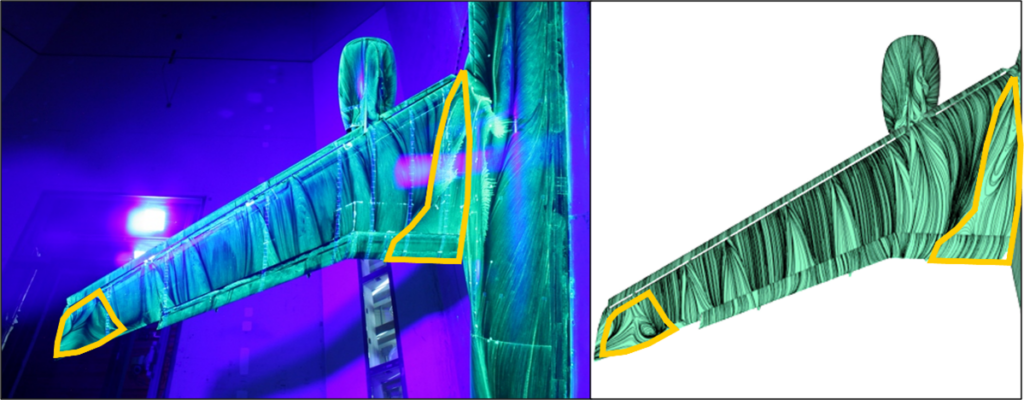
PowerFLOW has participated in the HLPW series from the very beginning in 2010, and has consistently demonstrated an advantage over RANS approaches in exactly the conditions the workshop was designed to stress, producing accurate lift, drag, and surface pressure predictions through the full angle-of-attack range. Critically, the method handled the intricate gap flows between slat, main element, and flap with high fidelity, capturing the separation onset and progression that determines maximum lift. And most importantly, a careful comparison of flow structures on the wing surface showed an amazing agreement, proving that PowerFLOW did not just predict the drag and lift value correctly, but that it got those integral values by predicting the true physics of the airflow [1],[2].
In parallel with the High-Lift Prediction workshops, Exa participated in other workshop series: the AIAA Drag Prediction Workshop (DPW) series, with PowerFLOW showing accurate prediction of transonic cruise drag and — more impressively — capturing transonic buffet onset, the unsteady shock-induced separation that defines the upper boundary of the usable flight envelope and that RANS tools routinely mispredict [3]. In addition, the AIAA Propulsion Aerodynamics Workshop series was exploring CFD capabilities for military jet propulsion inlets, typically S-ducts with complex flow separations, and again PowerFLOW unsteady simulations proved superior to the dominant RANS-based schemes.
Fifteen Years of NASA Airframe Noise Collaboration
Another critical element of Exa’s (and later SIMULIA’s) strategy to validate the LBM technology is an ongoing 15-year collaboration with NASA on airframe noise [4],[5]. From simplified landing gears and scale models of Gulfstream business jets to simulations of a full-scale large commercial aircraft, PowerFLOW was systematically validated and compared to detailed wind tunnel and flight test measurements by NASA for all aspects of airframe noise. This addresses a critical problem in both civilian and military aviation – certification for community noise levels. As aircraft engines have grown quieter through decades of turbofan advancement, the noise generated by airframe components — landing gear, wing flaps, and slats during approach — has become the dominant source of community noise for modern aircraft. Meeting the noise targets embedded in future regulations requires understanding and reducing it at the component level, a challenge for which PowerFLOW proved to be uniquely suited.
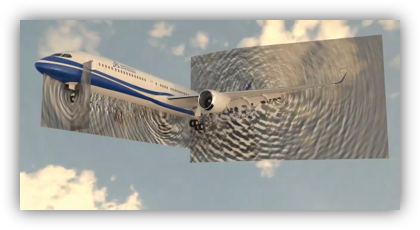
The partnership with NASA has continued to develop and expand, with ongoing work using simulation to support a paradigm shift toward physics-based virtual certification as a complement to flight test campaigns.
Following the acquisition of Exa Corporation by Dassault Systèmes in 2017, PowerFLOW was integrated into the SIMULIA brand on the 3DEXPERIENCE platform — creating a multiphysics suite built on the same kinetic-theory foundation and positioned directly at the aerospace and defense market’s most demanding simulation challenges.
To learn how these advances are being applied in practice, join Swen Noelting’s live webinar, “Optimizing Performance, Stability & Robustness in Defense Aviation with Advanced CFD Simulation,” on June 2, 2026. The session will explore how Lattice-Boltzmann-based CFD supports high-speed, unsteady flow and vibration analysis across defense aircraft, drones, missiles and launch vehicles. Register here: https://events.3ds.com/advanced-cfd-defense-aviation-optimization
[1] Koenig, B., Fares, E. & Noelting, S. Fully-resolved lattice-Boltzmann simulation of a NASA trap wing model. AIAA Paper 2013-3176.
[2] Benedikt Koenig, B., Fares, E., Murayama, M. and Ito, Y. PowerFLOW Simulations for the Third AIAA High-Lift Prediction Workshop, AIAA Paper 2018-1255
[3] Fares, E. et al. (2018). Transonic buffet simulation using the lattice-Boltzmann method. AIAA Paper 2018-1420.
[4] Khorrami, M.R. & Mineck, R.E. (2015). Towards full-aircraft airframe noise prediction: lattice-Boltzmann simulations. AIAA Paper 2015-2993.
[5] Czech, M, Brusniak, L., Khorrami, M., Fares, E., Koenig, B. Comparison of Boeing 777 Airframe Noise FlightTest Data with Numerical Simulations, AIAA Paper 2021-2162.

Interested in the latest in simulation? Looking for advice and best practices? Want to discuss simulation with fellow users and Dassault Systèmes experts? The SIMULIA Community is the place to find the latest resources for SIMULIA software and to collaborate with other users. The key that unlocks the door of innovative thinking and knowledge building, the SIMULIA Community provides you with the tools you need to expand your knowledge, whenever and wherever.

Swen Noelting is a SIMULIA Aerospace & Defense Industry Process Director. He has a M.Sc. Mechanical & Aerospace Engineering from the University of Arizona and a Ph.D. Aerospace Engineering from Universität Stuttgart, Germany. From 1998 – 2017 he was the VP Aerospace for Exa Corporation. 2017 – present: Aerospace&Defense Industry Process Director, Dassault Systèmes